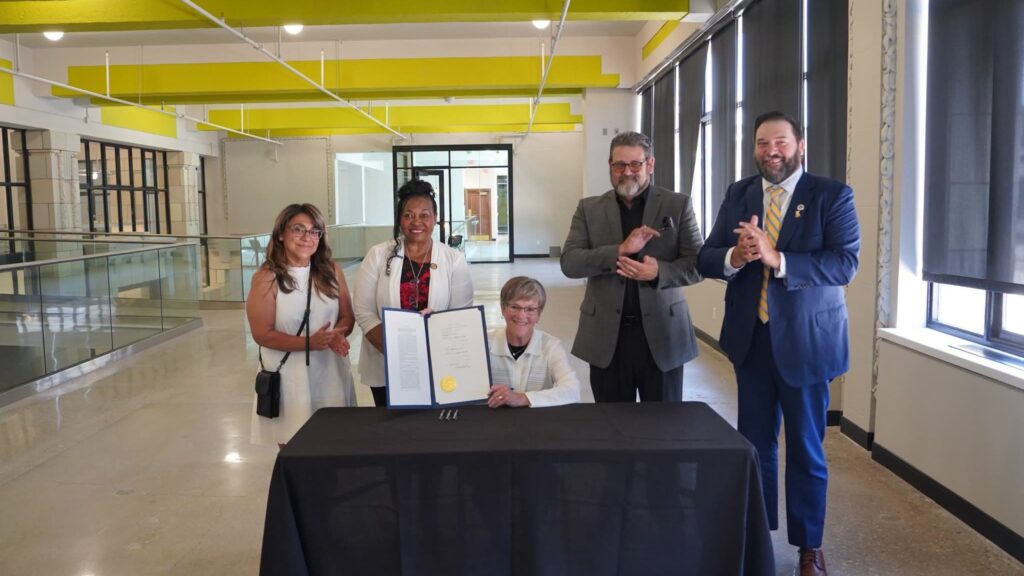
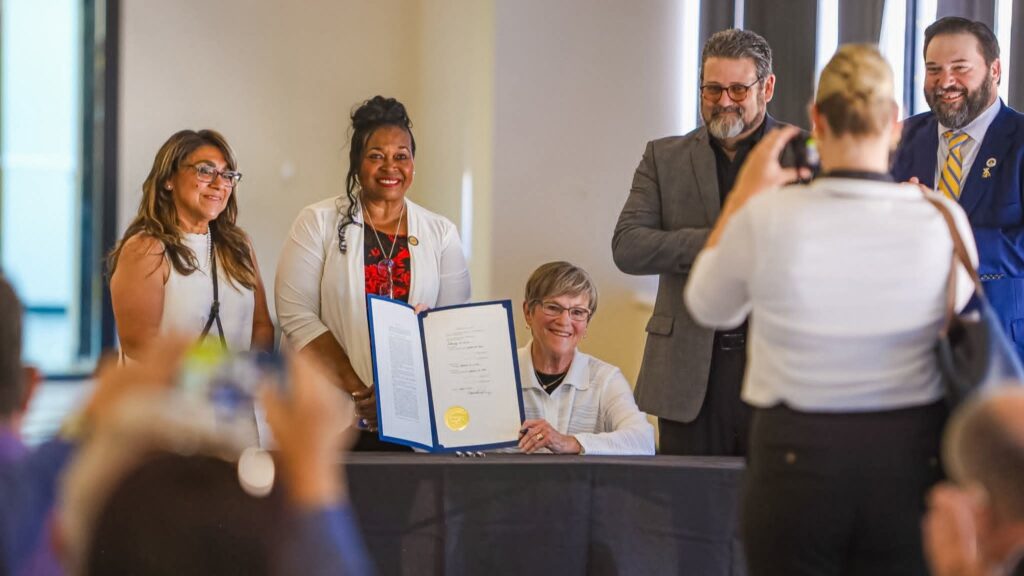
Kansas railroaders have something to celebrate after Governor Laura Kelly signed Senate Bill 353 into law, which officially created the Kansas Railroad Hall of Fame at the Great Plains Transportation Museum in Wichita. But for SMART-TD members, the legislation accomplishes something even more significant: it permanently guarantees a voice for organized railroad labor in preserving the history of railroading in the Sunflower State.

“The Kansas Railroad Hall of Fame is about more than honoring our past; it’s about ensuring the men and women who built, operated, and protected our railroads have a permanent voice in preserving that history. I’m deeply honored by Governor Kelly’s appointment, and SMART looks forward to helping tell the story of the hardworking railroaders whose dedication has kept Kansas and our nation moving for generations. This is a legacy that will educate, inspire, and honor railroad families for years to come.” — Ty Dragoo, Kansas State Safety & Legislative Director, SMART-TD  

From left to right: Kansas State Representative Angela Martinez, Kansas State Senator Oletha Faust-Goudeau, Governor Laura Kelly, Kansas State Historical Society Director Patrick Zellner, and SMART-TD Kansas Safety & Legislative Director Ty Dragoo

A Permanent Seat at the Table for Railroad Labor

The new law establishes the Kansas Railroad Hall of Fame Selection Committee, and SMART-TD members will have a major presence on the newly created board.

Three of the committee’s appointments have direct SMART-TD ties: 

  • Ty Dragoo, Kansas State Safety & Legislative Director, was personally appointed by Governor Laura Kelly.  
  • Chad Henton, Assistant Kansas State Safety & Legislative Director and Local 506 Legislative Representative, serves as SMART-TD’s official appointment.  
  • Vince Wetta, a retired SMART member, was appointed by the President of the Kansas Senate.  

Governor Kelly’s decision to use her personal appointment to select Dragoo speaks volumes about the trust and credibility SMART-TD has built in Topeka. It is a powerful recognition of the work Dragoo and the Kansas legislative team have done advocating for railroaders and rail safety across the state.

Beyond creating a Hall of Fame, the legislation ensures that the stories of Kansas railroading will always include the men and women who have operated the trains, protected the public, and kept freight and passengers moving. Thanks to this law, working railroaders will have a permanent seat at the table as those stories are preserved for future generations.

SMART-TD also recognizes Senators Ethan Corson and Oletha Faust-Goudeau, whose leadership helped move the legislation across the finish line.

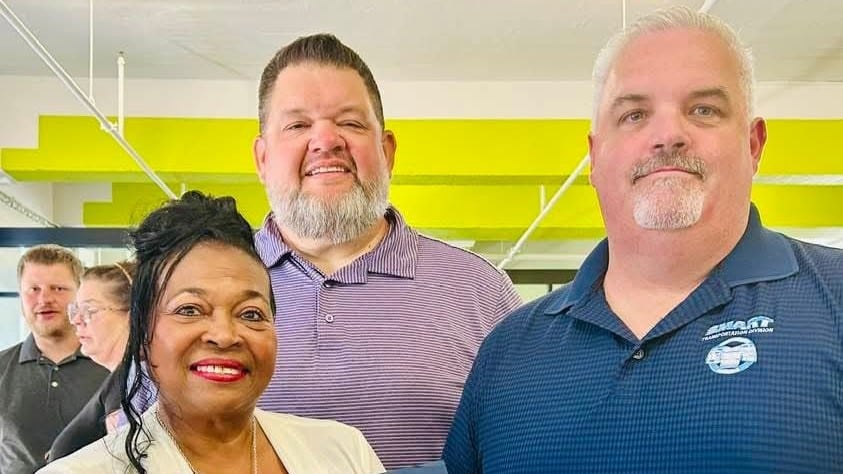
From left to right: Kansas State Senator Oletha Faust-Goudeau, SMART-TD Legislative Representative Drew Couch, and SMART-TD Local Chairman Isreal Cline

Generational Project Starts Off Right

Following the bill signing ceremony, Governor Kelly presented SMART-TD with one of the ceremonial signing pens. In a memorable moment, Dragoo asked that the governor instead present it to Karie Henton, daughter of Assistant Kansas State Director Chad Henton. Governor Kelly happily obliged, creating a special memory that reflected the strong relationship between Kansas leaders and the state’s railroad families.

SMART-TD was proudly represented at the signing ceremony by Local 1227 Local Chairperson Chad Henton, Israel Cline, and Local 1227 Legislative Representative Drew Couch.

This legislation is more than the creation of a Hall of Fame. It is a lasting acknowledgment that the history of Kansas railroading cannot be told without the working men and women of SMART-TD. Thanks to this new law, their voices will help write that history for generations to come. 

There’s less than one week left to finalize your registration for the upcoming Baltimore Regional Training Seminar (RTS).

Registration closes this Monday (August 17, 2026), and there will be no onsite registration available. Late registration is subject to an additional $50 late fee.

Register for the Baltimore RTS ►

Space in some of the training tracks is limited and will be filled on a first-come first-served basis. Online registration is required!

What You Need to Know Before You Go

The Baltimore Regional Training Seminar (RTS) begins with your arrival on Monday, August 31, 2026, with an evening Welcome Reception at 6:00 pm in the B&O Railroad Museum. The training will cover topics such as local governance, the roles and responsibilities of local presidents, secretaries, treasurers, legislative representatives, and local chairpersons in member advocacy, an overview of the SMART Constitution, and other key subjects.    

  • Location: Hilton Baltimore Inner Harbor    
  • Dates: August 31-September 3, 2026 (S&T: August 31-September 4) 
  • Registration Fee: $75 

Don’t forget: the Baltimore RTS will also feature an Assault Prevention Training that’s primarily geared towards SMART-TD’s bus and passenger rail members. Led by leadership from SMART-TD’s Bus & Transit Assault Prevention & Safety (BTAPS) Committee, attendees will discuss what constitutes unruly behavior, building rapport with passengers early on, and what to do if a violent incident occurs, including how to document it and report it to the BTAPS Committee.

Finalize Your Registration Today!

Register for the Baltimore RTS ►

For a detailed meeting agenda, please visit the Meetings page via the SMART Union mobile app. You can also use the app to register for the RTS by selecting “Meetings” from the drop-down menu.

Please contact Nick Torres in the SMART-TD office at 216-227-5269 or by email at ntorres@smart-union.org if you have any registration questions.

Don’t miss out on this opportunity to attend our last RTS of 2026! 

Over the past year, SMART-TD Local 1422 (Los Angeles, Calif.) has experienced tremendous loss.

In December of 2025, Brother Steven “Baby Crowe” Crowe II, who was proud to follow in the railroading footsteps of his father, was killed on the job.

Six months earlier, Brother Jesus Mesina was left in a coma after a car accident. Over a year later, he is still out of work as he continues his recovery.

One month before Brother Mesina’s accident, another car accident claimed the lives of Brother Mike Garcia’s three children, leaving him and his wife forced to confront a devastating future without their beloved family.

In all three situations, SMART-TD members both locally and across the country stepped up to show their support for these brothers and their families, just like our union always does when one of our own is in need. It’s an unspoken rule: if a member needs help, we step up.

Now, Local 1422 is facing yet another tragedy.

An Uncertain Financial Future Becomes Worse

On July 29, 2026, Brother Keith Martineau passed away after an extended illness, leaving behind his wife, Annie, daughters Samantha and Madison, stepdaughter Amie, and a grandchild.

A conductor off of Union Pacific’s Los Angeles Service Unit, Brother Martineau was a SMART-TD member for over 20 years.

At the time of his passing, Keith wasn’t working due to the progression of his illness, meaning that his family was already in a very difficult spot financially due to lost income.

Now, his wife and their children face an even more daunting future.

Local 1422 has set up a fundraiser to assist with the family’s upcoming needs and has a goal of collecting $1,000 for every year that Brother Martineau worked as a railroader.

Please consider contributing if you can ►

While the family has immediate financial needs that are important, this fundraiser is specifically designed for their upcoming needs, which are expected to be far greater.

Because of that, organizers want to keep this fundraiser for at least a month (or even longer) to help support them as much as possible.

Questions about the fundraiser may be directed to Brother Jason Garcia at (714) 931-5181.

Brother Martineau was a proud member of a SMART-TD local union that’s already seen so much loss and tragedy in one year. Let’s show his family that we’ve got their backs as they mourn the loss of their beloved husband, father, and union brother.

Help the Martineau Family rebuild the financial future ►

SMART-TD scored a major arbitration victory this week, successfully defending voluntary rest provisions for BNSF operating crews and stopping a carrier challenge with potential implications for railroaders across the U.S.

At issue in the arbitration was BNSF’s attempt to eliminate voluntary rest options negotiated through collective bargaining. On its face, the dispute involved specific rest provisions. The precedent behind it, however, was potentially much larger.

A decision allowing BNSF to unilaterally eliminate negotiated rest provisions could have provided carriers with a roadmap for attacking other agreements governing railroaders’ ability to take time away from work. This includes negotiated off days, compensated personal days, and, potentially, other collectively bargained time-off provisions or even our vacation time. 

Railroaders understand exactly what that means

Members already know the frustration of attempting to use a personal or vacation day only to hear that “manpower” prevents them from doing so. SMART-TD was not willing to allow the carriers to gain another avenue for eroding what little control railroaders have over our schedules and lives away from work.

“General Committee 001 is always willing to participate in good faith negotiations, but we will not tolerate unilateral attempts to strip our members of rights we have already gained through good faith bargaining,” General Chairperson Brent Lind said. “We appreciate the International’s hard work being prepared to progress this case through the courts and arbitration, and their dedication in defending our members’ rights.”

The stakes for our brothers and sisters on GCA-001 were high. They have a negotiated right to choose between 12, 24, or 36 hours of rest when they mark off at their home terminal. This is a fantastic feature to their on-property agreement, but it wasn’t given to them. It was negotiated for and won a generation ago, and it came at a cost. Lind, and GCA 001 Associate Chairperson Pete Trotta were not going to just roll over and give away what our union fought for no matter how long ago it was agreed on. Local Chairpersons Dan Corbin (Local 406, Missoula, Mont.) and Kole Olsen (Local 003, Laurel, Mont.) work-share crew rooms and locomotive cabs with the brothers and sisters who were having this control over their home time taken away from them. They knew exactly what that was about to do to the quality of life for their locals, and they weren’t looking to let it go without a fight. They both played a critical role working with Brothers Trotta and Lind to put together the best arguments possible from the ballast level.

BNSF understood the importance of the case as well. It is obvious they were willing to go all in on this arbitration, because the Berkshire Hathaway-owned railroad brought in outside counsel from Jones Day, one of the world’s largest and most prominent law firms.

SMART-TD countered a little bit differently.

General Counsel Erika Diehl-Gibbons and Jason Wright from SMART-TD’s Legal Department worked alongside TD Vice President Brent Leonard, GCO-001 General Chairperson Lind and Associate General Chairperson Trotta to build the union’s case.

Their greatest advantage wasn’t the size of the legal team or how much we spent on putting it together.

It was knowing our agreements, knowing our history and knowing where to find the people who made that history.

When History Became Evidence 

Railroad arbitration often turns on more than the words printed on a page. Bargaining history, past practice and the intent of the parties when agreements were negotiated often become critical.

That meant that institutional memory and wisdom from our labor movement was our best weapon. Luckily, SMART-TD is never short of Old Head railroaders willing to step up when they are called on. In that spirit, two of our former UTU Presidents became uniquely valuable witnesses in defense of our present-day fight.

Former UTU Presidents Mike Futhey (2008-2013) and Byron Boyd (2001-2004) helped lead this union during the era when agreements central to the dispute were negotiated. They didn’t have to speculate about what union negotiators intended decades ago.

They were there.

SMART-TD called both men out of retirement to testify.

“When somebody tries to twist an agreement we helped write into something it was never intended to be, don’t expect us to sit quietly in retirement and watch it happen,” said former President Boyd. “I still love this union and the men and women it represents. If they need me back in the fight to defend what we built, I’m coming.”

Former President Futhey agreed.

“We knew what these agreements were intended to accomplish because we were there negotiating them. You don’t get to rewrite that history decades later because it benefits the railroad today,” he said. This union and these members still mean the world to me. When they called, there wasn’t any question that I’d help.”

But memories alone weren’t enough. SMART-TD went looking for the receipts.

Wright worked with SMART-TD Archives Director Mike Vega, spending hours digging through boxes, historical files and union records to locate documents that could substantiate the bargaining history described by Presidents Futhey and Boyd.

Piece by piece, they produced exhibits backing up the former presidents’ testimony with the union’s own historical record.

Even though our union was the clear underdog in this fight against Jones Day and Warren Buffett, this is what SMART-TD brought to the table.

We had a powerful combination of current officers who understood what the disputed provisions mean to today’s railroaders; attorneys prepared to defend those rights; former presidents who could testify firsthand about how and why the agreements were negotiated; and an archive capable of producing the documents to prove it.

The arbitrator ultimately sided with SMART-TD, preserving the voluntary rest options BNSF sought to eliminate.

The immediate victory belongs to the BNSF members whose rest provisions were protected before the railroad ever got a chance to implement the scheme they announced in their bulletin from June.

But this victory belongs to every SMART-TD member.

Agreements won at the bargaining table don’t defend themselves. They survive because generations of union officers and members preserve their history, enforce their language and refuse to allow rights gained through collective bargaining to be taken away unilaterally.

Sometimes winning today’s fights even means opening boxes from 30 years ago and calling in the people who packed them.

This time, SMART-TD did both and showed BNSF and every railroad that was watching what we are capable of as a union family. 

For years, SMART-TD’s bus and transit members have delivered a simple message to lawmakers and regulators: no one should have to risk being assaulted simply for showing up to work.

This week, that message was heard loud and clear in the U.S. Senate.

On Wednesday, August 5, Senators Jack Reed (D-R.I.) and Josh Hawley (R-Mo.) introduced the bipartisan Bus Operator Safety and Security Act, legislation requiring newly purchased, federally funded fixed-route buses 30 feet or longer to include barriers fully enclosing the operator’s workstation.

For SMART-TD, its introduction represents more than another bill in Washington. It is evidence that years of work by our Bus Department, National Legislative Department and Bus and Transit Assault Prevention and Safety (BTAPS) Committee are breaking through.

We took our members’ stories to Capitol Hill. We brought their experiences to the Federal Transit Administration. Across the country, we have pushed lawmakers, regulators and transit agencies to recognize that assaults are not simply “part of the job.”

Now, lawmakers from both parties are stepping forward to champion the solution.

Hawley Again Stands with Transportation Workers

SMART-TD sincerely thanks both senators for putting in the work to protect our bus operators.

We are particularly pleased ( though not surprised) to once again find Senator Josh Hawley standing with transportation workers.

For SMART-TD members, Hawley’s support has become a pattern. He voted to provide railroad workers seven paid sick days, co-sponsored the Railway Safety Act and backed the Railroad Employee Equity and Fairness (REEF) Act to protect railroad unemployment and sickness benefits.

He has also stood with our Bus Department, supporting public transit safety and pushing back against the replacement of skilled transportation professionals with autonomous vehicles.

Supporting SMART-TD members is on brand for Senator Hawley.

Our members have come to anticipate that when transportation workers need someone willing to listen and fight, Missouri’s senior senator will be in the conversation.

But we never take that support for granted.

Senator Hawley has quickly established himself as one of our union’s and all transportation workers’ most reliable champions. Every vote, every co-sponsorship, and every time he uses his office to stand with working people is noticed and appreciated.

SMART-TD also thanks Senator Jack Reed for his leadership in bringing this legislation forward and for working across the aisle to address an urgent safety issue. Reed understands an important truth: an attack on someone operating a moving bus threatens not only the operator, but every passenger, driver, and pedestrian around that vehicle.

Protecting the operator protects everyone.

Bipartisan support in both chambers

The Reed-Hawley legislation is the Senate companion to H.R. 6635, the Bus Operator Safety and Security Act, introduced in the House by Rep. Shomari Figures (D-Ala.) and Rep. Jeff Van Drew (R-N.J.).

SMART-TD thanks Figures, Van Drew and the growing bipartisan group for supporting this effort.

Our union has made progress confronting transit violence under both the Biden and Trump administrations, and the cooperation surrounding this issue demonstrates what government can accomplish when working people come before partisan politics.

BTAPS took the fight to Washington

SMART-TD created BTAPS in 2023 to turn the firsthand experience of our members into action, and that is exactly what the committee has done.

Working with our Bus Department and National Legislative Department, BTAPS members have walked the halls of Congress, met with federal regulators and brought the reality of transit violence directly to decision-makers. During SMART-TD’s first Bus/Transit Day on the Hill, our delegation visited 15 members of Congress and the FTA.

The committee has also worked on solutions at the local property level, including helping develop a pilot program with Local 1594 and SEPTA involving glare-resistant, bullet-resistant operator barriers.

BTAPS members haven’t been theorizing about this problem from behind a desk. They have been working on the solution.

The introduction of the Bus Operator Safety and Security Act in both chambers calling for fully enclosed operator workstations is exactly the kind of change BTAPS was intended to produce.

Washington heard us

There is still work ahead. Introduction is not passage, and SMART-TD will keep fighting until meaningful protections become law.

But this week deserves to be celebrated.

SMART-TD thanks Senators Reed and Hawley, Representatives Figures and Van Drew, their bipartisan colleagues, the professionals at the FTA, our allies throughout transportation labor, and everyone who has helped move this issue forward.

Most importantly, we recognize our SMART-TD Bus Department, National Legislative Department and BTAPS Committee for refusing to accept violence against transit workers as part of the job.

You took our members’ message to Capitol Hill.

You took it to the FTA.

You carried it across the country.

Washington heard you.

Maryland General Assembly overrides the governor’s veto to pass commonsense safety legislation  

For 11 years, SMART-TD fought to make Maryland a safer place for railroaders and communities.

On the morning of August 3, 2026, that fight finally ended in a victory.

When the Maryland General Assembly gaveled into its special session, lawmakers wasted little time showing they stand with rail safety over politics.

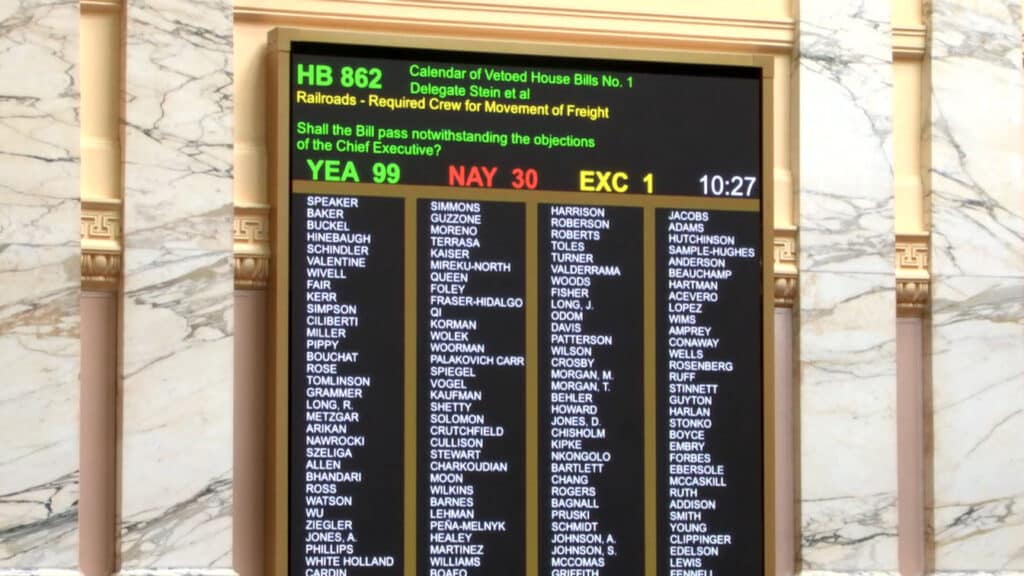
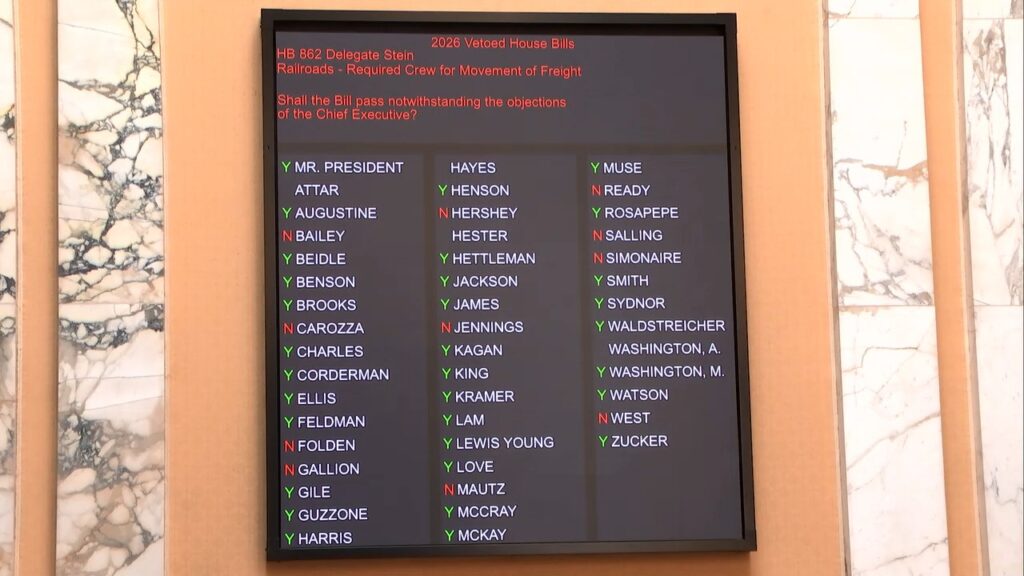
Within the first hour, both the House of Delegates and the Senate voted by more than the required three-fifths majority to override the governor’s veto of HB 862 and made two-person freight crews (2-PC) the law in Maryland.

Final House vote to override governor’s veto of HB 862

Final Senate vote to override governor’s veto of HB 862

Not Just Another Bill 

HB 862 was the culmination of more than a decade of work by generations of SMART-TD leaders, legislative representatives, and members who refused to quit.

“This has been a very long and difficult 11-year battle,” Maryland State Safety and Legislative Director David Pendleton wrote to SMART-TD President Jeremy Ferguson following the vote.

That battle appeared to be over back in April when the legislation cleared both chambers of the General Assembly. Despite multiple assurances that the legislation would be signed into law, the governor vetoed it.

For many organizations, that would have ended the story. The Maryland State Board took a different approach. They jumped right back in the fight, better armed. 

Down But NOT Out 

Rather than accepting defeat, the Maryland State Board and the National Safety and Legislative Department got creative and went back to work.

National Safety and Legislative Director Jared Cassity, Deputy National Safety and Legislative Director Don Roach, and SLD Pendleton developed a campaign strategy that combined member engagement, media outreach, and targeted electoral work.

Maryland’s Legislative Representatives (LRs) carried that plan into their districts, while our members and retirees knocked on doors, volunteered, and helped elect lawmakers who understood the importance of railroad safety.

As Pendleton put it, “Teamwork made the dream work.”

Pendleton specifically recognized President Ferguson for his support, Cassity and Roach for their leadership, and Maryland’s LRs for executing the plan on the ground.

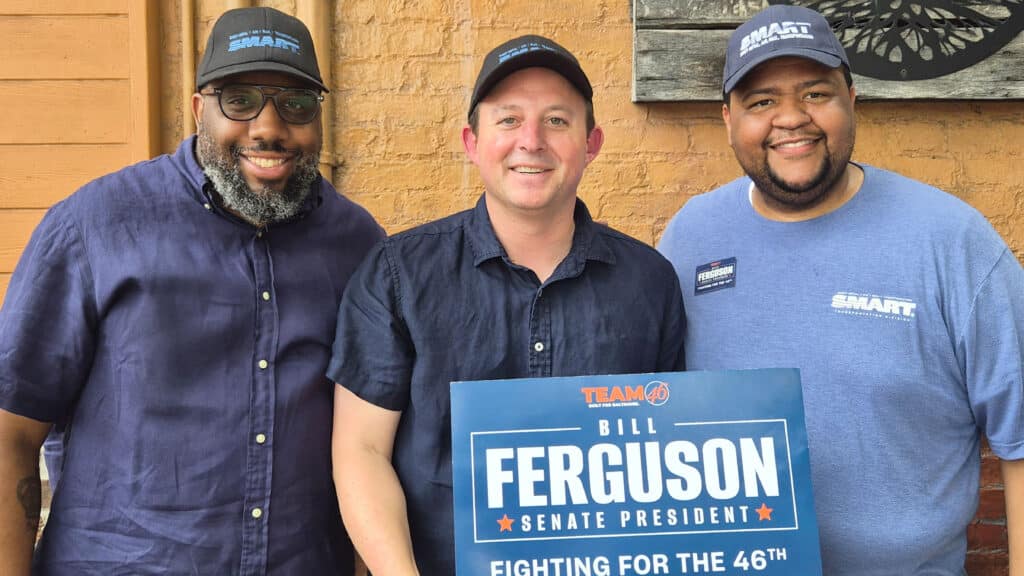
He gave a special thank you to longtime sponsors Delegate Dana Stein and Senator Arthur Ellis, champions who remained undaunted in the quest for the law of 2! He thanked House Speaker Joseline Peña-Melnyk and Senate President Bill Ferguson, leaders who put railroaders and our safety above corporate interests. He thanked Delegate Michele Guyton, Delegate Linda Foley, Senator Dawn Gile, Senator Corey McCray and the many legislators who stood with Maryland’s railroad workers from beginning to end.

Brother Benjamin Perry (left), Senate President Bill Ferguson (center) and Maryland SLD David Pendleton (right)

Most importantly, Pendleton recognized the members who volunteered their own time to help make this victory possible.

Among our Maryland brothers and sisters, Pendleton pointed to some of the members who helped him lead and organize this statewide effort, saying “I would like to thank the LO-023 team of Tom Cahill, Brittany Garris, Randy Martz, Chris Alexander and Jacob Stroman. Our membership picked well when they chose them to represent their Locals. They always answer when called upon, they never complain, and they ALWAYS execute. It is an honor to work with them, and I am truly appreciative. Special thanks to Brothers Benjamin Perry (1470) and Mike Sternfeld (Retired, 1470) for stepping up, knocking on doors, and working alongside our team. Working together to deliver the election victories for our members that laid the foundation for today’s success.”

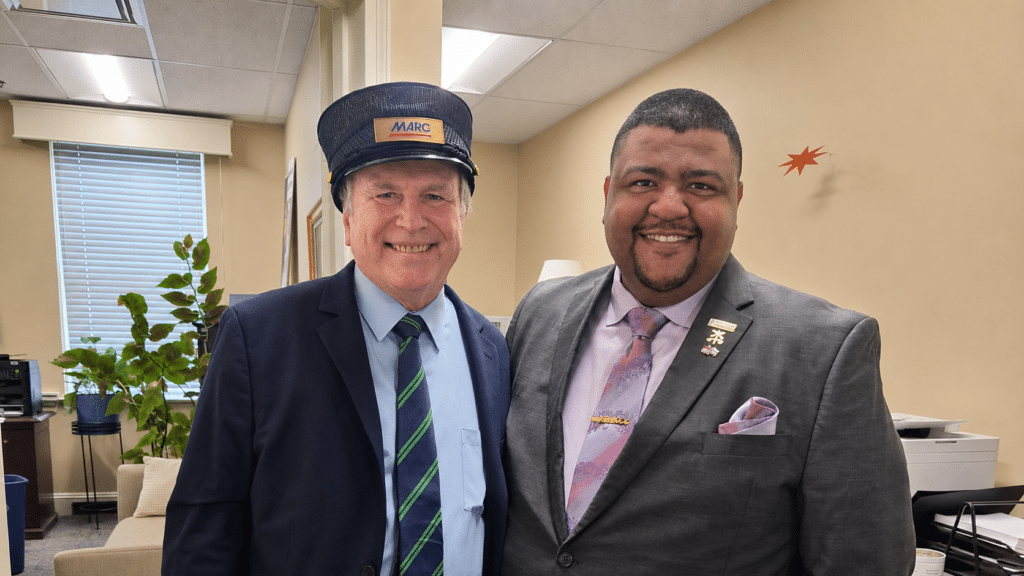
Bill sponsor Delegate Dana Stein (left) and SLD David Pendleton

Not “Politics as Usual”

SMART-TD has long said our political philosophy isn’t about Republicans or Democrats. It’s about who’s With Us and who’s Against Us.

This victory proved it. Our champions in the legislature who helped us secure the three-fifths supermajority needed to overcome the veto are all Democrats, however support in the General Assembly for the override was bipartisan.

In the House, Minority Leader Jason Buckel, along with Republican delegates Jim Hinebaugh, Kevin Hornberger, and Todd Morgan voted YES for the override. In the Senate, Republicans Mike McKay and Paul Cordeman voted YES.

Today the General Assembly reaffirmed that railroad safety is bigger than politics and that keeping qualified railroad professionals on freight trains is simply the right thing to do.

Maryland is safer today because SMART-TD refused to take “no” for an answer.

CLARIFICATION: Following some confusion about how to apply for assistance through SMART-TD’s Disaster Relief Fund, we’d like to offer some guidance and clarification for our members who have been affected by the Washington State wildfires and any future natural disasters.

The bottom line: we are committed to helping our members who have suffered damage to your homes, been displaced by evacuations, had their living situations affected as quickly as possible. 

To apply for Disaster Relief, please follow these steps:

  • E-Mail SMART-TD’s Disaster Relief Fund (TD-DRF@smart-union.org)
    • Please direct all requests, applications, questions, etc. to this address
    • This e-mail inbox is monitored, so you will receive a response in a timely manner
  • Members can also reach out to the SMART-TD headquarters at (216) 227-5327 if additional help is needed navigating the process
  • If you need more information, you can also visit the Disaster Relief section of the SMART-TD website

ORIGINAL ARTICLE PUBLISHED ON AUGUST 4, 2026

For the second time in just over a month, wildfires have ravaged yet another state.

In early July, Colorado faced multiple fast-moving fires that forced evacuations, destroyed homes and properties, and left countless families facing uncertainty.

Some of those impacted included our SMART-TD locals and families, including BNSF members from Local 945 (La Junta, Colo.), Union Pacific members as well as our brothers and sisters from the Colorado & Wyoming Railroad out of Local 204 (Pueblo, Colo.).

Now, some of our members in Washington State are facing a similar disaster in their own backyards.

“Unfortunately, we’ve been through things like this before in Washington,” said Washington State Safety & Legislative Director Steve Mazulo. “As long as everyone stays safe we’ll bounce back.”

As of noon, Pacific Time on August 4, 2026, Local Committee of Adjustment (LCA) 0001 Local Chairperson Mike Galusha said he’s not aware of any SMART-TD members who have lost their homes; most have just been displaced or evacuated. Those impacted include members from Locals 426 and 855 (Spokane, Wash.).

However, that could change once folks have access to their neighborhoods.

“Our community has really reached out, and everybody has come together and opened up their homes and helped each other out,” said Brother Galusha. “The amount of destruction [the fire] has caused is unbelievable. I would just ask that everyone please continue to keep us in their thoughts and prayers.”

Assistance is available through the SMART-TD Disaster Relief Fund

The SMART-TD Disaster Relief Fund exists for moments exactly like this.

If you have suffered damage to your home, have been displaced by evacuations, or your living situation has been affected by the Washington State wildfires, we encourage you to reach out immediately. Our union is committed to helping members and their families through difficult times, and assistance is available for eligible members through the Disaster Relief Fund.

“It’s important, though, that while our brothers and sisters are getting through this moment, they remember our union, and the disaster relief fund is there for them,” explained SLD Mazulo. “This is exactly why we have this fund, to get each other’s backs in moments like this one.”

If you have questions about the Disaster Relief Fund or need help connecting with the appropriate representative, please contact the SMART-TD office at (216) 228-9400.

Help us support our Washington State brothers and sisters

We are asking members to consider making a donation to the SMART-TD Disaster Relief Fund. Every contribution, large or small, helps ensure that we can provide meaningful financial assistance to members and their families as they recover from this disaster.

To help us get assistance directly to members as quickly as possible, please do not designate your donation for the Washington wildfires or any specific disaster. Simply make your contribution payable to the SMART-TD Disaster Relief Fund. Undesignated donations give the union the flexibility to respond immediately, without unnecessary administrative or governmental restrictions that can delay assistance getting to our members. Rest assured that we understand the intent behind these donations and will ensure they are used to help TD members affected by this disaster while preserving our ability to respond quickly whenever and wherever members need us most.

Donations to the SMART-TD Disaster Relief Fund can be mailed to:

SMART-TD Disaster Relief Fund
6060 Rockside Woods Blvd., N, Suite 325
Independence, OH 44131

Please call (216) 227-5237 with any questions regarding the Disaster Relief Fund.

To every member in Washington affected by these fires: your SMART-TD family is thinking of you, standing beside you, and ready to help however we can.

Letter sent on August 3 requests weekly reports on trends, outlook

In April of 2026, our union first sounded the alarm about the emerging situation at Barr Yard in Chicago.

An apparent repeat of a destructive plan pursued by CSX in 2017, the carrier was once again farming out its switching operation to multiple short lines, including the Belt Railway of Chicago (BRC) and Indiana Harbor Belt (IHB).

Nine years ago, CSX promised that this shift would lead to greater efficiency. Instead, the result was congestion, service failures, customer frustration, and federal scrutiny.

Back then, the Surface Transportation Board (STB) eventually stepped in, and the plan ultimately had to be reversed. Still, the railroad spent years recovering from the consequences.

Now it seems that history may be repeating itself.

Concerning Trends Caught the Board’s Attention

On August 3, 2026, the STB sent a letter to the BRC requesting an update and outlook on the short line’s operations. CSX also received a copy of this correspondence.

Citing the agency’s responsibility to monitor the health of the freight railroad network and the critical role of the BRC’s Clearing Yard to the network and the nation’s supply chain, the Board cited several “concerning trends” that it was made aware of, including:

  • Average weekly railcar inventory in Clearing Yard has increased by 57 percent in comparison to the same week last year (Week 30), from 3,212 cars in 2025 to 5,048 cars in 2026.
  • During the same period, average dwell in Clearing Yard increased by 72 percent, rising from about 18 hours to 31 hours.
  • Since the beginning of April 2026, average weekly railcar inventory in Clearing Yard has increased by 26 percent, up from 4,012 cars, with average yard dwell increasing by 63 percent, up from 19 hours. The Board elaborates, further saying this combination could be indicative of growing congestion in the larger Chicago complex and the region.

Weekly Reporting, Action Plan Part of the BRC’s Homework

The STB makes it clear in its letter: the Board wants to see a clear explanation from the BRC as to the reasoning behind these trends, as well as a plan for working with the Class I railroads to stabilize traffic at Clearing Yard and return it to normal levels.

In addition, the BRC must provide weekly reports to the Board that include several critical metrics, including:

  • Average Daily
    • Dwell;
    • Inventory;
    • Cars humped;
    • Cars re-humped;
    • Number of cars received;
    • Number of cars departed;
    • On-time departure percentage.

SMART-TD President Jeremy Ferguson praised the Board’s action, highlighting how it underscores what our union first predicted earlier this year.

“Since April, we have heard from our brothers and sisters at the BRC and our CSX members working at Barr Yard about the serious consequences that the carrier’s actions are having on both Chicago and the nation’s freight rail network,” he said. “We reported the issues that our Yardmasters have witnessed and now the STB sees it, too. Our memories are long, and the original outcome of this half-baked strategy is not easily forgotten. We commend the STB for stepping in and are confident it will stop this problem from progressing even further.”

Read the STB’s full letter to the BRC, which includes CSX and several other Class I carriers, below.


When Friends of Santa Cruz METRO announced that it would not meet the timeline necessary to place its transit funding measure on the November 2026 ballot, the group could have easily accepted defeat and given up.

Instead, they did the exact opposite.

Over the past few months, they dug in, knocked on doors, and attended countless farmers’ markets and community events to reach their goal of getting 10,417 valid signatures by August 7, 2026.

Not only did they reach that number; they surpassed it. 

After official confirmation this week, the group announced that it collected over 14,000 signatures from Santa Cruz County voters, meaning that the citizen-led transit funding measure will appear on the ballot in March of 2028.

Beyond the Ballot: What This Means for SMART-TD Members

This victory is about more than just snagging a spot on the ballot.

If this passes, it will prevent 100 SMART-TD Local 23 (Santa Cruz, Calif.) members from being laid off.

It will ensure that the quality and fast service that the community has come to expect will be maintained.

It will sustain the Youth Cruz Free program, which has led to a 500% jump in student ridership.

It will guarantee a reliable transit system that’s used by working families and community members from all walks of life in Santa Cruz County.

Thank You for Answering the Call!

In May of 2026, we asked SMART-TD members to consider helping the campaign by volunteering at transit centers and community events, encouraging registered Santa Cruz County voters to sign, and helping to ensure that signatures are complete, legible, and valid.

Because of your efforts and the efforts of countless volunteers and transit advocates, Santa Cruz County is one step closer to securing the future of a transit system that’s been working tirelessly to expand and improve its service.

“This victory was possible because of each and every volunteer who gave their valuable time to this campaign,” said SMART-TD Bus Department Vice President James Sandoval. “When SMART-TD members and transit advocates have a goal, nothing stands in their way. I’m so proud of the grit and determination that I’ve seen over the past few months to reach our signature goal. We did it!”

Celebration Set for Monday

Before looking ahead to March of 2028, Friends of Santa Cruz METRO is taking a moment to enjoy their victory!

SMART-TD members, friends, and supporters are invited to Woodstock’s Pizza (710 Front Street) in downtown Santa Cruz this Monday, August 3 at 4:30 p.m. PT to celebrate meeting the signature goal and turn in any lingering petition sheets.

If you still have some, be sure to bring them; it’s your last chance to turn them in!

As the campaign turns toward educating the public about what’s at stake over the next 20 months, SMART News will continue to keep you informed about ways that you can get involved and help secure the future of transit in Santa Cruz.

This is what solidarity looks like: congratulations to Friends of Santa Cruz METRO!

New federal rule would strengthen crew qualifications, improve cross-border safety and ensure engineers demonstrate real operating skills.

FOR IMMEDIATE RELEASE
July 31, 2026
INDEPENDENCE, Ohio

The SMART Transportation Division today welcomed a sweeping Notice of Proposed Rulemaking (NPRM) from the Federal Railroad Administration that incorporates several safety reforms the union has advocated for years.

While public attention will likely focus on new English language proficiency requirements for locomotive engineers and conductors, SMART-TD says the proposal goes much further. The rule would strengthen the way railroaders are trained, tested, and qualified, reinforce meaningful territorial qualification standards, and ensure that engineers demonstrate their own operating skills (not those of automated train-handling systems).

“Railroad certifications should represent proven ability, not simply possession of a certificate,” said SMART-TD National Safety and Legislative Director Jared Cassity. “When lives are on the line, the FRA must know that an engineer can safely operate a train, not just supervise a computer doing it.”

One of the proposal’s most significant provisions would prohibit railroads from using Energy Management Systems (EMS) (technologies that act as autopilot systems do in aviation) during the FRA-Certification skills examination and annual operational monitoring used to evaluate locomotive engineers. SMART-TD has long argued that these fuel-saving systems are valuable tools but should never substitute for demonstrating the manual skills required to operate a train safely. Today’s FRA’s proposal reflects that principle.

The proposed rule also strengthens cross-border safety by requiring English language proficiency for certified engineers and conductors operating in the United States, requiring U.S. training and certification standards for Mexican-based crews, and proposing additional operational safeguards at the southern border, including a 10-mile operational limitation.

In addition, the proposal clarifies that territorial qualification must be earned in the specific direction of travel. Engineers and conductors must demonstrate familiarity with the territory as it is actually encountered in service, recognizing that signals, landmarks and physical characteristics differ depending on the direction of movement.

“Taken together, these reforms reinforce a simple principle,” Cassity said. “A railroad certification should mean that a railroad performs its due diligence to ensure that train crews possess the knowledge, communication skills, and hands-on ability necessary to safely operate a train. Not just one trip and a pat on the back, like is happening today. That’s what our members expect, and that’s what the public deserves.”

SMART-TD thanked the FRA for recognizing these important safety issues and taking meaningful action while emphasizing that the proposal is an important step, but not the final destination. The union will continue to review the NPRM and participate fully in the federal rulemaking process to ensure that the strongest possible safety standards are adopted.

###

For more information or to connect with SMART-TD President Jeremy Ferguson, National Safety and Legislative Director Jared Cassity, or a member of their leadership teams, please contact: 

Dan Banks 
dbanks@smart-union.org 
(216) 227-5283 (Office) 
(330) 322-5949 (Cell) 

Alyssa Hansen 
alyssa.hansen@smart-union.org