Federal Agency Charged Railroad Company Refused to Hire Qualified Machinist Due to Epilepsy
 SEATTLE — The Washington, D.C.-based National Passenger Railroad Corporation, better known as Amtrak, will pay $112,000 and provide other relief to settle a federal disability discrimination lawsuit filed by the U.S. Equal Employment Opportunity Commission (EEOC), the agency announced.
According to EEOC’s suit, Amtrak withdrew its job offer of machinist journeyman at its Seattle yard when it learned Shawn Moe had a history of three epileptic seizures over the course of his life. Amtrak cited safety concerns, despite Moe’s record of safely working a similar job and despite his neurologist verifying to Amtrak that his epilepsy was successfully controlled on medication, that he had been seizure-free for years, and that he was able to safely perform the essential functions of the job without limitation while on medication.
“The fact that I have epilepsy has never prevented me from safely doing my job, not in the years I worked for another locomotive company before I applied to Amtrak, and not at the railroad machinist job I found after Amtrak took back its job offer,” said Moe. “Amtrak’s decision to withdraw its offer hit my family at a particularly vulnerable time because my wife and I just had our first baby. I thought, what if other employers react as Amtrak did and I can no longer practice my trade? How would I support my family?”
The Americans with Disabilities Act (ADA) prohibits an employer from discriminating against an employee because of his disability, and also requires an employer to assess a worker’s actual ability to perform job functions where potential safety concerns are raised. EEOC filed suit in U.S. District Court for the Western District of Washington [Case No. 2:15-cv-01269] after first attempting to reach a pre-litigation settlement through its conciliation process.
The three-year consent decree settling the lawsuit provides $112,000 to Moe in lost wages and compensatory damages. The decree also requires Amtrak to train its staff on hiring obligations and assessing reasonable accommodations under the ADA. Amtrak will also implement and disseminate a modified ADA policy, and will post a notice for employees about the consent decree and employees’ rights under the ADA.
EEOC Senior Trial Attorney May Che said, “Amtrak concluded that Mr. Moe presented a significant safety risk without assessing the actual likelihood of him having a seizure at all. In enacting the ADA, Congress stated that employers must rely on objective, factual evidence — not on subjective perceptions, irrational fears, and patronizing attitudes — about the nature or effect of a particular disability, or of disability generally.”
EEOC Seattle Field Director Nancy Sienko added, “One out of every 26 people will develop epilepsy at some point in their lives. Given that epilepsy reportedly affects 2.2 million Americans and affects each person differently, it is critical that employers do not base job decisions on stereotypes, but instead carefully consider an employee’s abilities.”
According to publicly available information and its website, www.amtrak.com, Amtrak is a publicly funded service, operated and managed as a for-profit corporation with headquartered in Washington, D.C. In fiscal year 2015, Amtrak served over 30.8 million passengers and had $3.2 billion in revenue, while employing more than 20,000 people nationwide.
EEOC enforces federal laws prohibiting employment discrimination. Further information about EEOC is available on its website at www.eeoc.gov.
 We are pleased to announce that SMART TD members on New Jersey Transit have ratified a new collective bargaining agreement.
 The Surface Transportation Board released two decisions related to its oversight of Amtrak’s operations under the Passenger Rail Investment and Improvement Act of 2008 (PRIIA).
 The Columbus Dispatch reported that the issue of crew consist has railroads at odds with federal regulators. This comes after the Federal Railroad Administration announced a proposed rule earlier this year requiring two-person crews on trains.
 It’s been on the news, and you may have heard about it: the Medicare appeals process is taking longer, specifically, at the Administrative Law Judge (ALJ) level. This article explains the five levels of appeals and provides information about the wait times for an ALJ hearing.
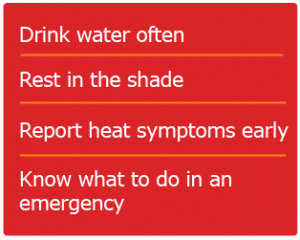
 The body normally cools itself by sweating. During hot weather, especially with high humidity, sweating isn’t enough. Body temperature can rise to dangerous levels if you don’t drink enough water and rest in the shade. You can suffer from heat exhaustion or heat stroke.