A first-of-its-kind rail safety law has officially passed both chambers of the New Jersey Legislature and is now on the Governor’s desk awaiting signature.
A-4460, also known as S3389 in the Senate, establishes firm maximum train length limits, addressing the growing dangers posed by excessively long trains. It also enacts strict two-person crew requirements for freight trains, ensuring that critical safety functions are not placed on the shoulders of a single worker. Together, these provisions reflect real-world operating conditions and directly address risks that rail workers have warned about for years.
The bill also strengthens oversight of railroad infrastructure, requires enhanced safety reporting, mandates the use of modern detection technologies, and expands/solidifies the role of labor organizations in investigations of derailments and other accidents. The bill is one of the most comprehensive and practical rail safety packages passed in the modern era.
Protecting rail workers and communities is not a partisan issue, but a shared responsibility. A-4460 passed with overwhelming bipartisan support.
This landmark legislation represents the culmination of years of dedicated advocacy by the SMART-TD New Jersey State Safety and Legislative Board, led by Director Ron Sabol. Together they carried our lived experiences from yards, terminals, and crew rooms across the state directly to the halls of the State House in Trenton. Their message was simple and consistent: rail safety saves lives, and it must be treated as a top priority.
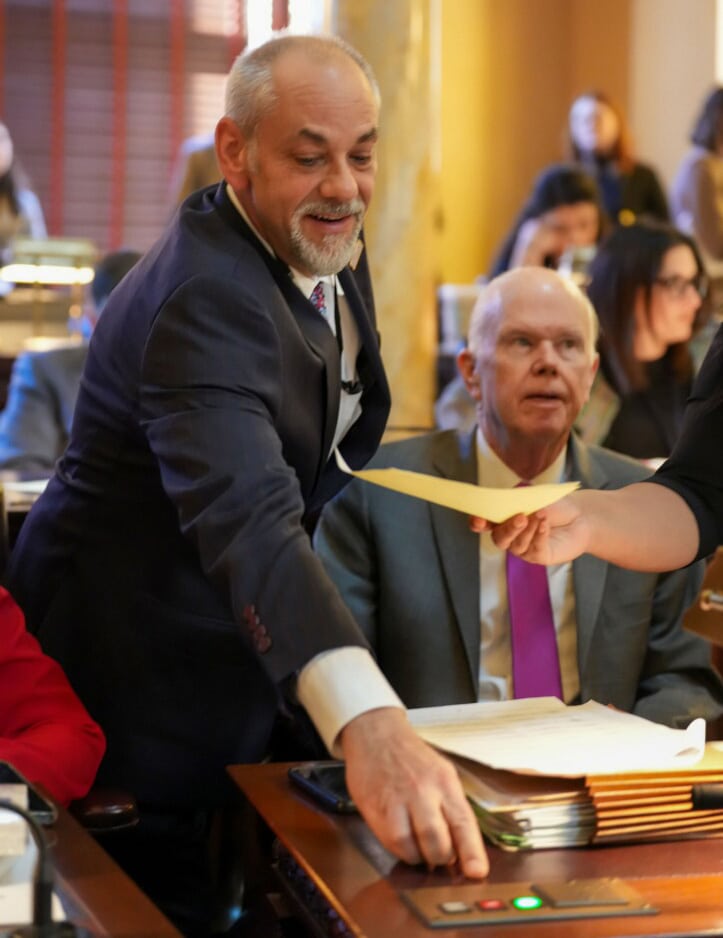
The worker-driven effort behind this legislation was formally recognized when Sabol was given the honor of casting a vote for the bill. This honor was extended by Senator Patrick Diegnan, who represents New Jersey’s 18th Legislative District. This acknowledgement recognizes SMART-TD and Sabol’s leadership and tireless advocacy in helping move this legislation across the finish line.
Our rail safety package now awaits final approval in the form of Governor Phil Murphy’s signature. This worker-led victory proves that when rail workers bring their experiences directly to lawmakers, meaningful change follows!
(Photo: Ron Sabol casting a vote for S3389 on the Senate floor.)
On December 5, 2025, Sister Q.Hamilton (Local 1033, Atlanta), a conductor and yard foreman for CSX, was involved in a life-altering car accident while reporting for an extra board shift at Howell Yard.
A single mom, Hamilton was involved in a head-on collision two minutes from the yard office. She sustained a broken hip, a fractured tailbone, multiple broken ribs, and most devastatingly, her injuries will soon require open-heart surgery. As you might imagine, CSX responded with a Christmas care package that included her Out of Service Medical paperwork and 10 attendance points for a “No Call / No Show.”
If you are able, please consider supporting Sister Hamilton and her daughter. Hamilton did not want to ask for help. True to form as a railroader, she is proud, strong, and independent. Her local officers stepped in and forwarded her information to the International, because sometimes even the strongest among us need the family to step up.
Accident Stresses Why Union Representation Matters
Our sister is now facing a long and painful road to recovery physically, emotionally, and financially. As a single parent, the stakes could not be higher for her and her daughter.
This is why our union exists.
We are not expendable parts. We know what it takes to pass the tests this industry and this lifestyle throw at us. We know the value of each of our brothers and sisters who have passed these tests. We have to stand up for one another because no one else will. Solidarity isn’t a word: it’s the act of showing up for each other.
In that spirit and especially in this holiday season, SMART-TD is turning inward once again and asking our union family to rally around one of our own. Your help, whether large or small, will make a real difference as they navigate this impossible moment, weather the storm ahead, and work toward getting back on their feet.
SMART Transportation Division is heartbroken to report the tragic on-duty death of Brother Charles Harrison, a member of Local 847 in Birmingham, Alabama, on December 13, 2025. Brother Harrison entered the railroad industry with Norfolk Southern and was a member of Local 622 until the end of 2024 when he was hired by CSX, where he continued his service to the railroad and to our union family. He had been a SMART-TD member since 2022.
The National Transportation Safety Board (NTSB) has launched an investigation into the accident that took Brother Harrison from us. SMART-TD’s National Safety Team is on the scene supporting this process. Because this is an active federal investigation, our ability to comment on the circumstances of the accident is severely restricted.
What we can say is that our entire union family is deeply saddened today. Our thoughts and heartfelt condolences go out to the members of Local 847, to Brother Harrison’s family and friends, and to all who knew and worked alongside him. We will share additional information as we are permitted.
SMART-TD Urges Members to Review Requirements
The Federal Railroad Administration has issued Safety Advisory 2025-02, highlighting serious safety concerns involving shoving and pushing movements over highway-rail grade crossings equipped only with flashing lights or passive warning devices. Recent fatal accidents involving point protection failures prompted the FRA to call for renewed focus on job briefings, visibility assessments, and rule compliance. The FRA is also calling for railroads to begin additional operational testing of these scenarios.
Between 2020 and 2025, four rail workers were killed in Illinois, Texas, Ohio, and California while riding the point during shove moves over passively protected crossings. The FRA cites these tragedies as evidence that existing procedures are not always sufficient in real-world conditions and that additional training, rule revisions, and testing may be necessary.
Under 49 CFR 218.99 and 218.93, employees providing point protection must make a visual determination that the track is clear before occupying a crossing. This includes verifying the absence of approaching or stopped roadway traffic and ensuring nothing obstructs the view of the crossing or its approaches.
As railroaders know too well, just because a road is clear of vehicle traffic when we start our shove, that doesn’t mean it will stay that way long enough for us to cover the crossing. When the crossing doesn’t have gates and or bells, this makes it even more dangerous for us.
If weather, lighting, vegetation, roadway layout, or other factors prevent a complete visual assessment, the movement must not enter the crossing until a qualified employee is positioned to provide protection or until alternative procedures (such as stop-and-flag) are in place.
FRA is also reminding railroads that shove moves are less conspicuous than locomotives leading with headlights and horns. Because motorists may not see a shove movement in time, crews must not rely on crossing signals alone when only passive or flashing-light protection is present.
The advisory recommends several actions that will directly affect operating employees:
Enhanced Job Briefings Briefings must clearly identify all passive or flashing-light crossings in the route of the shove movement, the method of communication to be used, visibility challenges, and the requirement that a crossing not be entered unless the track is confirmed clear.
Review and Update of Operating Rules Railroads should ensure their rules thoroughly define “track is clear,” outline proper visual-assessment procedures, and address unique crossing configurations or environmental limitations.
Increased Operational Testing FRA urges railroads to prioritize crossings where visibility is limited and conduct operational testing to evaluate rule compliance. Employees should anticipate increased testing activity in these areas.
Evaluation of Crossings for Feasibility of Riding Protection Railroads must assess whether employees riding the point can realistically determine if the track is clear. Where they cannot, FRA expects railroads to implement additional protection, including stop-and-flag requirements.
SMART-TD encourages all members to review these expectations, report visibility hazards, and never allow a movement to enter a crossing without a complete “track is clear” determination. Your safety is the most important thing in this line of work. This FRA advisory reinforces your authority (and the obligation) to stop a movement whenever conditions prevent a safe assessment.
In a significant departure from years of controversy over executive-only bonuses, Amtrak’s Board of Directors has ended its longstanding practice of reserving year-end incentive payments exclusively for senior leadership. This year, Amtrak has voted to reduce executive bonuses by half and redistribute those funds to the front-line professionals who directly serve passengers every day.
The result: more than 18,000 Amtrak employees (including SMART-TD conductors, assistant conductors, on-board service personnel, and other front-line team members) will receive a $900 holiday bonus this December.
The Federal Railroad Administration (FRA) informed SMART-TD of this decision on December 11. This change marks the first time in recent memory that Amtrak’s bonus structure meaningfully includes unionized front-line workers.
This shift follows years of criticism from SMART-TD and media outlets (most notably the New York Post) over Amtrak’s executive compensation practices. Even when the railroad faced deficits or operational challenges, senior executives collected substantial bonuses while conductors, engineers, and other essential workers who directly deliver passenger service were excluded.
A Record-Setting Year and Recognition for the Workforce That Delivered It
This year’s change comes as Amtrak celebrates its most successful year to date. In 2025, the railroad safely transported the most passengers since its founding in 1971. This milestone was made possible only through the dedication, professionalism, and long hours of front-line employees.
“The acknowledgment of our members’ role in this historic ridership year is meaningful,” SMART-TD President Jeremy Ferguson said. “Our crews answered the bell and delivered record-setting service.”
SMART-TD Welcomes the New Bonus Structure
President Ferguson also praised the decision to prioritize the people who operate America’s passenger rail system:
“SMART-TD appreciates Amtrak’s decision to prioritize the men and women who keep our passenger rail system running every day. Providing frontline employees with a meaningful bonus is an important acknowledgment of their dedication and service, especially during the holiday season. We thank the Trump administration for supporting this effort to recognize the hardworking employees who make Amtrak strong.”
FRA and USDOT: Executive Bonuses Rebalanced, Front-Line Bonuses Added
According to information released by the U.S. Department of Transportation and the FRA, Amtrak executives will forgo 50% of what they would have received under the former incentive structure
U.S. Transportation Secretary Sean P. Duffy stated:
“This administration cares about the hardworking men and women who keep this country moving… We rely on our incredible workforce, including our unionized workers at Amtrak, to make it all possible.”
SMART-TD wants to acknowledge the role the Trump Administration played in pressing for the inclusion of front-line workers in this year’s bonus distribution. Their engagement contributed to the corrective action on an issue that has been of deep concern to our membership for years.
A Turning Point for Amtrak’s Workforce
For SMART-TD members, this year’s $900 bonus represents more than a financial benefit. It reflects long-sought recognition of their essential role in the success, safety, and reliability of the national passenger rail network.
As Amtrak closes out a historic year of ridership and revenue, SMART-TD will continue advocating for fair compensation, improved working conditions, and a bonus structure that places value where it truly belongs: with the men and women who move America.
2025 Layoffs Break Records for Non-union Workers
Brothers and Sisters,
It’s a simple fact: unions provide stability in an economy where predictability is rare.
Non-union workers suffer in many industries, but conditions are especially harsh in the technology sector. Workers are seen as expendable, and with a continuous supply of hungry computer science graduates, burnout (both physical and mental) is a normal operating procedure. We’re no strangers to this kind of grind, but we have something they don’t: Solidarity.
Most white-collar workers have come to expect mergers and mass layoffs, with little thought given by their leaders to the actual humans who make these companies run. They work with an understanding that they could find the door slammed in their face faster than they can pack up their desk.
One of the most well-known mass layoffs in the technology industry (and, in fact, record-breaking at the time) happened in 2002. Hewlett-Packard Co. (HP) announced that it would cut thousands of jobs as part of its acquisition of Compaq Computer Corp, a merger that promised to “boost efficiencies” AKA Precision Scheduled Manufacturing.
In total, more than 17,000 workers lost their livelihoods in an instant.
It was a lose-lose situation: employees, seen as disposable, were put on the chopping block while the merger failed to meet its lofty, promised goals.
Without local representation or the protections provided by a union contract to safeguard their interests, these workers were ultimately lost to the footnotes of history.
More than 20 years later, this kind of move has become a standard procedure for many firms who need to clean up their financial forecasts, whether in finance, advertising or manufacturing, from Meta to Boeing to Verizon and beyond.
The unmentioned but common denominator? These are almost always non-union workers who lack the benefits and job protections that are a well-known hallmark of union membership.
This is an unprecedented guarantee in the history of American railroading that underscores the importance of belonging to a union and why having a voice in the workplace is critical.
When the agreement was announced, we didn’t mince words: the biggest railroad and biggest rail union in America were breaking new ground that protects jobs, families, and the future of the U.S. supply chain.
Or take our brothers and sisters at the Port Terminal Railroad Association.
A disturbing pattern emerged over the past several years indicating ongoing disregard for union agreements, safety obligations, and basic respect for the workforce at that railroad.
We fought for our Yardmasters and PTRA management got our message: this behavior will not be tolerated and will stop now.
What’s been most notable, however, is the solidarity between crafts on the property.
Although represented by several different unions, Yardmasters, engineers, conductors, and maintenance workers have proven that unity and solidarity are the best protections against intimidation.
That’s the union difference at work.
We aren’t disposable: as a member of a union your brothers and sisters are there to protect and fight for one another, to lend a hand when one is needed, and to show our strength when management decides to overlook that we are human beings. We are not line-items in a financial report, and they owe us their respect.
Like all families, unions are far from perfect. No organization is without flaws. But when the going gets tough, we get tougher. This determination is what ensures we don’t become another statistic in an article about the latest 10,000-head layoff.
Instead we have a voice at work, and have legal protections from mistreatment. We’ve got each other’s backs; from the day you receive your union card until it’s time to retire.
That’s the value of being in a union, and why we fight to protect our SMART-TD family.
In solidarity,
Jeremy Ferguson
President, SMART Transportation Division
The amounts of compensation subject to Railroad Retirement Tier I and Tier II payroll taxes will increase in 2026, while the tax rates on employers and employees will remain unchanged. In addition, unemployment insurance contribution rates paid by railroad employers will not include a surcharge, as continued improvement in the rail economy has kept the Railroad Unemployment Insurance Account at a healthy balance, according to the Railroad Retirement Board (RRB).
Tier I and Medicare Tax
The Railroad Retirement Tier I payroll tax rate on covered rail employers and employees for 2026 remains 7.65%, identical to the Social Security tax rate. For withholding and reporting purposes, Tier I is divided into:
6.20% for retirement
1.45% for Medicare hospital insurance
The maximum amount of an employee’s earnings subject to the 6.20% Tier I retirement portion will increase from $176,100 in 2025 to $184,500 in 2026. As in previous years, there is no maximum on earnings subject to the 1.45% Medicare portion.
An additional 0.9% Medicare payroll tax applies to individuals earning more than $200,000, or $250,000 for married couples filing jointly. Employers begin withholding the additional Medicare tax when an employee’s wages exceed $200,000. The final amount owed or refunded is calculated with the individual’s federal income tax return.
Tier II Tax
Railroad Retirement Tier II tax rates will remain unchanged for 2026 at:
4.9% for employees
13.1% for employers
The maximum amount of earnings subject to Tier II taxes will increase from $130,800 in 2025 to $137,100 in 2026.
Tier II tax rates are based on an average account benefits ratio reflecting the balance of the Railroad Retirement system. By law, employee Tier II rates may range from 0% to 4.9%, while employer rates may vary between 8.2% and 22.1%, depending on funding levels.
Unemployment Insurance Contributions
The employers (not employees) pay railroad unemployment insurance contributions, which are experience-rated by the employer. Under the Railroad Unemployment Insurance Act (RUIA), a surcharge is applied when the Railroad Unemployment Insurance Account balance falls to or below certain indexed thresholds.
The account balance was approximately $405.3 million as of June 30, 2025, down from $454.8 million the prior year. Surcharges are triggered when the balance is at or below $100 million, indexed to $173.0 million as of June 30, 2025. Because the account remains well above that threshold, no surcharge will apply in 2026, continuing the surcharge-free years of 2024 and 2025.
Unemployment insurance contribution rates for railroad employers in 2026 will range from:
0.65% (minimum)
12.0% (maximum) applied to monthly compensation up to $2,150, an increase from $2,065 in 2025.
In 2026:
91% of covered employers will pay the minimum 0.65% rate
3% will pay the maximum 12.0% rate
New employers will pay 5.58%, reflecting the average contribution rate paid during 2022–2024.
* Additional Medicare Tax: Employees pay an extra 0.9% Medicare tax on earnings above $200,000 (individual) or $250,000 (joint filers). This additional tax is not reflected in the percentage rates above.
Note: Tier I Medicare and Tier I Railroad Retirement tax rates are equivalent to the 2026 Social Security tax rates. Tier II Railroad Retirement tax rates do not apply to employees covered under Social Security
FOR IMMEDIATE RELEASE
Independence, OH — 11/28/25 — Members of SMART-TD working on Union Pacific (UP) properties have decisively voted to ratify the 2025 Tentative Agreement (TA), with over 80 percent of ballots cast in favor. This is a clear signal of overwhelming support for the contract.
After nearly a year of determined negotiations, SMART-TD and UP reached a TA that mirrors the recently ratified national pattern agreement while securing additional, critical protections tailored for our UP members.
What the Agreement Delivers
Substantial Wage Increases — The contract provides a compounded wage increase of 18.77 percent over the five-year life of the agreement, as detailed in the national SMART-TD agreement ratified on October 30, 2025.
Enhanced Benefits & Quality-of-Life Improvements — Members will see strengthened health benefits (medical, dental, vision), improved vacation accrual, and other quality-of-life enhancements reflected in the national agreement.
Critical Protections for UP Members — Importantly, the TA resolves longstanding issues unique to UP:
It ends the rail carrier’s two-decade-long practice of deducting “outside earnings” from back pay awards in wrongful termination cases. This is a major win for fairness and financial security.
It ensures fully reinstated members are made whole, reimbursing medical premiums and expenses incurred while awaiting arbitration decisions.
It expands meal allowances in recognition of the changing costs rail workers bear on duty.
A Strong Vote of Confidence
The decisive “yes” vote demonstrates members’ trust in SMART-TD’s bargaining team and the value placed on the protections and improvements secured under the TA. The overwhelming results affirm that the membership believes this contract moves the union and its members forward, materially improving wages, benefits, and job security.
“This ratification reflects our members’ unified voice and confidence in what was negotiated,” said SMART-TD President Jeremy Ferguson. “The decisive support underscores a shared commitment to preserving good jobs, strong benefits, and fairness for all members working on Union Pacific. I want to thank all of the General Chairpersons and their General Committees from our Union Pacific properties for their hard work negotiating this agreement. Their leadership in this process will protect our people and their families’ interests over the next five years.”
What Comes Next
With ratification confirmed, the TA becomes binding. UP-employed SMART-TD members will begin receiving the agreed wage increases, benefit enhancements, and the new protections outlined in the agreement. Union leadership encourages all members to review the full text of the agreement. This includes the wage schedule, benefit provisions, and protections. SMART-TD wants to ensure our UP members have a full understanding of what was won.
SMART-TD remains committed to representing the interests of all its members. Though this agreement covers those on UP properties, the union continues its work across all railroads to ensure every member benefits from strong contracts now and into the future.
For more information or to connect with SMART-TD President Jeremy Ferguson or a member of his staff, please contact:
Dan Banks dbanks@smart-union.org (216) 227-5283 (Office) (330) 322-5949 (Cell)
Alliance, Nebraska — Aaron “A.J.” Hamburger Jr. will take the stage at the legendary Carnegie Hall in New York City as part of the National Honors Bands Performance Series. A.J. is the son of BNSF conductor and SMART-TD Local 934 (Alliance, Nebraska) Vice Local Chairperson Aaron Hamburger. On February 8, 2026, out of more than 10,000 applicants worldwide, A.J. will join only 350 other students on stage.
A.J. will perform on his clarinet with the Honors Band, a distinction that recognizes the very best young musicians worldwide. His nomination came from his middle school band director, Shannon Kinsella, whose mentorship helped spark A.J.’s passion for music. After being nominated as an 8th grader, A.J. then recorded four audition pieces in the summer before his freshman year at Alliance High School. A.J.’s performance earned him a place among performers who are typically high school upperclassmen.
Help Cover A.J.’s Travel Expenses
A.J. and his family are raising funds to help cover travel expenses from Nebraska to New York for this extraordinary opportunity. Supporters can contribute through the family’s GoFundMe page:
Music runs deep in the Hamburger family. Aaron Sr. himself played trombone in high school and college, earning a scholarship to attend Western Nebraska Community College, where he performed collegiately before beginning his railroad career. A.J. is being recognized by the National Honors Bands Performance Series for his ability to play his primary instrument (the clarinet), but he doesn’t just play one instrument. He plays eight of them! From woodwinds to brass and percussion, he’s been the kind of student every band director dreams of: a musical “utility player” who can fill in wherever needed. Even as a freshman, A.J. has stood out as the go-to musician who makes the band stronger, deeper, and more dynamic.
A Proud Reflection of the Railroading Life
Railroading is a profession defined by a shared goal: providing opportunity for loved ones.
We go to work every day, fully aware of the dangers. When we see our kids taking advantage of the opportunities our labor provides and when they chase their dreams, it makes the long nights and missed holidays worth it. It justifies the sacrifice.
A.J. embodies that spirit. His work ethic, passion, and versatility are proof that the efforts of his dad’s railroading life have helped create new opportunities for the next generation.
A.J.’s career goals include being a “conductor.” Of course, A.J.’s version of conducting is a bit different from his dad’s!
About the Honors Performance Series
The Honors Performance Series gives top student musicians from around the world the chance to perform at venues like Carnegie Hall, working alongside renowned conductors and peers. “We processed nearly 10,000 nominations this year and selected the most talented student performers from around the world. Performing at Carnegie Hall is a once-in-a-lifetime experience that these musicians will never forget,” said Marion Gomez, Music Director for the Honors Performance Series.
Tickets for the February 8th performance will be available through the Carnegie Hall box office, and the event is open to the public.
November 24, 2025 — Washington, D.C.
According to Federal Transit Administration (FTA) data, trespasser and suicide-related incidents now account for 50 percent of all transit-related fatalities reported in 2024. Between 2016 and 2024, these events have risen sharply, with major incidents up 71 percent, fatalities up 70 percent, and injuries up 65 percent.
Today, the FTA issued safety advisory 25-1: reducing rail trespassing and suicide events. They are calling on state safety oversight agencies and rail transit agencies to take stronger action to identify and mitigate hazards related to these events on their properties.
FTA Recommendations
The advisory directs these organizations to:
Use their Safety Management Systems (SMS) to proactively identify hazards and assess risks related to trespassing and suicide events.
Actively develop and implement mitigation strategies to reduce the likelihood and severity of these incidents.
Monitor and measure the effectiveness of those mitigations through ongoing safety performance procedures.
Support for Rail Crews
For the men and women who operate passenger and commuter trains daily, these incidents represent a tragic reality. By the time a person enters the gauge of the tracks, it is often already too late to react. The emotional and operational toll of these events is profound, underscoring the need for prevention and mental health support for all involved.
FTA has hosted webinars and developed mental health resources for transit workers, emphasizing both public safety and the well-being of employees exposed to traumatic events. They also have published a Mental Health Resources for Transit Workers web page ► which highlights many resources for railroaders who have been involved in these tragic incidents.
Using the page, railroaders can connect with the Substance Abuse and Mental Health Services Administration, the National Institute of Mental Health, Centers for Disease Control and Prevention, and other organizations that provide counseling and care.
Moving Forward
SMART-TD encourages all passenger and commuter rail members to review this advisory and remain vigilant for potential hazards. The union will continue to work with federal partners and transit agencies to promote effective safety practices and ensure the protection of both rail workers and the traveling public.