Secretary urges continued cooperation to build project. Project would reduce trip time to just over 2 hours from current 3.5.

DOT_Logo_150pxWashington –  The U.S. Department of Transportation (DOT)’s Federal Railroad Administration (FRA), the State of North Carolina and the Commonwealth of Virginia announced today that they have signed off on the Final Environmental Impact Statement (FEIS) for the proposed Richmond to Raleigh (R2R) passenger rail line along the Southeast Corridor. The completion of the FEIS is one of the final steps necessary before construction of the project can move forward once funding is secured.

“Without a strong passenger rail system, the Southeast’s growth will be choked by congestion for a very long time,” U.S. Transportation Secretary Anthony Foxx said. “North Carolina, Virginia and the Department of Transportation have worked together to bring us closer to high-speed rail connecting Richmond and Raleigh, and I urge everyone involved to continue pushing this effort forward. High-speed rail in this region is not a luxury but a necessity.”

The 162-mile route between the two cities would utilize existing and former rail lines for approximately 60 percent of the route and is planned to be free from at-grade crossings of track and roads. This route is part of a larger multi-state planning effort to provide high-speed passenger service between Washington, D.C., and Atlanta. In July, Secretary Foxx announced that the Department of Transportation would invest approximately $1 million to develop a regional long-term vision for the corridor and engage states and stakeholders to help the region form a governance organization that can sustain planning efforts and implement the vision.

“Today brings us closer to breaking ground on this critical project for one of the fastest growing areas of the country.  The project will improve safety and reliability, reduce the travel time between Richmond and Raleigh, and increase opportunity for jobs and growth in the Southeast,” FRA Acting Administrator Sarah Feinberg said.

A recent U.S. Department of Transportation report, Beyond Traffic, in turn found that our country will add 70 million more people by 2045, and that the Southeast will indeed absorb a significant portion of that growth. The FEIS includes responses to comments from citizens, elected officials, residents, businesses and other stakeholders that have been involved in the process.

Feinberg
Feinberg

At a nomination hearing September 17, 2015, before the Senate’s Committee on Commerce, Science, and Transportation, the Federal Railroad Administration’s (FRA) Acting Administrator Sarah Feinberg testified on her qualifications as Administrator. Below is her speech.

“Chairman Thune, Ranking Member Nelson, and Members of the Committee, thank you for the opportunity to appear before you today. Senator Manchin, thank you for your kind introduction. I am grateful for your friendship, your decades of service to our home state, and your strong support.

“I’ll just briefly note that I’m so pleased that my brothers, David and Matthew, are here with me, and other members of my family are with me in spirit.

“It is an honor to have been nominated by President Obama to serve as the Administrator for the Federal Railroad Administration and to have earned the confidence of Secretary Foxx. It is also a great responsibility, one that I take seriously.

“Just one month after I became Acting Administrator, a Metro-North train traveling out of New York City with hundreds of passengers hit a car at a grade-crossing. Six people were killed doing what millions of Americans do every day: traveling home from work; visiting friends; on the way to see family.

“Days later, in Senator Manchin’s and my home state of West Virginia, a mile-and-a-half long train carrying 109 tank cars loaded with crude oil derailed near the town of Montgomery. One person was injured; multiple small communities were evacuated; a fire burned for days. And anyone who visited the scene would agree: we got lucky.

“In May, an Amtrak train traveling significantly over the speed limit derailed in Philadelphia. The horrific accident took the lives of eight people—again, men and women simply closing out an evening commute and heading home to see their families.

“These accidents are searing reminders that millions of Americans depend on railroads, and FRA’s diligent oversight, to transport them safely to their jobs each morning, to their homes and families each night, and to deliver goods and products safely every day.

“Next year, FRA will be a half-century old. The agency has a proud history and a long list of accomplishments, most notably its significant contributions in recent years to improving rail safety. Rail deaths and injuries are down dramatically, worker injuries are down, derailments and incidents are down. And those decreases are very much a testament to the work of the men and women of FRA and the rail industry too.

“But, in many ways, safety in the rail industry has plateaued. Improvements are generally not as dramatic as they used to be, and we occasionally even see spikes in the wrong direction. That calls for action.

“The American people expect every federal agency to adapt to new conditions and new realities, to be willing to change, to be open to criticism. Over the last eight months, that is what FRA has done – willing to respond to new leadership, and a new direction. Along the way, we found new solutions to old challenges.

“We have tried new solutions to end the old challenge of grade crossings accidents and fatalities. We partnered with police around the country to step up enforcement. And, in June, Google agreed to integrate our grade crossing data to add audio and visual alerts on Google maps, marking the first time the agency has partnered with a technology company.

“We have taken a new approach to the way we handle old NTSB recommendations. When I arrived at FRA in January, there were more than 70 NTSB recommendations awaiting action. With new determination, we have taken action on more than half of them – reducing the number of outstanding recommendations by nearly 15 percent. Some of these recommendations had been sitting for at least five years. Today, we await word back from the NTSB on another 30. I will not be satisfied until each recommendation is acted upon, implemented, or at the very least responded to.

“We’ve also been looking for new solutions when it comes to our financing programs.

“FRA listened to the frustrations that many members of this committee expressed about the Railroad Rehabilitation & Improvement Financing (RRIF) program, and we’ve acted.

“With more staff and greater attention, we made the program stronger and faster. This year, we have already completed two and expect to complete two more soon. You have my word: the RRIF program is open for business.

“While working to try to bring new solutions to these old challenges, we’ve also stayed focused on our ongoing priorities. The men and women of FRA have spent much of 2015 delivering significant results on those priorities.

“With our sister agency, the Pipeline and Hazardous Materials Safety Administration, we completed the High Hazard Flammable Train rule. Since the crude oil train derailment in Lac-Mégantic, Canada, two years ago, the United States has seen more than a dozen crude oil train derailments of our own. In May, the Department of Transportation issued a final, comprehensive rule that aims to prevent these types of accidents—and lessens their impact if they do occur.

“We’ve prioritized PTC implementation – hiring staff and creating a task force that reports to me regularly on progress and the performance of each railroad. We were also proud to work with many here today and in the greater New York City region to provide a nearly $1 billion loan to implement Positive Train Control on MTA’s system.

“Both the Administration’s budget and its GROW AMERICA Act have requested significant funding to assist commuter railroads on PTC installation. Chairman Thune, I want to thank you and members of this committee, in particular, for the recently passed legislation that seeks to leverage $200 million to cover some of the costs and expenses railroads face when taking out a RRIF loan to implement PTC.

“All this activity is in addition to our continued focus on making sure the agency’s partners deliver High Speed Intercity Passenger Rail projects for the American people.

“We continue to closely monitor the funding that Congress invested across the country to provide faster, more frequent and more reliable passenger rail service.

“None of this success would have been possible without the tireless work of the nearly 900 public servants at the agency who are dedicated to rail safety. It’s been my honor to lead them as Acting Administrator.

“Chairman Thune and Ranking Member Nelson, I am pushing FRA each day to be vigilant in the pursuit of safety, and open to paths to innovation from any source. The agency is engaged, enthusiastic, and driven, because we know the gravity of our responsibilities and the size of our opportunities. A safe rail system is a strong rail system. And our country continues to need rail to build its future.

“If confirmed, I would eagerly work with all members of this committee and all members of Congress to build a stronger and safer rail system. One we can all be proud of.

“Thank you Mr. Chairman, and members of the Committee, and I look forward to your questions.”

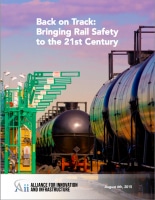
Aii report_small“Back on Track: Bringing Rail Safety to the 21st Century,” is a study conducted by the Alliance for Innovation and Infrastructure (Aii) on opportunities that are currently available to enhance rail transportation safety in the United States. 

The study, which focuses largely on crude oil and hazardous shipments, gives real-world solutions that are intended to prevent accidents, rather than mitigate them. Included in that study is a recommendation for the Federal Railroad Administration (FRA) to require two-person crews (see page 14). 

To view the report in its entirety, click here. 

Feinberg
Feinberg

Washington — The pending nominee to be the next administrator of the Federal Railroad Administration (FRA) will provide testimony at a U.S. Senate Committee on Commerce, Science, and Transportation confirmation hearing on Thursday, September 17 at 9:45 a.m.
Ms. Feinberg has served as the Acting Administrator of the FRA since January 2015 and the president formally nominated her to be the next administrator at FRA on May 29, 2015. Her nomination questionnaire is available here. 

Nomination Under Consideration:
Sarah Feinberg, to be the Administrator of the Federal Railroad Administration 
 
Hearing Details:
Thursday, September 17, 2015
9:45 a.m.
Full Committee Nomination Hearing
 
This hearing will take place in Senate Russell Office Building, Room 253 and a live video of the hearing will be available.

Hynes
Hynes

Alternate National Legislative Director Greg Hynes testified Thursday, August 28 at the Federal Railroad Administration’s (FRA) Risk Reduction public hearing.

The FRA published a notice of proposed rulemaking February 27, 2015 requiring certain railroads to develop a Risk Reduction Program (RRP). The Rail Safety Improvement Act of 2008 already requires the development and implementation of railroad safety risk reduction programs.

Risk reduction is a comprehensive, system-oriented approach to safety that: (1.) Determines an operation’s level of risk by identifying and analyzing applicable hazards; and (2.) involves the development of plans to mitigate that risk.

Each RRP is statutorily required to be supported by a risk analysis and a Risk Reduction Program Plan (RRPP), which must include a technology implementation plan and a fatigue management plan.

Below is Hynes’ testimony.

“On April 28, 2015 SMART and six other labor organizations submitted written views on the proposed rulemaking. My testimony will further explain the concerns of SMART.

“I acknowledge that the rail unions agreed to the draft of the risk reduction proposal. However, the proposed rulemaking takes excessive liberty with that tentative agreement. The technical drafting by FRA is not acceptable and we submit it varies from what was approved in the Rail Safety Advisory Committee (RSAC) deliberations.

“I want to reiterate the strong opposition to the Baker Botts study relied upon by FRA to restrict discovery. You should be aware that Baker Botts is a political surrogate for the railroads. The report it submitted reflects this bias. Clearly, the study lacks the objectivity that FRA should have required for an issue so controversial. Its conclusion that the information compiled for the risk reduction plan should be secret is not supported by the statutes it reviewed. FRA needs to recognize that each of the statutes mentioned by Baker Botts limits discovery only in a limited way, and discovery is allowed in every safety statute. The exception is for discovery of governmental documents.

“Our members have voiced great concern that FRA’s proposal here would have a significant negative impact on safety. If a safety hazard exists of which a railroad has knowledge, then the public and railroad employees should not be prevented from knowing such information. Congress has mandated that FRA, in carrying out its duties, shall consider the assignment and maintenance of safety as the highest priority. And it must recognize the clear intent of Congress for the furtherance of the highest degree of safety in railroad transportation. Restricting the public’s access to the railroad’s knowledge of a safety hazard does not comply with the statutory mandate.

“It became clear early in the RSAC working group that FRA was planning to provide the railroads complete protection to keep secret its risk reduction plan. Therefore, it was incumbent upon rail labor to insist that any such information contained therein be compiled “solely” for the risk reduction plan. Any information currently discoverable would continue to be. The problem is that the railroads might attempt to insert many items into the plan and state that they were collected solely for the plan. FRA must clearly specify that such maneuvers would violate the regulation. Also, the labor organizations previously submitted a list of documents that had been discoverable in court proceedings. In order to limit future litigation costs, this list should be restated in the final plan. Otherwise, FRA will be creating a legal nightmare, because the railroads would likely argue in court that almost everything sought was compiled solely for the risk reduction plan.

“Another major concern is that the proposed rulemaking limits the involvement of the collective bargaining representatives in compiling the safety hazards and their mitigation. Unless we are given an equal role, as the railroads to develop the plan many safety hazards likely will be overlooked. The current draft does not comply with the “best efforts and good faith” statutory mandate in development of a railroad’s risk reduction plan. We commend FRA in its explanation of the meaning of best efforts and good faith. However, FRA’s statement in the proposed rulemaking that it will simply “consider” the comments submitted regarding the consultation process requirements when developing the final rule is not acceptable. The workers should be on an equal footing with the railroads in developing the plan. If a railroad does not agree with a union that an issue is a safety hazard, the railroad should be required to show good cause for not including it in the mitigation plan. The railroads must be required to demonstrate substantial grounds not to include an identified safety hazard.

“There are several other points regarding the development of the plan which need to be addressed. FRA has not imposed any time limits upon the industry to consult with the workers or to develop the plan. Rather, the employees are given 60 days notice prior to the consultation. If there are no time limits for completing the plan, then the carriers could drag their feet indefinitely.

“Next, it is not clear why FRA in Appendix B suggests that the railroads should wait one year after publication of the rule to hold substantive consultations. Consultations should begin as soon as possible. Safety delayed is safety denied.

“Another time issue is in section 271.103 (a)(2). The railroads are given 36 months to fully implement the risk–based hazard management plan. If the carriers know the safety problems and how to mitigate them, the plan should be implemented no later than six months after FRA’s approval. There may be minor exceptions only with the approval of the employees.

“In conclusion, in the interests of safety, we strongly encourage FRA to amend the proposed rulemaking in accordance with our suggestions.”

FRA_logo_wordsWASHINGTON – The Federal Railroad Administration (FRA) today announced that it is soliciting applications for $10 million in competitive grant funding available to states to improve highway-rail grade crossings and track along routes that transport energy products like crude oil and ethanol.  The guidelines for the grant applications set by the FRA encourage states to include innovative solutions to improve safety, especially at highway-rail grade crossings.  The funding is part of the Railroad Safety grants for the Safe Transportation of Energy Products (STEP) by Rail Program.  

“The U.S. Department of Transportation has made increasing safety at highway-rail grade crossings, especially along routes transporting energy products, one of its top priorities,” said U.S. Transportation Secretary Anthony Foxx.  “This money allows the Department to support innovative ideas and solutions developed at the local level, and I encourage states to apply for this funding.”

Highway-rail grade crossings collisions are the second-leading cause of all railroad-related fatalities.  Last year, 269 individuals died in these collisions.  While the number of fatalities has decreased for the last several decades, this number increased last year for the first time this decade.

Highway-rail grade crossing accidents are frequently the result of a driver’s lack of awareness of a crossing or an oncoming train or a driver’s attempt to “beat the train.”  Earlier this year, FRA ramped up its campaign to prevent collisions and save lives at highway-rail grade crossings through greater education, stronger enforcement and smarter engineering.  To accomplish this, FRA has developed key partnerships, and has:

“Most of these deaths are completely preventable, and that is why the Federal Railroad Administration has redoubled its efforts to reverse last year’s upward trend.  These funds will allow states to take innovative ideas and make them a reality to increase safety and decrease fatalities,” said FRA Acting Administrator Sarah Feinberg.

In GROW AMERICA, the U.S. Department of Transportation (DOT) has proposed creating new grant program that would make $250 million available to local communities for highway-rail grade crossings as well as other critical rail infrastructure projects.  In addition, the Department has proposed continuing Federal Highway Administration’s $220 million per year dedicated grant program for highway rail grade crossing projects. 

Earlier this year, DOT released its comprehensive rule that raises the bar on the safety of transporting crude oil by rail.  The rule requires stronger tank cars and 21st century electronically controlled pneumatic (ECP) brakes that activate simultaneously on all tank cars, reduce the distance and time needed for a train to stop, and keep more tank cars on the track if a train does derail.  DOT has also required that railroads transporting crude oil notify State Emergency Response Commissions of the movement of crude oil through individual states.  During the last two years, DOT has taken more than two dozen actions to increase the safety of transporting energy products by rail.

View a copy of the Notice of Funding Availability.

To view education materials, visit Operation Lifesaver’s website, our partner in grade crossing and trespasser safety.

high_speed_rail_1The Federal Railroad Administration has decided on a preferred route for the proposed high-speed rail that would run from Houston to Dallas and through the eastern counties of the Texas Brazos Valley.

The line approved for the proposed train would get people from Houston to Dallas in 90 minutes. It cuts right through Grimes, Madison and Leon Counties, among others.

Read more from KBTX.com.

FRA_logo_wordsFRA is issuing this safety advisory to emphasize the importance of timely repairing ballast defects and conditions on main tracks. FRA notes that ballast defects and ballast conditions that are not repaired in a timely manner can lead to future defects.

FRA believes it is important for track inspectors to be aware that ballast defects and conditions can cause track components to deteriorate rapidly and compromise the stability of the track structure, and that inspectors are trained to identify and repair ballast defects and conditions.

This safety advisory recommends that track owners and railroads: (1) Assess current engineering instructions on ballast safety and update them to provide specific guidance to track inspectors (designated personnel that are qualified to inspect and repair track) on how to identify and initiate remedial action under 49 CFR 213.233(d) for ballast defects and conditions, as well as on the appropriate remedial action to implement, particularly in areas with one or more additional track conditions; (2) train track inspectors on the updated engineering instructions and this safety advisory to ensure they understand how to identify and initiate remedial action for ballast defects and conditions in a timely manner, and understand the importance of such remedial action in preventing the development of unsafe combinations of track conditions; and (3) ensure that supervisors provide adequate oversight of track inspectors to achieve identification and remediation of ballast defects and other track conditions.


oil-train-railMINNESOTA – Lack of action during this year’s legislative session doesn’t mean nothing’s being done regarding rail safety as oil trains keep passing through the state and region.

About 3,000 firefighters and other emergency responders from 80 departments throughout the state have been trained to respond quickly to oil-train-related disasters, and the Minnesota Pollution Control Agency has increased scrutiny of the accident response plans prepared by railroads and emergency personnel.

On the national level, the Federal Railroad Administration permanently extended a requirement for railroads transporting highly explosive oil, such as the crude being shipped from the Bakken region of North Dakota, to disclose the expected movement of their trains. The extension came after prodding from Sen. Al Franken and others.

Read more from Post Bulletin. 

FRA_logo_wordsCINCINNATI — The Federal Railroad Administration will soon take a good, hard look at how Amtrak could better serve the Midwest with interstate passenger rail transit, and local leaders are saying it will take Cincinnati one step closer toward daily rail service to Chicago.

In an announcement sent to Congressional leaders last week, the FRA announced it will spend nearly $3 million dollars on a planning initiative to bolster passenger rail service in the Midwest and Southeast regions.

Ohio, Kentucky, and Indiana will all have a stake in that plan, along with 10 other states.

Read more from WCPO.com.