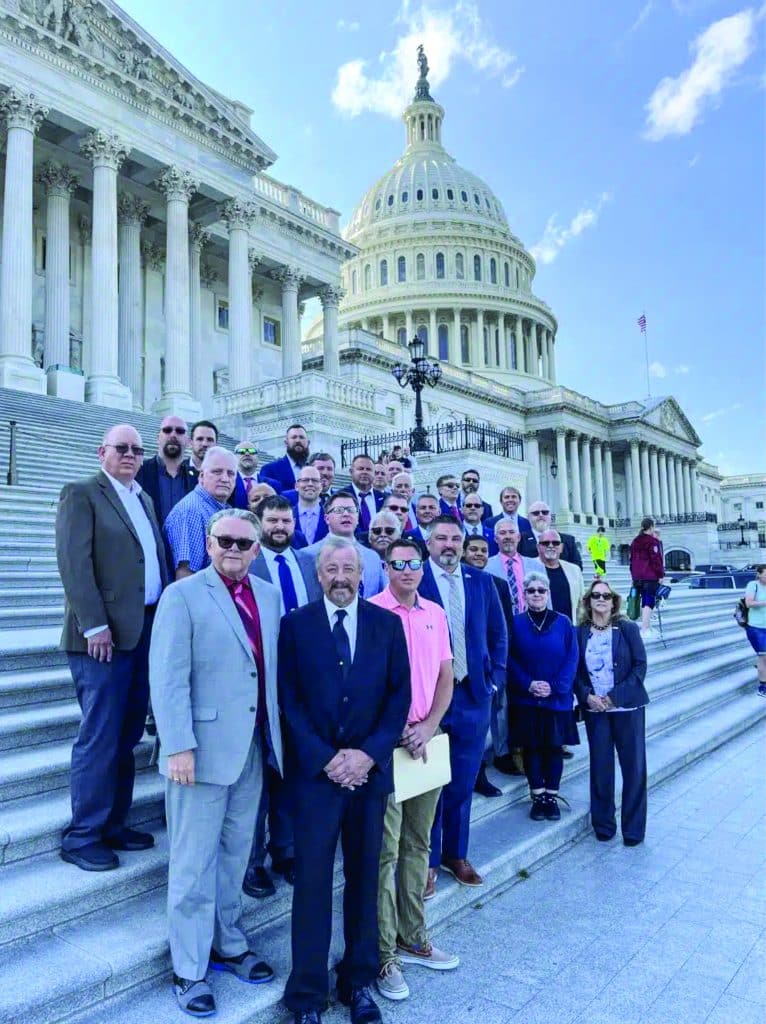
Under ordinary circumstances, SMART-TD’s National Legislative Department relies on National Legislative Director (NLD) Greg Hynes, Alternate National Legislative Director Jared Cassity and Legislative Department Chief of Staff Jenny Miller to educate our nation’s lawmakers on rail safety. But on this year’s “Railroad Day on the Hill” — held annually on the legislative calendar — 35 men and women representing 15 different states answered the call, traveling to Washington, DC to advocate for railroaders.

This formidable group of SMART-TD representatives conducted more than 100 meetings with legislators: sharing the gospel of the Railway Safety Act of 2023, shorter trains, increased quality of life and better safety inspections of rolling stock with any Congress member or staffer willing to listen.

In addition to holding this important series of meetings and reaching out to over 100 members of the House and Senate, SMART-TD representatives attended a press conference in support of U.S. Sen. Bernie Sanders (I-Vt.) as he announced the introduction of the Healthy Families Act. This legislation includes provisions ensuring that every company with over 100 employees provides a minimum of 7 paid sick days to its employees. This bill has language in it that speaks directly to railroad companies.
The Healthy Families Act indicates the progress our union made in the 2022 national contract negotiations. In December 2022, Sanders pushed for similar legislation that was strictly aimed at railroaders — and though it won a majority of votes in both the House and Senate, it failed to get the 60 votes needed to carry a filibuster-proof supermajority and make it to President Biden’s desk to be signed into law.

With the ramifications of this bill’s success weighing heavily on the quality-of-life improvements that SMART-TD continues to seek for our members, Sen. Sanders reached out to SMART’s Legislative Department and made a point of inviting our representatives to his press conference.

Following the successes of the day’s events, NLD Hynes expressed his gratitude to the army of SMART-TD leaders who made the trip.

“These men and women went above and beyond the call of duty to be here today, and because of them, we had a fantastic show of force in the halls of Congress. The validity of our issues speaks for itself, but when leaders from these different states show up to meet with their congressional and senate delegations, it makes an impact on these lawmakers,” he said. “They hear from Jared Cassity and me all the time, but when someone from home comes to meet with them in DC, it puts a face to our issues in a unique way.

“I want to thank each and every one of them for making the effort to come out this year, and with your help, we will deliver on the promise of the Railway Safety Act, the REEF Act, and all the issues that speak to the quality of life our members deserve and the dignity of the work they do each day.”
At the scene of a derailment, there is no substitute for the knowledge and experience of conductors as well as firefighters. In our current national climate, government and media attention are on the topic of derailments and the emergency response to them.

SMART Transportation Division needs to hear from our members who have a background in both.

Many of our members are either currently volunteer firefighters or came to the railroad from a professional firefighter background. Having been trained in both crafts and having field experience in both makes these men and women uniquely qualified to be part of this national discussion.

SMART-TD wants to provide you the bullhorn to let your voices be heard in the halls of the United States Congress as well as in the board rooms of the nation’s rail carriers.

The SMART-TD National Legislative Department is preparing a short survey to help us identify our brothers and sisters with the necessary experience in firefighting to lend their expertise to this important conversation. Please keep an eye on your email inbox and respond to this survey that will be coming out in the coming days. Our union is the largest freight rail employee union in the country, and we are in a natural position of leadership when it comes to rail policy.

Our strength comes from our members, and right now is a prime example. We need our brothers and sisters to help us lead the policy-making process that will define safety standards for all of us for generations to come.

Please consider answering the survey questions when you see them in your inbox and be the difference now that safeguards your coworkers in the future.

The RSA, which was born from the East Palestine derailment and contains two-person crew language, cleared its first major hurdle today when it passed through the Senate’s Commerce, Science, and Transportation Committee. The bill’s passage through committee was not without controversy and fireworks, with a debate between two Republican Senators during a discussion of amendments. However, at the end of the meeting, the RSA was passed and now moves on to the Senate.  

As a rule, freshman legislators on every level are expected to spend their first year, if not their first term, being seen and not heard. There is a tremendous learning curve, and most are happy to take in all of the information and calibrate themselves before becoming vocal, especially when taking on the standard bearers of their own political parties.  

Unlike most other Senators, JD Vance (R-Ohio) had the luxury of a learning curve taken away from him by the derailment in East Palestine, Ohio. Like a first-round draft-pick quarterback who has to put down the clipboard and step into the game before planned, Vance was thrown into the middle of the action.  

Today – May 10, 2023 – Vance helped usher the Rail Safety Act of 2023 to a bipartisan 16-11 win in the Senate’s Commerce, Science, and Transportation Committee.  

Vance’s opening statement in support of the bill came directly on the heels of longtime Senator Ted Cruz (R-Texas) pulling his support for the Vance/Brown Bill. In the face of this adversity, Vance came out swinging. Among other holes he poked in Cruz’s argument against the bill, he said: “We cannot on the one hand acknowledge that Ohio taxpayers and Ohio citizens are bearing the cost of this accident and on the other hand say that it’s ridiculous to require the railroad industry to do a little bit more on safety. They should be incurring some additional costs so that another East Palestine doesn’t happen again.” 

In a direct response to Cruz’s damnation of his bill as being too costly for railroads to be expected to pay for, Vance added: “Yes, it may make rail transportation a little bit more expensive. But it’s going to make rail transportation a little more expensive in the service of safety. Because let’s be honest. We have allowed the rail industry to socialize the risk of their business while privatizing the rewards. The people of East Palestine are going to deal with the cost of what Norfolk Southern did for the next generation.” 

When the hearing was opened for Senators to offer amendments to the bill, another institution of the Senate and Vance’s Republican party, John Thune (R-South Dakota), offered an amendment he claimed would alleviate the burden of Class II and Class III railroads. In his remarks, he more than suggested that other legislators aren’t in touch with rural/agricultural economies. In the face of the Thune amendment, Vance responded, “There are a number of agricultural communities small and big in the state of Ohio and a lot in East Palestine. They bear the cost when railways set off chemical bombs in their community – which is exactly what happened a couple of months ago. Those costs have been socialized onto Ohio and American taxpayers.” 

Following Vance’s comments, the Thune amendment was defeated. Shortly after that success, Vance and the Railway Safety Act of 2023 scored a huge win for rail labor with a 16-11 passage of the bill (without the rejected amendments proposed by Cruz and Thune). For his part in the day’s proceedings, the newcomer received accolades not often heard in the halls of the United States Senate.  

Senator Eric Schmitt (R-Mo.) thanked Vance for his leadership and said that he was happy to lend his support to the legislation. Both Senators Amy Klobuchar (D-Minn.) and Committee Chair Maria Cantwell (D-Wash.) made a point to highlight Vance’s acumen. Chair Cantwell said of Vance that, “I have to say, sir, you’ve come to the Senate and you’ve hit the ground running. And I appreciate that because you are responding to a crisis that happened in your state and you’re responding on behalf of your citizens so that this doesn’t happen again.” 

It goes without saying that SMART Transportation Division is encouraged by the bipartisan effort it took to get the Rail Safety Act of 2023 through the Senate committee, and we hope the sentiment continues as the bill now proceeds to the Senate floor and then onto the House.  

Rail safety is not for sale. America’s rail workers need legislation to reverse the harmful trajectory of the industry and to protect the communities in which they operate. We thank Senators Vance and Schmitt for their support, as well as every Democratic Senator on the Senate Commerce Committee for fighting to protect our members. 

SMART released the latest episode of SMART News on Tuesday, May 2. Episode eight features videos on organized labor’s success repealing so-called right-to-work in Michigan; SMART Heroes reaching the 500th graduate milestone; victories against wage theft in Virginia and Washington; SMART-TD’s rail safety efforts in the U.S. Senate; SMART members’ retirement security; and much more.

Watch individual videos from this episode:

SMART Local 80 Business Manager Tim Mulligan detailed the “travesty” of Michigan Republicans passing right-to-work legislation and taking prevailing wage away from union members in the Wolverine State; he also explained how organized labor worked with pro-worker elected officials to restore full collective bargaining power and prevailing wage in March of this year.

“Local 80, 7, 292 and actually our Transportation Division, we came together as one to get rid of right-to-work,” Mulligan told SMART News. “The repeal of right-to-work and the reinstatement of prevailing wage is so important for Michigan as a state.”

Later in the episode, International Training Institute Administrator Michael Harris and SMART Heroes graduates Kevin Moore and Sean Thompson spoke about the impact that SMART Heroes has had on their lives – as well as the other 500 military servicemembers and recent veterans the program has graduated over the last five years.

“I was honestly a little bit shocked at the level of camaraderie and brotherhood [in the union], that mimicked what I had in the [service],” said U.S. Army veteran Moore.

In other segments, SMART locals detailed recent victories on behalf of workers harmed by wage theft and worker misclassification; SMART-TD Ohio State Legislative Director Clyde Whitaker testified for rail safety in front of the U.S. Senate Commerce Committee; Local 24 members highlighted enormous megaprojects and job opportunities in central Ohio; and members in Maryland and Canada talked about their work serving their neighbors during the SMART Army’s month of community action in April.

Finally, SMART General President Joseph Sellers reflected on the progress our union has made on pension strength and security, progressing from the red zone, to the yellow zone, and finally to the green zone in January of last year.

“I wasn’t quite sure that I, during my working career, would have the opportunity to see a green zone National Pension Fund,” Sellers said in his interview with SMART News. “That was a really good process for us.”

Watch all episode eight segments here.

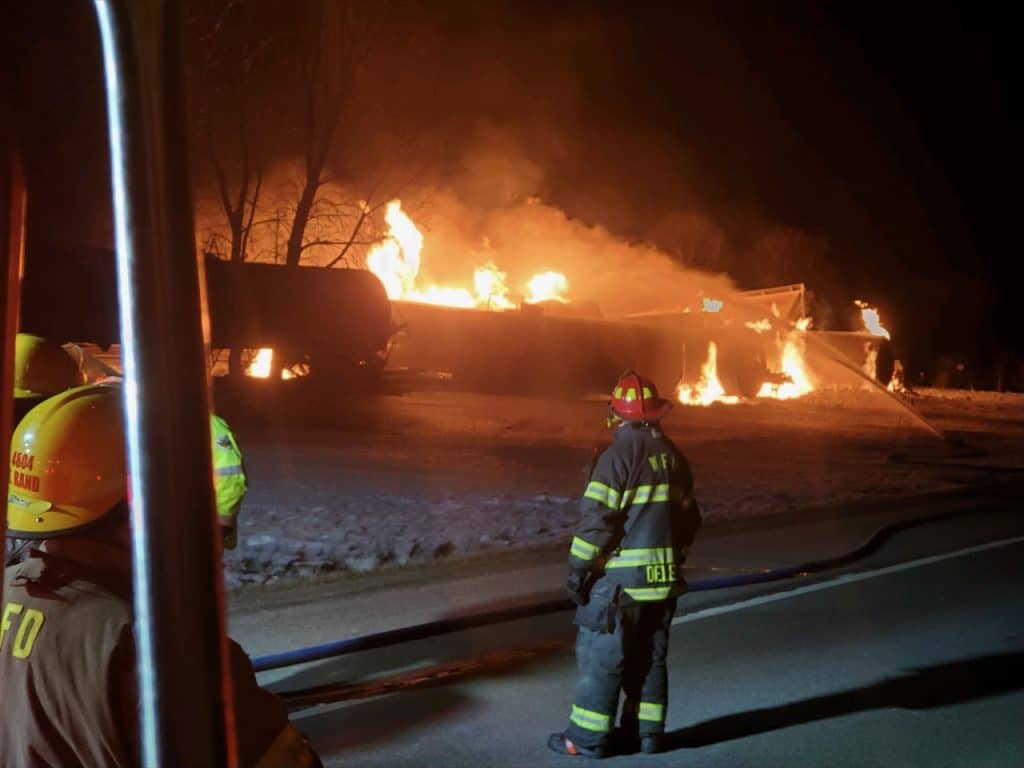
Rail safety laws are under increasing scrutiny with each new derailment. Here, firefighters look on as flames burst from a derailed train in Raymond, Minn.
Firefighters on the scene of the fiery derailment in Raymond, Minnesota.

Media outlets and elected officials continue to spotlight rail safety in the wake of derailments in East Palestine, Ohio, Raymond, Minn. and states across the country. That makes it even more crucial for SMART members, families and allies to get involved in the fight for rail safety laws, SMART-TD Alternate National Legislative Director Jared Cassity told SMART News.

“The best way for members to get involved is to use the Action Center on our website – you go on there and you can write your representatives and let them know what your concerns are,” Cassity said. “We need everyone on board here; it’s going to take actual peer pressure and constituent pressure on our elected officials to get stuff moving and get things done.”

Watch Cassity discuss ongoing efforts to pass rail safety laws on SMART News.

The Norfolk Southern disaster showed the nation what SMART-TD members have been saying for years: precision scheduled railroading (PSR) is bad for workers, communities and the environment. Now, the heightened scrutiny has presented an opportunity for rail labor to push for new safety regulation. At the federal level, that has taken the form of the bipartisan Railway Safety Act of 2023, legislation that includes a nationwide mandate for well-trained two-person crews on all freight trains; restrictions on train length and weight; regulations on the installation, frequency, upkeep and response to wayside defect detectors; speed restrictions; drastically increased fines for rail companies and management employees who do not adhere to rail safety protocols; and much more.

“Unfortunately, precision scheduled railroading has taken a toll, and the railroads can no longer hide behind what they’ve done to railroading. The dangers are out there for all to see, and East Palestine is proof of that,” Cassity said during his SMART News appearance. “This piece of legislation speaks to stuff that we need desperately to improve rail safety, like crew size issues, train length issues, train makeup issues, defect detector issues. It puts in place legislation that we need to start seeing the changes to put an end to PSR.”

SMART-TD officers have been lobbying U.S. Senators to support the Railway Safety Act since its introduction, with Ohio State Legislative Director Clyde Whitaker recently appearing with Ohio Senator Sherrod Brown to promote the act. And that’s not all: Across the country, SMART-TD local unions have lobbied for state-level rail safety laws, forming a comprehensive effort to bring change to the industry. In Ohio, that recently culminated in the passage of two-person crew legislation.

“State Legislative Boards and State Legislative Directors are actively pursuing legislation in their states that are on the same level or in the same vein of what we’re doing federally,” Cassity said. “So our members need to reach out and contact their state directors to see what they can do to help … so [politicians] can see the support and feel the need, the desperate need that we have from our workforce to keep each other safe.”

Members looking to get involved in the fight for rail safety can text “Rail Safety” to 67336 (message and data rates may apply).


Freight rail safety in the news

Freight rail safety was the focus of the March 2023 episode of the Talking SMART podcast. SMART-TD Alternate National Legislative Director Jared Cassity and SMART-TD Government Affairs Rep. Daniel Banks joined the podcast to discuss the fight to improve freight rail safety at both the state and federal levels in the weeks following the disaster in East Palestine, Ohio. 

The East Palestine derailment and other well-publicized accidents since have made clear what SMART-TD and rail labor have been saying for years: So-called “Precision Scheduled Railroading” is bad for workers, the public and the environment.

“It speaks to the seriousness of the devastation that has been done to the railroad industry since the implementation of Precision Scheduled Railroading, and it speaks to the fact that our predictions are now coming into fruition. And it’s both a shame and a frustration, and – to be quite frank – a very anger-filled reaction for us,” Cassity said. “It’s shocking to see all these derailments take place. … All of these things can be brought back to Precision Scheduled Railroading and what it’s done.”

“We need to act in solidarity” on freight rail safety

Both Cassity and Banks emphasized the importance of pushing for freight rail safety regulation across the country. Federal legislation like the bipartisan Railway Safety Act of 2023 has already been introduced, along with bills in states across the country. Now, both guests said, SMART members, families and allies need to get involved and make sure the railroads and elected officials feel the pressure.

“We need the action. Today’s the day, and we need to capture the momentum – we need to act in solidarity,” Banks said, adding that members can get involved by texting “Rail Safety” to 67336 (message and data rates may apply).

“When it comes to combatting the railroads, what we need is membership engagement, membership interest, membership participation,” Cassity explained. “We need the members to win this fight … we have got to have the membership speaking, because they’re the constituents, they’re the influencers. The union is the voice of many, but we need the many voices to be speaking as one.”

At the end of this episode, SMART General President Joseph Sellers discussed what SMART is doing to recruit nonunion sheet metal workers and meet the workforce needs presented by megaprojects, infrastructure investment and more. Listen to the full episode here, or wherever you get your podcasts.

Return to Talking SMART index page.


Talking SMART is a member of the Labor Radio Podcast Network — working people’s voices, broadcasting worldwide 24 hours a day.


Freight rail safety in the news

SMART Transportation Division President Jeremy Ferguson issued the following statement on Feb. 21:

“The greatest threat to the American railroad industry and the communities with which it intersects is Precision Scheduled Railroading (PSR). The changes PSR has brought since its inception in 2017 have only served to make executives and Wall Street shareholders richer, while the risk to employees and the public has become greater.

“The derailment that occurred in East Palestine was predictable and preventable. Unfortunately, financially driven equations, like the operating ratio, have caused rail carriers to abandon fundamentally sound practices for haphazard, inherently dangerous, impetuous movements of freight and locomotives across America’s rail system — all in the pursuit of increasing the bottom line. This is neither responsible nor sustainable, and we are now seeing the reality of this fact coming into fruition.

“Because of PSR, we find ourselves in an era of exponential increases to train length, less consideration to train make-up or construction, the desire to reduce crew size and introduce automation, the reduction in frequency and quality of inspections to equipment and infrastructure, and the permissibility of railroads to self-report and self-police — none of which are consistent with safety.

“Now is not the time to introduce more technology but rather to focus on the fundamental changes needed to reverse railroading’s dangerous trajectory. Now is the time to put an end to PSR.

“While our hearts break for the people of East Palestine, Ohio, we are thankful that our calls for meaningful oversight are finally being heard. We look forward to working with President Biden and the Department of Transportation to get this right. The catastrophe in Ohio and Pennsylvania demands that we get this right.

“We stand willing and ready to do just that.”

Secretary Buttigieg’s letter is available here.

Brothers and Sisters,

It’s no secret that Precision Scheduled Railroading (PSR) has devastated this industry. And it’s no secret that safety and service have suffered, but now the most vulnerable among us are being threatened. In the carriers’ pursuit to remove themselves from the limelight of regulatory authorities and neglected shippers, they are now blindly rushing new-hire trainees through unilaterally expedited training courses that have slashed educational curriculums in the hopes of being able to reflect an inflated headcount to remove the proverbial wolves from off their backs.

Today, in far too many Class I training courses, newly hired employees are receiving less than half of the standard training times that existed little more than a year ago. Without so much as an improved educational mechanism, the railroads are falsely claiming the ability to train in less time with less on-the-job experience. The material has not changed. The way in which the education is delivered has not changed. The only thing different is the abbreviated time frame, which is unacceptable and a danger to us all.

Exacerbating this issue is the fact that the railroads are not adequately staffed for on-the-job training. Currently, a concerning number of complaints have been received by our National Legislative Office pertaining to trainees being trained by newly promoted conductors. This practice is reckless, irresponsible, and a violation of the applicable regulations. A carrier should never task a recently promoted conductor with the training of another new hire employee unless it has received explicit approval from the union, and only in very limited circumstances. Permitting an employee with less than 12 months of service to train a new hire employee is not only a violation of the regulations, but it has resulted in injuries and fatalities in the past and we cannot allow it to continue.

Additionally, accidents and incidents involving newly promoted conductors (those which have graduated from these shortened training programs) are occurring. It is critical that we be made aware of these mishaps so that we can follow-up with the employee to offer assistance, where needed, and to ascertain that the carriers are reporting in compliance with the regulations and/or their internal operating rules and procedures. As you are aware, the FRA relies on the carriers to self-report or self-police, so it is vitally important that we can verify their compliance in order to ensure proper accountability.

Lastly, we are asking you to please be on the lookout for your new brothers and sisters. Keep a watchful eye over them, but also encourage them to report the concerns and shortcomings they have experienced both in the classroom and in the field to the Unsafe Condition Report on our website or the SMART-TD app. Let them know that it is OK to bring these issues to us, and that their reports will be kept confidential. If you see a wrongdoing, please let us know. For example, if they are assigned to an employee with less than 12 months of service, or if they are involved in an incident that could serve as an indicator for a lack of training, please report that to your local representative as soon as possible.

Local officers, if you receive a report of this nature, please promptly pass it up to your General Chairperson and State Legislative Director for further handling. We are all in this together, and we have to have each other’s back, but we also have to hold the carriers accountable and to ensure they meet their mandate to provide a safe working environment.

In solidarity,
Jeremy R. Ferguson
President, Transportation Division

In April 2021, we met with Steve Dodd and Greg Hynes to talk about the first 100 days of the Biden administration. We have brought them back for this Talking SMART episode to talk about the first year of the administration and, more specifically, its impact on SMART members. 

Steve Dodd

Brother Dodd is SMART’s Director of Governmental Affairs. He spoke with us about the many actions the Biden administration has already taken to support working families, including positive impacts of the passage of the American Rescue Plan on COBRA, unemployment benefits, multiemployer pensions, and funding for school HVAC retrofits.

He also discussed the PRO Act and what it means for SMART members to have so many labor friendly people now appointed to top positions in the Biden administration.

“This president has done something that all presidents have always talked about but never were able to accomplish,” said Dodd. “This Bipartisan Infrastructure bill, and now its implementation, means a great deal to not only sheet metal workers but all workers, whether they’re union or nonunion, across the United States.”

Greg Hynes

Brother Hynes is a fifth-generation railroader and SMART TD’s National Legislative Director. He discussed how the Biden Administration, in contrast to the previous administration, now very much has an open door for labor and actively seeks input from unions on issues of concern to working families.

“The most obvious are the appointments and the people that President Biden has surrounded himself with,” said Hynes. “He’s actually put competent people in charge of these agencies. And they are all very labor friendly, I mean, it comes from the top down.”

Greg also touched on how the American Rescue Plan included funding to rehire furloughed Amtrak workers, the significance of new leadership at the Federal Rail Administration which is now re-prioritizing rail safety over corporate profits, and what it really means when politicians or rail carriers say we need to just “cut back on regulations.”

In addition, listen for the open mic segment with SMART General President Joseph Sellers at the end of this episode. He responds to multiple questions that have come in from SMART members asking about what steps the Biden-Harris administration has taken to address the multiemployer pension crisis.

Return to Talking SMART index page.


Talking SMART is a member of the Labor Radio Podcast Network — working people’s voices, broadcasting worldwide 24 hours a day.

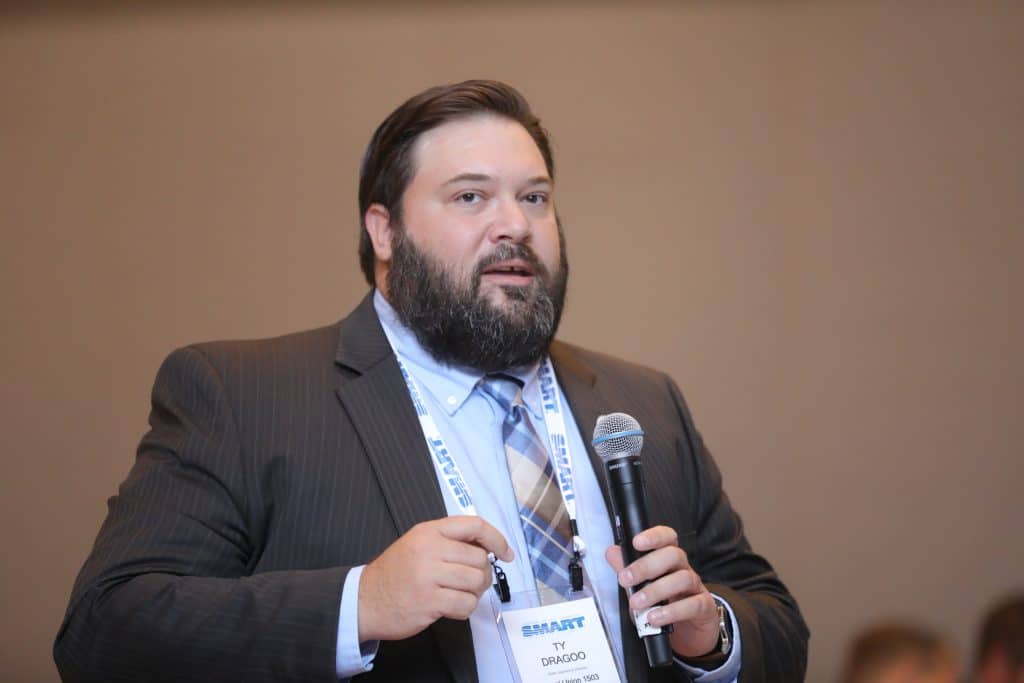
In the June 2021 Talking SMART episode, we dug into freight rail safety issues that affect both railroad workers and the safety of communities around the country. Our featured guests were SMART Transportation Division Kansas State Legislative Director Ty Dragoo and former Transportation Division Nebraska State Legislative Director Bob Borgeson.

SMART Kansas SLD and freight rail safety expert Ty Dragoo
Ty Dragoo

Brother Dragoo followed his father into the railroad industry and hired on as a conductor for Union Pacific in 2005. He has served as a legislative representative of Local 1503 in Marysville, Kansas, been the state’s legislative director since 2010 and helped lead efforts to create a transportation safety task force in his state. Ty spoke with us about his work in Kansas, including two-person crew legislation and the downsides of so-called precision scheduled railroad.

Bob Borgeson

Brother Borgeson represented SMART in a state – Nebraska – with a high concentration of Transportation Division members, where he worked to bring greater public attention to the important work our members do. Bob spoke with us about the negative impacts of long trains, efforts to move two-person crew legislation in Nebraska, and the innovative media and outreach tools SMART has used recently to bring attention to key rail safety issues in his state.

In addition, listen for the open mic segment with SMART General President Joseph Sellers at the end of this episode. He responded to multiple questions that have come in from SMART members asking about what steps the Biden-Harris administration has taken to address the multiemployer pension crisis.

Return to Talking SMART index page.


Talking SMART is a member of the Labor Radio Podcast Network — working people’s voices, broadcasting worldwide 24 hours a day.