
So-called “right-to-work” laws force unions to represent and bargain on behalf of workers who don’t pay dues. Union dues are the funds that empower local unions to devote resources to bargaining better contracts, organizing more jobsites and workplaces, and better representing members. When local unions are forced to bargain on behalf of non-dues-paying members, both SMART members and nonunion workers suffer.
Know the facts:
• The average worker in “right-to-work” states makes approximately $8,989 less per year than workers in free bargaining states.
• “Right-to-work” laws damage retirement contributions, hurting members’ pensions.
• The workplace fatality rate in so-called right-to-work states is 37% higher compared with free bargaining states.
• Uninsured rates are 11.9% higher in so-called right-to-work states compared with free bargaining states.
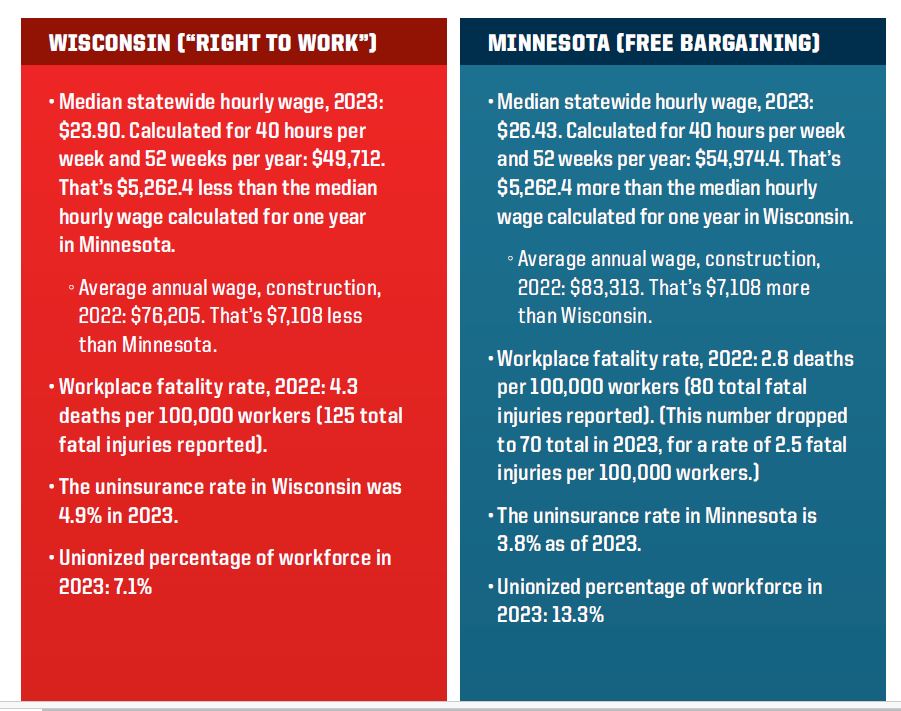
State-by-state comparison:
The Economic Policy Institute compared the economic paths of Wisconsin and Minnesota from 2010 to 2018, which included the years in which Wisconsin passed a so-called right-to-work law and Act 10, which restricted the collective bargaining rights of public sector unions. During that time, job growth in Minnesota grew 11% compared to Wisconsin’s 7.9%. Minnesota’s wages increased by 9.7% compared to Wisconsin’s 6.4%. Household income grew 8.5% in Minnesota compared to Wisconsin’s 6.4%.
Related News
- Special Focus: The real enemy
- Strength in unity
- The SMART difference
- SMART-TD’s mission remains the same
- SMART Canada celebrates 50th Canadian Convention
- Elections have impact: Two-person crew becomes law in Va.
- Fourth General Vice President Billy Kenyon retires
- Local 85 builds on SMART-TOOTRiS partnership to offer apprentices child care
- Government retreats on passenger rail investment
- What the union is doing for you: SMART-TD wins for members at NRAB First Division