New federal rule would strengthen crew qualifications, improve cross-border safety and ensure engineers demonstrate real operating skills.
FOR IMMEDIATE RELEASE
July 31, 2026
INDEPENDENCE, Ohio
The SMART Transportation Division today welcomed a sweeping Notice of Proposed Rulemaking (NPRM) from the Federal Railroad Administration that incorporates several safety reforms the union has advocated for years.
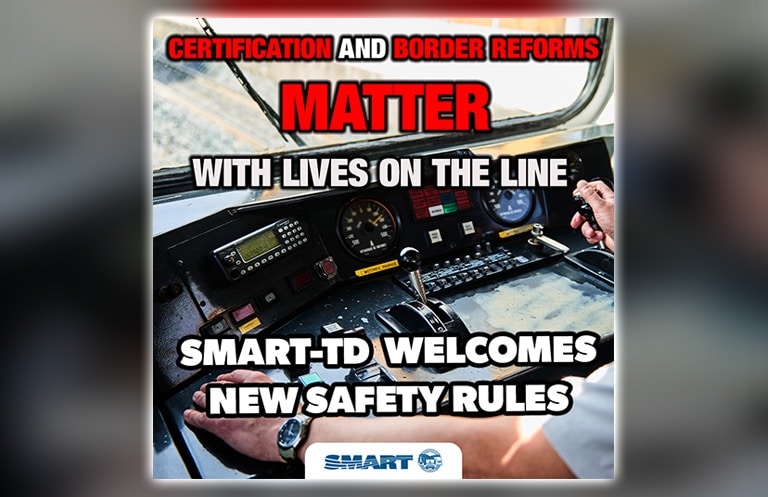
While public attention will likely focus on new English language proficiency requirements for locomotive engineers and conductors, SMART-TD says the proposal goes much further. The rule would strengthen the way railroaders are trained, tested, and qualified, reinforce meaningful territorial qualification standards, and ensure that engineers demonstrate their own operating skills (not those of automated train-handling systems).
“Railroad certifications should represent proven ability, not simply possession of a certificate,” said SMART-TD National Safety and Legislative Director Jared Cassity. “When lives are on the line, the FRA must know that an engineer can safely operate a train, not just supervise a computer doing it.”
One of the proposal’s most significant provisions would prohibit railroads from using Energy Management Systems (EMS) (technologies that act as autopilot systems do in aviation) during the FRA-Certification skills examination and annual operational monitoring used to evaluate locomotive engineers. SMART-TD has long argued that these fuel-saving systems are valuable tools but should never substitute for demonstrating the manual skills required to operate a train safely. Today’s FRA’s proposal reflects that principle.
The proposed rule also strengthens cross-border safety by requiring English language proficiency for certified engineers and conductors operating in the United States, requiring U.S. training and certification standards for Mexican-based crews, and proposing additional operational safeguards at the southern border, including a 10-mile operational limitation.
In addition, the proposal clarifies that territorial qualification must be earned in the specific direction of travel. Engineers and conductors must demonstrate familiarity with the territory as it is actually encountered in service, recognizing that signals, landmarks and physical characteristics differ depending on the direction of movement.
“Taken together, these reforms reinforce a simple principle,” Cassity said. “A railroad certification should mean that a railroad performs its due diligence to ensure that train crews possess the knowledge, communication skills, and hands-on ability necessary to safely operate a train. Not just one trip and a pat on the back, like is happening today. That’s what our members expect, and that’s what the public deserves.”
SMART-TD thanked the FRA for recognizing these important safety issues and taking meaningful action while emphasizing that the proposal is an important step, but not the final destination. The union will continue to review the NPRM and participate fully in the federal rulemaking process to ensure that the strongest possible safety standards are adopted.
###
For more information or to connect with SMART-TD President Jeremy Ferguson, National Safety and Legislative Director Jared Cassity, or a member of their leadership teams, please contact:
Dan Banks
dbanks@smart-union.org
(216) 227-5283 (Office)
(330) 322-5949 (Cell)
Alyssa Hansen
alyssa.hansen@smart-union.org
Related News
- Led by SMART-TD, Kansas Makes Railroad History
- Andrew Fudge Wins SMART-TD Endorsement in Oregon House Race
- Federal Court Upholds 2-PC
- Registration for Baltimore RTS Closes on Monday!
- Untimely Passing Leaves Conductor’s Family in a Difficult Financial Situation
- SMART-TD Wins Landmark BNSF Arbitration Protecting Members’ Right to Rest
- Critical Bus Operator Safety Legislation Results from Years of Advocacy
- Maryland Legislature Finishes the Job on 2-PC
- CLARIFICATION: How to Apply for Disaster Relief Following the Washington State Wildfires
- The fearmongering, speculation, and rhetoric stop now