Under the agreement, UP will relinquish control of rail operations in Eugene, Oregon’s yard, the largest between Seattle and San Francisco, as well as 29 miles of main line that supports regional businesses and industries.
The lease to CORP, a short-line railroad, will result in the loss of 30-40 highly qualified, FRA-certified Class I railroad jobs. If allowed to proceed, they will be replaced with about 15 new CORP employees, who will possess far less territorial knowledge and experience.
This is a recipe for disaster: replacing a unionized workforce with the skills and knowledge to safely operate these trains with less-qualified counterparts will have devastating consequences for the local community and its economy.
SMART-TD organizes defense of Eugene Yard crews and community
Oregon State Safety & Legislative Director Dan Garrison emphasized that the change boils down to the railroad’s focus on cutting cost, while shifting responsibility for safety and accountability to a smaller railroad.
Brother Garrison has been organizing an appeal to the U.S. Surface Transportation Board (STB). With the assistance of SMART-TD President Jeremy Ferguson, Jared Cassity in our National Safety and Legislative Department, and our legal team, they plan to stop UP in its tracks.
The power of public comments
The STB has the authority to approve or reject the sale or lease of rail lines throughout the U.S. While reviewing these deals they review input from interested parties and the public at-large.
Brother Garrison and President Ferguson are leveraging this opportunity to the fullest extent possible! This is SMART-TD’s opportunity to educate the STB on exactly what the ramifications will be if UP’s hedge fund parlor trick is allowed to go through as planned.
SMART-TD is steadfast
UP’s lawyers may not appreciate the blue-collar logic or the amount of effort our brothers are putting into blocking their plan, but they should expect it.
This is personal for Garrison, who works as a UP conductor out of the Eugene Yard. He knows and stands behind every man and woman UP puts at risk with this plan.
It is a problem when our brothers and sisters lose their jobs. It is not acceptable to force an experienced, professional workforce to crisscross a state the size of Oregon to chase work. UP’s profit comes at our members’ expense.
When railroaders are faced with what appears to be an insurmountable problem, we grab our hammer, duct tape, wrench, and zip ties and figure out how to get the job done.
The deadline for submissions to the STB is this Friday Jan 31. We’ll make sure our voices are heard, and if Garrison and his team are up against it, UP can be sure that these guys and President Ferguson will stand strong and fight with every tool they have available.
Our mission does not waiver: SMART-TD is committed to fighting for the protection of American rail workers, the safety of the public, and the long-term stability of the U.S. freight rail network.
From safety to the importance of funding and expanding passenger rail, several key issues that are top-of-mind for SMART-TD members were discussed during a recent Congressional hearing.
Held by the U.S. House of Representatives Rail, Pipeline, and Hazardous Materials Subcommittee, the purpose of the session was to examine the state of the freight and passenger rail networks and consider priorities for the next surface transportation reauthorization package due this Congressional cycle.
Jared Cassity, SMART-TD’s Deputy National Safety and Legislative Director, spoke during the hearing and highlighted the significance of our members to the railroad industry.
“I have had no greater pleasure in my career than the opportunity to represent the single most significant factor of what sets our railroad industry apart from the rest of the world, and that is the American railroad worker,” Cassity emphasized. “It is because of their efforts and their dedication that the rail industry has been able to achieve so many improvements over the last couple of decades, but there’s still much work that needs to be done.”
New Congress includes familiar faces
Committee member Congressman Troy Nehls (R-TX), who sponsored the bipartisan Railroad Safety Enhancement Act of 2024, made a point to recognize both Cassity and SMART-TD’s National Safety and Legislative Director Greg Hynes during the hearing. Congressman Nehls has emerged as a dedicated partner in advocating for the safety of railroad workers.
Brother Hynes told SMART News after the hearing that he was encouraged that Congressman Nehls continues to serve on the Rail subcommittee in this new Congress.
Hynes was adamant, saying “Rep. Nehls and the bill he wrote are a key to our members’ day-to-day safety. He is a true believer in our workforce, and we will need him on both the Transportation & Infrastructure Committee and the Railroad subcommittee to make sure we finish the job on 2-PC. He’s a big piece of the puzzle for this union to continue 2024’s momentum.”
Safety steals the spotlight
The safety of rail workers will likely be a key part of this subcommittee’s agenda, an idea that Cassity underscored during his remarks.
“Our members’ main priority when they’re at work is to perform the functions of their jobs to the best of their ability, day in and day out,” Cassity noted. “They want to get to where they’re going safely, without incident, and then back home to their families — the same way they went to work.”
Cassity stressed that SMART-TD’s bottom line remains focused on safety.
“Our mission is simple, and it does not waver—safety will always lead the way. We stand ready to work with you and your offices to get us there.”
Awareness of train length challenges
Congresswoman Dina Titus (D-Nevada), Ranking Minority Leader of the Subcommittee and a longtime labor advocate, described the importance of both passenger and freight rail in her district, but also expressed several concerns.
“Las Vegas is my district, and it was founded as a rail stop,” said Congresswoman Titus. “Right now, through my district, we have a number of trains every day carrying all kinds of things. Now, also, we’re at the forefront of high-speed passenger rail.”
With so much rail traffic in her district alone, Congresswoman Titus said that safety is critical, especially when it comes to train length.
“I continue to have concerns as trains get longer and longer,” Congresswoman Titus admitted. “Not only do we need to be mindful of train length, but I want to be sure that our workers and first responders know exactly what’s moving on those trains.”
Cassity promotes rail safety through better training
Staying focused on safety, Congresswoman Titus pointed out that conductors are still getting hurt on the job and asked Cassity why that is.
He says that the answer is simple: thorough training makes a big difference.
When he hired on with the railroad 20 years ago, things were very different.
“The emphasis was on training,” Cassity said. “We had to go through a regimented process, and we had roughly six months of training.”
In this instance, repeating history would likely be beneficial.
“We have got to get back to taking on training—not focusing on regulatory minimums and only doing what’s required by the regulation, but actually owning safety and making sure that our folks are comfortable in their own skin when they’re at work and aware of what’s going on, what changes have been made, and how to do the job effectively and efficiently,” Cassity recommended.
Labor should drive responsible use of new technologies
As the conversation veered into the impact that new technologies and innovations have on the rail industry, Cassity encouraged lawmakers to set boundaries on its implementation so that safety isn’t compromised.
“Labor supports new technology and innovation to help us work safer,” Cassity noted. “But we need to make sure that the umbrella is not too big, so that when the new technologies are being developed that there’s not too much freedom because the impact could be great on the American public.”
To ensure that doesn’t happen, SMART-TD needs a seat at the table.
“It’s vitally important that we play a role in these technologies and innovations because we are the ones that are most impacted by it, and we’re also the ones best suited to protect the public and how it can impact them,” Cassity said.
High-speed passenger rail would solve many problems
Congressman Seth Moulton (D-MA) asked Cassity why the United States hasn’t invested in high-speed rail as heavily as other countries.
“People hear ‘railroads’ and they think about ancient technology or ancient methods of transportation, and we’ve got to get outside of that box and make sure that we’re talking to folks and letting them know what rail can do for them and how we can make their lives better.”
Part of that involves amplifying the many benefits of railroads compared with other means of transportation.
“One single train can take 150 to 300 trucks off the highway. That’s good for everybody who uses our highways,” Cassity explained. “We know that tens of thousands of Americans die on our highways every year. Railroads are far safer.”
To ensure that rail ridership increases, dedicated funding and investment are key.
“We’re enjoying some of the most robust funding in Amtrak’s history, so it should be no surprise that 2024 was a record year for ridership. Not only were more people able to enjoy the benefits of rail travel, but rural communities were better equipped to directly connect their citizens with the rest of the country,” Cassity said. “But like every other passenger rail service on the planet, Amtrak cannot survive on fare box revenue alone, which is why adequate funding is so important.”
Cassity made it clear: investing in high-speed rail is crucial to the future of transportation in the United Sates.
“High speed rail, in my opinion, is the greatest opportunity for funding to do something meaningful for the people of America…to make an impact on the economy and the infrastructure as a whole.”
Washington, D.C. – In a significant victory for Dining Car Stewards across the country, General Chairperson Rick Pauli of GO-769 is pleased to announce the unanimous ratification of SMART-TD represented Dining Car Stewards’ Tentative Agreement. The vote, which concluded on January 13, 2025, marks a significant achievement for the SMART Transportation Division and its members.
Income increases match conductors’ gains
The newly ratified agreement, which spans seven years from July 1, 2022, through December 1, 2028, brings substantial gains for Dining Car Stewards. The Agreement secures a General Wage Increase (GWI) of 34.5%, compounding to 40.21% over the course of the contract. This wage increase is consistent with the gains previously secured for Amtrak Conductors and Assistant Conductors, further strengthening the union’s position across the workforce.
Retroactive pay, parental leave and MLK day
In addition to the substantial wage increases, the Agreement includes several key highlights designed to improve the quality of life for Dining Car Stewards:
Full retroactive pay dating back to July 1, 2022, ensuring workers receive compensation for the entire period prior to ratification.
10 weeks of paid parental leave, providing vital support for families during a critical time.
The addition of Martin Luther King Jr. Day as a paid holiday, honoring the legacy of a leader who fought for equality and justice.
Increased meal allowances, helping offset daily expenses for workers on the road.
Maintained health and welfare benefits with a modest increase, ensuring that Stewards have continued access to quality care as they serve on Amtrak trains.
Small or large, SMART-TD wants every craft to prosper
This victory is a testament to the power of solidarity and our union’s commitment to securing fair treatment for all our members. Brother Pauli and SMART-TD work just as hard for our small number of Dining Car Stewards as we do for our thousands of conductors.
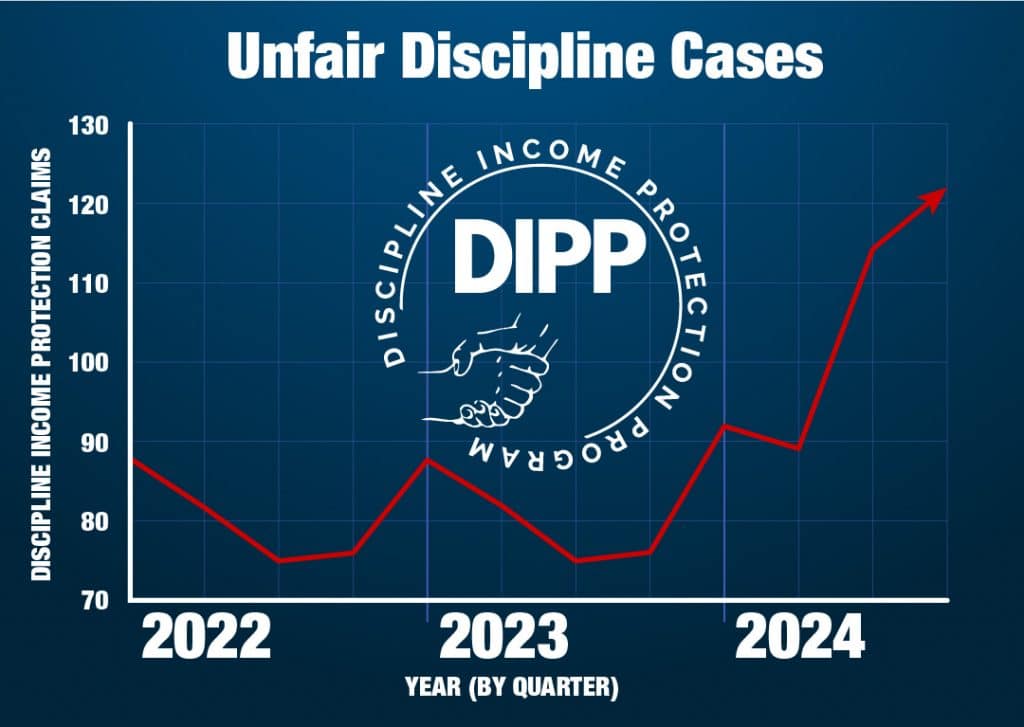
January 22, 2025 – As we move through the annual slow season in railroading, SMART-TD has noticed a distinct spike in claims under our Discipline Income Protection Plan (DIPP). What once might have been a “discussion” or a “we both know I didn’t see that” moment is now being turned into something far more serious: 15 to 90 days in the penalty box without pay.
Make no mistake: this is a management strategy to cut payroll while business is slow. Management would rather issue discipline than plan for the annual slow season. Even when SMART-TD members follow every rule, subrule and regulation, discipline is rising.
Railroads are held accountable for furloughs but not discipline
The truth is, the Surface Transportation Board made it clear to the railroads: furloughs are a bad look. If the industry does furlough workers, they can’t blame manpower issues for their service failures. By targeting individual employees with performance-based discipline they can cut costs, while gaslighting their workforce instead of acknowledging their own lack of planning. It’s easier to take us out one at a time than to fight Uncle Sam and the media coverage that would come with a furlough.
Defense: arbitration and DIPP
Our union’s track record in arbitration clearly demonstrates that many of these charges are totally without merit. If you are the victim of unfair discipline, contact your chairperson so they can begin the process of securing your back pay. You may be without an income while the case moves through mediation, which is why DIPP income protection is important.
SMART-TD President Jeremy Ferguson, who also serves on the DIPP board of trustees, sums it up, “The bottom line is that DIPP is run by members for members, and moments like this is why we do it. Our work insurance shields our members when the railroads and transit agencies get out of line. We’ve increased the maximum daily benefit amount to $300. This equates to $4,200 per pay half, giving our members a much-needed financial cushion if and when they get put out of service, and we made it faster for changes in benefits to go into effect. We are 100% serious about protecting the quality of life for as many members as possible.”
DIPP is not operated to make a profit. Our program has the highest approval rate on claims in the industry, and we are doing everything we can to put money in your hands when you need it.
Faster approval for income protection
DIPP’s trustees have reduced the waiting period for increased benefit amounts from 90 days to 30 days. Given the rapid rise in members being taken out of service, Ferguson and the other trustees wanted to ensure that our members and their families receive the financial support they need as quickly as possible.
To all SMART-TD members: stay vigilant, stay professional, and know that SMART-TD is with you every step of the way.
For more information on SMART-TD’s DIPP plans and to sign up or adjust your premium, follow this link to our website.
If you’re a retired railroad worker or the spouse or survivor of one, several important changes are coming to your pensions.
Previously, the U.S. Railroad Retirement Board (RRB) reduced the tier-1 amount of an individual’s railroad retirement annuity because of his or her pension.
Now, more money is going back into the pockets of many SMART-TD members.
Signed on January 5 by President Biden, the Social Security Fairness Act ends two statutory reductions (the non-covered service pension (NCSP) and the public service pension (PSP)) that are now known as the windfall elimination provision (WEP) and the government pension offset (GPO).
When the NCSP reduction and PSP offset were enacted over 40 years ago, the initial goal was to equalize social security benefit formulas for workers and their spouses with similar earnings histories.
Calculated based on someone’s lifetime earnings, the NCSP reduction lowered the individual’s primary insurance amount, which ultimately determined the monthly tier-1-annuity amount.
The PSP offset further reduced the tier-1 annuity for spouses or survivors by two-thirds of the gross public pension amount payable to those who fall under either category.
Local government employees with less than 30 years of coverage who also receive a public service pension for work not covered by social security and some federal employees hired before December 31, 1983, are some of the individuals who were affected by the NCSP reduction.
Railroad spouses and widow(er)s who were not covered by social security during the last 60 months of employment with the pension-paying government entity but received a public pension based on their own earnings fall under the category of those who were affected by the PSP reduction.
Thanks to the legislation and the repeal of both provisions, anyone who was impacted by the NCSP reduction and PSP offset will have their full tier-1 benefit amounts restored for months retroactive to December 2023 and future monthly benefit payments.
However, it’s important to note that railroad spouses and widow(er)s whose public employment was covered by social security (including federal employees hired after December 31, 1983) and those who are receiving a public pension not based on their own earnings, were not impacted by the repeal. The Social Security Fairness Act also does not impact existing laws requiring offset of railroad retirement annuities for any social security benefit, public disability benefit, or workers’ compensation received. That means that if you’re receiving an RRB and social security benefit, your tier-1 amount will continue to be offset by the social security benefit.
Members do not need to take specific action, except for those who have moved or changed banking information. If that applies to your situation, you are asked to report these details to the RRB’s toll-free number by calling (877) 772-5772.
Temple, Texas—It is with deep sorrow and heavy hearts that SMART-TD honors the life and remembers the legacy of Brother Charles “Chuck” Cheek, who passed away on Thursday, December 12, 2024, at the age of 53.
A member of Local 331 who previously served as a Local Chairperson for LCA 393C, Chuck was sadly diagnosed with Stage 4 cancer in August 2024.
As he began navigating the difficult and taxing medical road that comes with a terminal cancer diagnosis, our SMART-TD family showed what solidarity is all about. Thanks in part to the efforts of current local union leadership, over $22,000 was raised to assist with Chuck’s financial burden as he underwent surgery and chemotherapy treatments. This was done through a benefit event, meal fundraisers, raffles, a GoFundMe campaign, and many generous personal donations.
While Chuck’s initial progress was positive, he peacefully passed away after his last chemotherapy treatment. His resilience and courage throughout his battle with cancer were a powerful inspiration to all who had the good fortune to know him.
We extend our deepest and most heartfelt sympathies to his wife, Kristi, and their family. We also want to extend our sympathy Brother Cheek’s Union family at Local 331. Most importantly, we want to express our gratitude for the powerful impression that Chuck Cheek left on both working families in Texas and our union.
Wilmington Terminal Railroad, a subsidiary of Genesse and Wyoming, has voted unanimously to join SMART-TD!
Since coming under G&W ownership in 2005, the workers have been without representation.
From living in the “Right to Work” state of North Carolina, to dealing with threats from their notorious union-busting employer, the workers’ journey to becoming part of the SMART-TD union family was anything but easy.
New Brother Parker Greenough got tired of G&W’s threats to shut down the terminal and switch the cars elsewhere if organizing talk became a reality.
“I always figured that it [securing union representation] would be difficult and that it would take a long time, but we were finally ready,” Greenough said. “Enough is enough.”
Vice Chairman of General Committee 433 Andy Goeckner is especially proud of how determined Greenough was to fight for representation, no matter what obstacles G&W threw his way.
“Parker did a great job communicating with the crew base and making sure they were singing from the same hymnal, so to speak,” Goeckner reflected.
The Journey to Union Membership
After having important conversations with his co-workers, they decided that they were ready to stand up to G&W’s endless stream of scare tactics and join a union.
There was just one problem: he didn’t know exactly where to start.
A Friday night Google search led him to SMART-TD, and he immediately made a call to the organizing department.
By Monday morning, he was on the phone with Goeckner, who asked Greenough what he and his brothers needed. Authorization Cards were in the mail to them that same day.
Crucial support also came from Local 1105 President Mike Stafford. He was present during the initial town hall and provided invaluable help as the vote approached.
“I was shocked at how easy SMART-TD and Andy made this process,” Greenough noted. “We could tell that he was excited to be in this fight with us, and that made us even more motivated to organize.”
A Unanimous Vote for a Voice on the Job
Much to the chagrin of G&W, the crew base unanimously voted to join SMART-TD.
Vice Chairman Goeckner then walked our new members through the process of filing the correct documentation with the Department of Labor and other federal organizations.
Fellow North Carolinian Todd McCray, who hails from the CSX General Committee, helped Wilmington Terminal navigate the process at the state level, a responsibility that he wasn’t required to assume.
“Todd’s not an organizer,” Goeckner pointed out. “Being from the same state and having the knowledge to make it happen, he just wanted to help his brothers secure the protection and respect that they deserve. He went above and beyond his job description to bring these guys into our SMART-TD family.”
McCray believes that the vote is a true reflection of the “union difference.”
“SMART has negotiated some great agreements on G&W properties,” McCray said. “These guys see that and what they’re missing out on and what a union can do for you.”
Even in the face of repeated discouragement from organizing for years, Goeckner is impressed that Greenough and his brothers never backed down.
“They didn’t fall for G&W’s blatant attempts to swing the vote and stood firm on what they wanted. That’s what being a part of the SMART-TD union family is all about, and we’re excited to welcome them onboard!”
After a week, the destructive California wildfires are still raging near Los Angeles and show no signs of slowing down.
Firefighters’ containment efforts are being further complicated by another round of high winds that are expected to pummel the area today.
Whether as first responders, victims of the devastation, or both, some of our SMART-TD members are experiencing this natural disaster firsthand.
With the number of destroyed structures from the Eaton and Palisades Fires currently sitting at more than 12,300, we expect to see the number of members who have lost their homes to the blaze continue to grow.
How to request assistance from SMART-TD’s Disaster Relief Fund
As the long-term recovery and rebuilding process starts to slowly take shape, there are several important updates that we’d like to share.
First, SMART-TD is taking a two-tiered approach to the relief that’s available.
Tier 1: These funds are intended to provide immediate relieffor those who have been ordered to evacuate and cover things related to temporary relocation, such as paying for hotels, food, and clothing. Members who would like to apply for Tier 1 relief are asked to contact their General Chairperson, Local Safety & Legislative Representative, or State Safety & Legislative Director. You will be asked to provide your name, home address with verification that you were under an evacuation order (not the address of where you are temporarily located during the evacuation), phone number, e-mail address, and Zelle account information for fund distribution. If you do not have a Zelle account, you may provide the routing and account numbers for your bank account.
Tier 2: These funds are dedicated to the recovery of lost property and long-term reimbursement needs once evaluation of the damage begins. Members who would like to apply for Tier 2 relief will need to complete the regular application for assistance upon being able to provide a verification of the damage to their home or property. Applications may be obtained by contacting your General Chairperson, Local Safety & Legislative Representative, or State Safety & Legislative Director.
If you aren’t sure who your General Chair is, that information is available on the SMART App along with their contact information by clicking the arrow to the right of your local’s meeting date and location. If you do not have the app, your local officers will be able to get you in contact with your General Chair.
Disaster Relief Fund Donations Welcome
As a reminder, we encourage those who are able to donate to the SMART-TD Disaster Relief Fund. Donations will go directly to those members who need it most, helping them and their families rebuild their lives and recover from this tragedy.
Contributions can be made payable to:
SMART-TD Disaster Relief Fund 6060 Rockside Woods Blvd., N Suite 325 Independence, OH 44131
Please call the Transportation Division office at (216) 228-9400 with any questions regarding the Disaster Relief Fund.
A Transformative Leader for Railroad Workers
Washington, D.C. – As Amit Bose formally steps down from his role as Administrator of the Federal Railroad Administration (FRA), the SMART Transportation Division (SMART-TD) takes a moment to express its profound gratitude for his leadership and the lasting impact he’s had on railroaders across the country.
Since taking the throttle of the FRA in 2021, Bose has been a champion for the hard-working men and women of the rail industry. His tenure marked a transformative shift in the way the FRA interacts with rail labor, treating our members not only as workers, but as experts in our field. He has consistently gone beyond simply listening to the needs of SMART-TD and its members. He has consulted with us, seeking our input on policies that affect the future of the American rail industry.
“Under Amit’s leadership, the FRA became a true partner to railroaders,” said SMART-TD President Jeremy Ferguson. “He didn’t just hear us; he understood us. From advocating for the two-person crew rule becoming a federal mandate to ensuring the majority of our members now have paid sick leave, his legacy is one of listening, learning, and taking action. His respect for our members as professionals has truly been revolutionary.”
Key Changes in FRA’s Perspective
Bose’s efforts extended beyond the public eye. His time at the FRA saw major milestones that benefit both railroaders and the public at large. Notably, his leadership ensured that the Association of American Railroads (AAR) could no longer use the FRA as a rubber stamp for any request for exemptions that would undermine the quality of life for rail workers or risk the safety of this nation’s communities. Under his watch, the C3RS (Confidential Close Call Reporting System) was expanded to include major railroads like Norfolk Southern and BNSF, marking a significant shift in the approach to safety within the industry.
In perhaps one of his most significant achievements, Bose oversaw the transfer of control of the Pueblo, Colorado, rail research center – often called the “Area 51 of railroading” – away from the AAR. The center, once a hub for research that served corporate interests, is now under the control of an independent third party, ensuring that its research benefits the advancement of the entire industry, with a clear focus on safety for both workers and the public.
“Amit has been a voice for the voiceless,” said Greg Hynes, National Director of SMART TD’s Safety and Legislative Department. “He didn’t just push through initiatives; he took the time to understand the concerns of those of us who work the tracks every day. His leadership created a better, safer environment for railroad workers and, in turn, improved the quality of rail service for the American public.”
A Legacy of Dedication to Rail Workers
The deep respect and commitment Bose showed for SMART TD’s members went beyond policy changes. He regularly sought input from the union’s leadership, including President Ferguson, National Safety and Legislative leaders Hynes and Jared Cassity, and others. He wasn’t just interested in top-level discussions; he made a genuine effort to understand what was happening at the ballast level – the day-to-day realities that frontline workers face.
“Amit’s approach was unique in that he always made sure to meet our members exactly where they were, not just in Washington, but in the rail yards, too,” said Jared Cassity, Deputy National Safety and Legislative Director. “He was a leader who knew that the best way to improve the system was by lacing up his boots, hitting the ballast, and listening to those who work in it every day.”
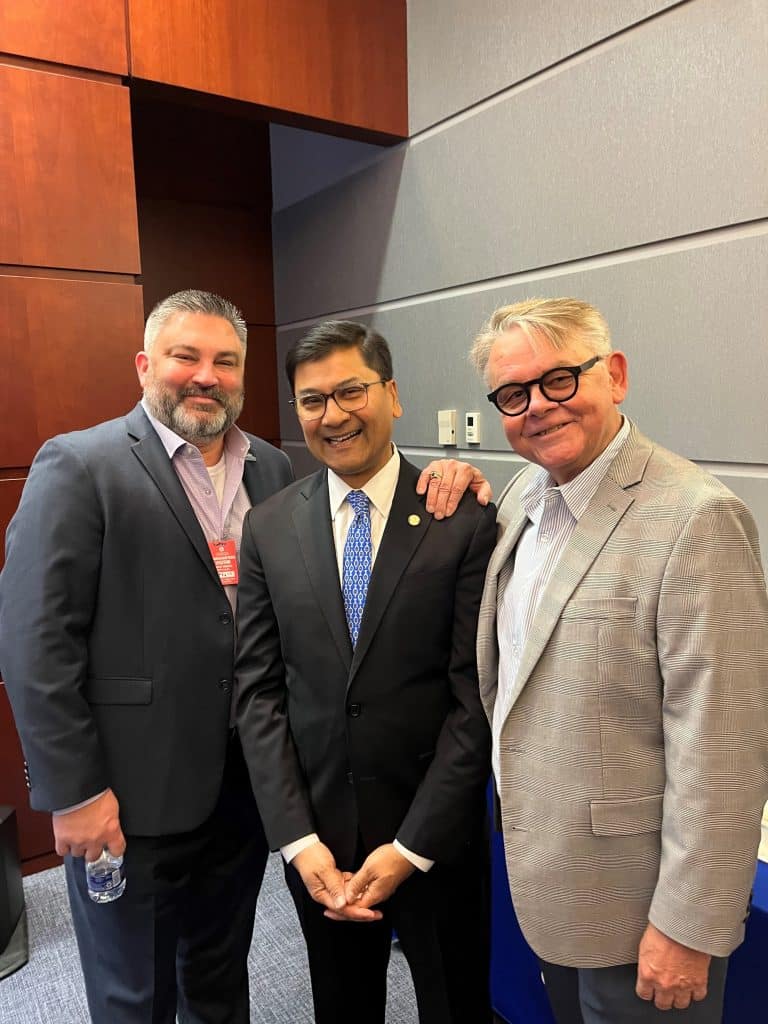
Jared Cassity, Administrator Bose, and Greg Hynes
Cassity went on to say, “In an era of political figures who focus on headlines and photo ops, Bose’s leadership was a reminder that true public service is about humility, dedication, and a commitment to serving the people. Amit Bose never lost sight of who he was working for, the workers who make the American economy run.”
“Under his leadership, the FRA didn’t just serve the railroads,” President Ferguson added. “It served railroaders. And for that, we will always be grateful.”
The Department of Transportation held a press conference today to thank Bose for his job well done. Fittingly, the press conference was held in the same room where less than a year ago, Bose stood shoulder to shoulder with Brothers Ferguson, Cassity, and Hynes to announce the finalization of his administration’s 2-Person freight rail crew rule. The significance of the setting wasn’t lost on SMART-TD’s leadership.
As Amit Bose moves on from his position as FRA Administrator, SMART-TD extends its sincerest thanks to him and his staff for their outstanding service and the improvements they brought to the rail industry. Amit’s legacy will undoubtedly serve as a model for future FRA Administrators, one who understood that the government’s true role is to serve the public, especially those who work tirelessly behind the scenes to keep the wheels of America turning.
“We were lucky that our rail members were a large part of the public that Amit chose to serve,” said Ferguson. “And we hope his example will inspire future FRA leadership to continue to work for the betterment of those who make this industry what it is.”