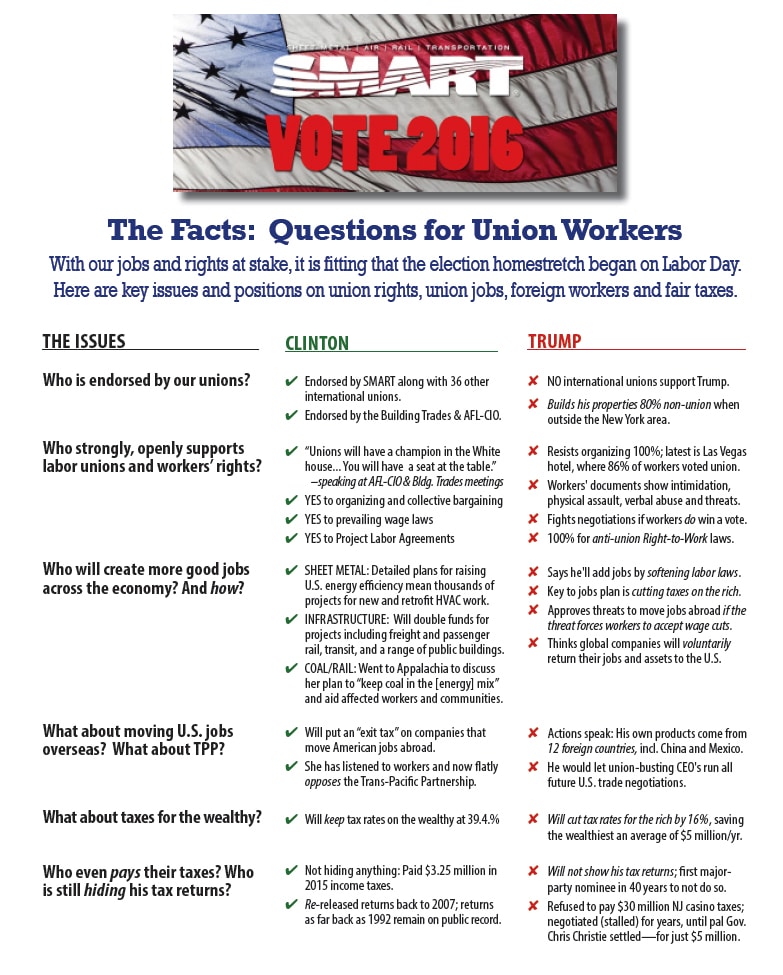
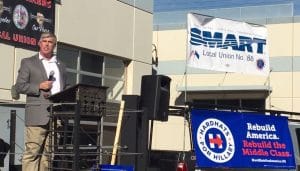
Sellers focused on the grassroots efforts underway in Nevada and across the United States as SMART members have taken the lead in ensuring their voices are heard on election day.
Click here to view the video
Author: paul
Sheet metal apprentices from training centers across Maryland, Pennsylvania, Delaware and New Jersey competed earlier this year in the region’s first apprenticeship contest in seven years.
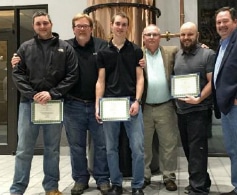 Sheet Metal Local 19 in Philadelphia hosted 22 apprentices from 8 locals to compete in second-year, third-year and fourth-year categories. Contestants were chosen through testing at their local level, and the top apprentice in each year from each local attended the regional competition.
The event was open to states in Region 2, one of 12 regions across the U.S. and Canada served by the International Training Institute (ITI), the education arm of the unionized sheet metal, air conditioning and welding industry.
Apprentices tested their skills with a digital written exam administered on the TotalTrack system; drafting, fabrication; and for the fourth-year apprentices, welding.
First-, second- and third-place winners took home cash and, of course, bragging rights.
• Second-year: James Hultberg, Local 12, 1st place; Paul Farkas, Local 25, 2nd place; and Jack Veasey, Local 19, 3rd place.
• Third-year: David Holzer, Local 12, 1st place; Dana Yerkes, Local 19, 2nd place; and Julian Ortiz, Local 25, 3rd place.
• Fourth-year: Dustin Bezuk, Local 12, 1st place; Thomas Curry, Local 19, 2nd place; and Kevin Hughes, Local 22 3rd place.
While other contests allow all apprentices to compete by skills, Region 2 kept categories specific to the level (year) in the program.
“Everyone covers the same skills in the second, third and fourth years. We stuck to what the second-year apprentice should know, what the third-year apprentice should know, what the fourth-year apprentice should know,” said Norbert Klusmann, Training Coordinator for Local 100 in Suitland, Maryland and Region 2 Chairman.
“What it comes down to is execution. The students shouldn’t have a hard time. The judges should have a hard time. These are the best of the best.”
“The morale was a huge thing for us,” Frick added. “We wanted our apprentices to be on a level playing field. No surprises. They’re all winners as far as we’re concerned.”
Forum for communication
The general goal of the contest was simply to get apprentices, instructors and training coordinators from across the region to network, share ideas and help one another make their programs better.
Keith Schettler, a new coordinator at Local 12 in Pittsburgh, started as a skeptic and quickly turned into the contest’s cheerleader. As well as giving his apprentices a good learning experience, he took the opportunity to learn from seasoned instructors and coordinators – an important part of growing as an instructor, Schettler said.
“Without the contest, it builds complacency in the program,” he added. “It was a great way as a new coordinator to judge where we were as a training center. We can’t sit back on our laurels. This is a competitive work force. If you don’t have people who are willing to compete, you’re not going to get that job. You can’t put a value on this for the region.”
The competition not only fired up the apprentices, it inspired instructors and coordinators to step up their programs back at home, Schettler said.
“It let the true focus of education shine through,” Schettler said. “It showed the apprentices where they needed to be, but it also allowed us to evaluate ourselves.”
Klusmann added, “These apprentices were bonding. That’s the stuff that made it go well. The apprentices were already talking about next year.”
Sheet Metal Local 19 in Philadelphia hosted 22 apprentices from 8 locals to compete in second-year, third-year and fourth-year categories. Contestants were chosen through testing at their local level, and the top apprentice in each year from each local attended the regional competition.The event was open to states in Region 2, one of 12 regions across the U.S. and Canada served by the International Training Institute (ITI), the education arm of the unionized sheet metal, air conditioning and welding industry.
Apprentices tested their skills with a digital written exam administered on the TotalTrack system; drafting, fabrication; and for the fourth-year apprentices, welding.
First-, second- and third-place winners took home cash and, of course, bragging rights.
• Second-year: James Hultberg, Local 12, 1st place; Paul Farkas, Local 25, 2nd place; and Jack Veasey, Local 19, 3rd place.
• Third-year: David Holzer, Local 12, 1st place; Dana Yerkes, Local 19, 2nd place; and Julian Ortiz, Local 25, 3rd place.
• Fourth-year: Dustin Bezuk, Local 12, 1st place; Thomas Curry, Local 19, 2nd place; and Kevin Hughes, Local 22 3rd place.
While other contests allow all apprentices to compete by skills, Region 2 kept categories specific to the level (year) in the program.
“Everyone covers the same skills in the second, third and fourth years. We stuck to what the second-year apprentice should know, what the third-year apprentice should know, what the fourth-year apprentice should know,” said Norbert Klusmann, Training Coordinator for Local 100 in Suitland, Maryland and Region 2 Chairman.
“What it comes down to is execution. The students shouldn’t have a hard time. The judges should have a hard time. These are the best of the best.”
“The morale was a huge thing for us,” Frick added. “We wanted our apprentices to be on a level playing field. No surprises. They’re all winners as far as we’re concerned.”
Forum for communication
The general goal of the contest was simply to get apprentices, instructors and training coordinators from across the region to network, share ideas and help one another make their programs better.
Keith Schettler, a new coordinator at Local 12 in Pittsburgh, started as a skeptic and quickly turned into the contest’s cheerleader. As well as giving his apprentices a good learning experience, he took the opportunity to learn from seasoned instructors and coordinators – an important part of growing as an instructor, Schettler said.
“Without the contest, it builds complacency in the program,” he added. “It was a great way as a new coordinator to judge where we were as a training center. We can’t sit back on our laurels. This is a competitive work force. If you don’t have people who are willing to compete, you’re not going to get that job. You can’t put a value on this for the region.”
The competition not only fired up the apprentices, it inspired instructors and coordinators to step up their programs back at home, Schettler said.
“It let the true focus of education shine through,” Schettler said. “It showed the apprentices where they needed to be, but it also allowed us to evaluate ourselves.”
Klusmann added, “These apprentices were bonding. That’s the stuff that made it go well. The apprentices were already talking about next year.”
In this video, SMART TD’s New Jersey Legislative Director Dan O’Connell discusses the effect a Trump Presidency would have, especially its negative consequences for SMART TD members.
 More than 30 contractors, training coordinators, business agents, business managers, safety directors, instructors, SMART and SMOHIT executives and strategic partners from across the country gathered for the second Safety Champions Conference and Safety Awards hosted by the Sheet Metal Occupational Health Institute Trust (SMOHIT) Sept. 12 and 13 in Scottsdale, Arizona. A two-day event this year, the conference featured keynote speaker Phillip Ragain, director of research and development for The RAD Group, and the discussion, “Generative Safety Culture and Mechanisms that Produce It.”
The conference’s second year was a continuation of last year’s discussion, “What is a Safety Champion?” said Randall Krocka, SMOHIT administrator.
“Our goal is to make safety as natural as breathing,” added Krocka during opening remarks. “We’re here to learn together and share ideas, because we’re all partners in keeping our people safe. It starts with leadership. This is a room full of leaders who take ownership of safety.”
During the keynote, participants worked together in a series of breakout sessions to discuss how to create a positive safety culture in the industry one contractor, and one training center at a time.
Ragain discussed the five rungs of the Safety Culture Ladder, from pathological, where safety is considered a burden and a nuisance, all the way up to generative, in which workers at all levels feel as if they are their “brother’s keeper.”
“We need to get to a place where people at all levels feel personally responsible for safety,” Ragain said. “Where the workforce is fully engaged. Where people take initiative to improve safety, even when their efforts go unrecognized. The thought process is, ‘We are never safe enough.’ It takes constant effort by everyone. And it all starts with leadership.”
Through the workgroup sessions, contractors, training coordinators, safety managers, and business agents and managers put their heads together to brainstorm ideas. One fact Ragain shared: people speak up only 39 percent of the time when they see an unsafe situation.
This led to an important question that teams were challenged to answer: How can leaders create a context in which people will be more likely to intervene during an unsafe situation?
“Sometimes it’s as simple as saying ‘Thank you for looking out for me,’ Ragain said. “Even if the person intervening is wrong, just saying that can drive the culture of intervention.”
“We’re working together,” added Kris Benson, an instructor at Local No. 66. “We all need to share in the responsibility of safety because it affects all of us.”
The conference opened with the annual Safety Champion Awards and recognition dinner. Winners honored for their efforts in safety include Tim Myres, apprenticeship and training trust at Local No. 20 in Indianapolis; Michael Sapien, full-time instructor at Local No. 359 in Phoenix, Arizona; Sheet Metal Workers Local No. 22 in Cranford, New Jersey; James Walton and Robert Dickamore from Superior Air Handling for the Mox Project in Aiken, South Carolina; Cindi Bell and Diane Patterson from California Sheet Metal in El Cajon, California; and John Santivasci, Jr. CMC Sheet Metal in Capitol Heights, Maryland.
Winners of the second Safety Design Contest also were acknowledged, including Jeff King from Local No. 33 in Toledo, Ohio; George Plane from Local No. 67 in San Antonio, Texas; and Chris Caricato from Local No. 206 in San Diego.
Superior Air Handling won for the second consecutive year for its work at the Mixed Oxide Facility, known as The Mox Project, at the Savannah River Site. The company has reached a milestone of more than 1.75 million safety man-hours, which amounts to seven years without a lost-time injury. The company expects to hit 2 million this spring.
“These awards are for the guys. Without them, I don’t have a job,” said James Walton, safety manager and certified health and safety technician. “They’re the reason I get up and go to work every day.”
Through the labor-management partnership, Krocka plans to “think of this as an ongoing conversation” during the year that will continue through to next year’s conference, he said.
“We need to recognize this is an area where labor and management share the same goals. We all want to see our members go home every night with their fingers and limbs intact,” said Rich McCleese, general secretary/treasurer for the International Association of Sheet Metal, Air, Rail and Transportation (SMART) workers. “We all win when our members are safe and employed.”
Part of the initiative is SMART MAP (Member Assistance Program), a training program that educates members on how to help their peers find professional help for their problems and addictions. During training, members also are taught what avenues are available to them as union members, said Chris Carlough, SMART education director.
In the last two years, 250 members have undergone training. The remaining session for 2016 is Nov. 7 – 10 in San Diego.
Programs like SMART MAP and the Safety Champions Conference have the same goal, said Michael McCullion, SMACNA director of safety and health.
We are one month out from election day. Now is the time to get involved. Visit www.SMARTVote2016.org to sign up or text SMART to 90975 (message and data rates may apply). Click on image to play the video.
With Hurricane Matthew already having cost destruction and loss of life within the Caribbean, we urge all members in its path to prepare themselves for its eventual arrival. Visit www.Ready.gov for more information.
Seattle’s Sheet Metal Local 66 has a new leadership development program which has passionately embraced the concept of trade unionism.
The journeywomen have taken the initiative to build a support network for all working women throughout the Seattle Local Union, having committed to mentor the 41 female apprentices in the current 400-member class of five-year apprentices.
Business Manager Tim Carter opened the training by outlining the importance of the program on the first day, saying “The deeper we dig into the topic of women’s rights in the workplace, the more we realize that mentoring programs for our female apprentices are long overdue; they will serve as a safe place for our female apprentices to share situations with their mentors, which will help our Business Representatives find resolutions for the issues our Sisters are facing.”
Connie Ashbrook, Executive Director of Oregon Tradeswomen Inc., a nonprofit organization dedicated to promoting success for women in the trades, and her Advocacy Program Manager, Tiffany Thompson, led a training session on the unique problems women in the trades face, including sexual discrimination and harassment.
The session touched on identifying, addressing and eliminating harassment and on the ability to identify behaviors that indicate harassment and discrimination beyond what is legally defined.
JATC Trustee and Women’s Committee Champion Vanessa Carman has been a key architect in setting this initiative in motion.
“I feel that providing a support system for our Sisters will have a huge impact on retaining our female membership,” Carman said. “Beyond that, there are many other benefits to having a mentorship program: providing support, morale, diversity and pride as well as building confidence in our future leadership.”
SMART Education Director Chris Carlough led a discussion centering around the development of mentoring and peer programs, helping the local union adopt the type of program they were going to build.
“This is more than just a class highlighting the serious issue of sexual harassment,” Carlough explained. “We are building a network of compassionate union members—both women and men—to encourage and support all of our members in their work and family life.”
“The long term goals of this program will include how to change the culture of our union to end bullying and harassment—which will make our workplaces safer, more productive and just a more decent place to work.” Carlough added.
With “work cut out for us,” members up to challenge
“I left the two days of training feeling a wide range of emotions, but most of all I felt hopeful that things will change now that our union is fully aware of the harassing environment on jobsites,” said SM Local 66 shop foreman Martha Holly.
Holly added, “Change will not happen overnight; we all know that. In the future I hope all women in our trade feel supported enough by our women’s committee to have the courage to say, Enough! We deserve to work in a respectful workplace. The women of Local 66 have our work cut out for us, but we are all up to the challenge!”

Fresh from the vice presidential debate, Democratic candidate and Virginia senator Tim Kaine spoke at a rally at Local 19 in Philadelphia where he spoke about his and Hillary Clinton’s economic vision for America.
Speaking about Donald Trump’s possible failure to pay taxes like other Americans, Kaine noted that it “makes me very, very angry” since he knows first-hand with his own son currently serving in the Marine Corps the sacrifices that American troops make and the support Trump denies them.
Referring to the $916 million loss Trump claimed on his 1995 taxes, Kaine noted “I guess it takes a lot of genius to lose a billion dollars.” He asked if “this is the kind of genius you want running the whole American economy? You got to be kidding me.”
Motivating the standing room only crowd of union members and Philadelphia activists, the son of a union iron worker reflected that “It’s close. Just eight days ago it was even. It looks pretty good now, but I’m not sure what’s going to happen in the next eight days.”
“In every election, I put this thought in the back of my head — that I’m the underdog until I win it,” Kaine said. “That’s how you have to run every race.”
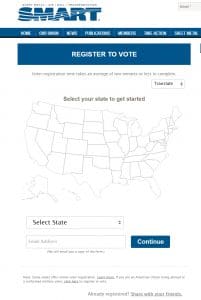 To give you every chance to make your voice heard this November. Check your voter egistration status and get automatically registered (states with online registration only) at this link.