
Text SMART to 90975 to download the SMART Union app or click here to download the app via the web.
Author: paul
A new Gallup poll shows 52% of Americans believe labor unions benefit the broader U.S. economy, while only 41% believe unions hurt the economy. Although that is still below the historical norm, this it is the most positive Americans have been about unions in a decade and reflects a turning away from the onslaught of anti-union news and propaganda elicited by heavily financed billionaire backed groups seen in recent years.
This represents a 7-point rise since 2011 and it is the most positive Americans have been about the economic effects of unions since before the Bush Administration’s Great Recession of 2007.
In addition, seventy percent of respondents reported back that think unions help members of the union and 55 percent believe they are a positive contributor to companies where workers are unionized.
While Union membership has been on the decline for decades, a recent study by the Economic Policy Institute (EPI) linked wage stagnation during that period to that decline:
According to the Economic Policy Institute study, union membership among men in the private sector dropped from 34 percent in 1979 to just 10 percent in 2013. Among women, unionization has dropped from 16 to 6 percent in the same time period. A study released on Tuesday by the EPI points to declining union membership as one cause of wage stagnation among all Americans.
Click here for the Gallup poll.
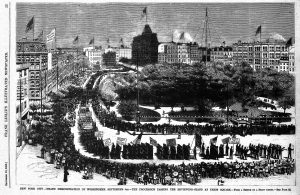
The New York City Central Labor Union held the first Labor Day on September 5, 1882—exactly 134 years before this year’s holiday. Then as now, it is a day for enjoyment and for reflection, for remembering the struggles of the past and recommitting to our own work of today and tomorrow.
The power of organized Labor—of the millions of men, women, and families who unite to win respect in the workplace—is never more visible than in these national elections. We have a long history of effective political action, but now it’s time to raise the bar.
After decades of anti-union greed and assault by radical conservatives, our issues–workers’ issues—are once again at the forefront of our national agenda. We have a bipartisan group of candidates—for President, Senate, Governor, and other offices—who openly support unions and union jobs. We should return that support with boots on the ground and with every vote we can deliver.
In 1882, those first Labor Day planners called for a parade and festivities. What stands out is their stated goal: to demonstrate “the strength and esprit de corps of the trade and labor organizations.”
Election season is our time to recommit to fully and clearly demonstrating our strength and union spirit.
From September 5 to November 8, each of us should commit to applying the collective power of 202,000 SMART households. We should put in our time, our energy, and our ballots—along with millions of other union families across America—to support those who support workers, our issues, and our rights.
Let us celebrate Labor Day 2016 in the best possible way: by raising the bar on our efforts to elect candidates who support working-family values—union values.
Joseph Sellers, Jr.
General President
The U.S. Court of Appeals for the Seventh Circuit has found that Unions have the First Amendment right to display an inflatable rat as part of an area standards campaign. Furthermore, localities that attempt to prohibit the use of inflatable rats may be infringing on that First Amendment right.
The decision was made in Laborers Local Union No. 330 v. Town of Grand Chute. The case overturned a lower court decision which originally dismissed the Union’s First Amendment claims. The Town of Grand Chute in Illinois had ordered the LIUNA local to remove an inflatable rat that was being used as part of an area standards campaign. Though the rat was located on a public right-of-way next to the construction project the town still acted to remove the inflatable after the owner of the construction site called to complain.
The Union took the matter to Federal Court claiming a violation of the First Amendment right to engage in free speech. The Union noted that Grand Chute had never enforced its own sign ordinance against other signs around town or even against the rat prior to the property owners complaint. A lower court had originally dismissed the Union’s complaint, arguing that the sign ordinance existed to protect local aesthetics. The Federal Court found that the Union’s free speech was in fact violated due to inconsistent enforcement of the town ordiance and ordered the case be returned back to the District Court with a list of detailed instruction on how the case is to be reviewed.
In a summation of its opinion, the Federal court ruled that incomplete enforcement of the town’s own ordinance “is not an adequate answer to a contention that unit of government has allowed some speech and stifled other speech, choosing which ideas can be conveyed.”
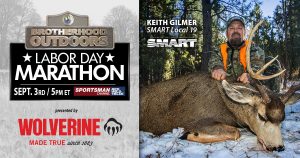 The Union Sportsmen’s Alliance (USA) and Sportsman Channel are teaming up again to honor the American workforce during the 2016 Brotherhood Outdoors Labor Day “Salute to the American Worker” – Presented by Wolverine, which airs Saturday, Sept. 3, from 5-8 p.m. EST.
Over the course of six consecutive episodes, Brotherhood Outdoors will examine guests’ family and work lives while showing viewers that regular, hardworking men and women have what it takes to get out there and hunt and fish with pros Daniel Lee Martin and Julie McQueen.
“Brotherhood Outdoors is a testament to those who make our American way of life as spectacular as it is today,” said USA Deputy Director Mike d’Oliveira. “When I watch some of these episodes, I think two things: First, I’m reminded of the hard work and dedication it takes to make our country tick, and secondly, I see all of these great stories from the men and women to make this all happen. It makes me proud that we have the opportunity to showcase their unique trades skills and their passion for the great outdoors, and we are appreciative of Wolverine Boots to help us tell this story.”
The show’s relatability to the “everyman” and its intimate glimpse into its guests’ lives are what make Brotherhood Outdoors a truly unique show in its category.
Schedule for Sept. 3 (EST):
5:00 p.m. Sheet Metal Worker (SMART Local 19), Keith Gilmer sees 100 deer the first day of his dream hunt, but he decides to wait patiently for a big Montana muley to appear from amidst the abundant whitetails and give him the perfect shot.
5:30 p.m. Laborer (LiUNA Local 5), Mark Kezler feels the vibration as toms come drumming, spitting and gobbling within 100 yards. Yet the wise old South Dakota Merriam’s turkeys dodge the plan again and again as hosts Daniel Lee and Julie try to lure them within Mark’s range.
6:00 p.m. Painter (IUPAT DC 30, Local 157), Jason Gaal, armed with a flashlight to spot glistening eyes, prowls for Florida gators. Suspense runs high with the big, toothy lizards as host Daniel Lee ends up in the murky, gator-infested waters.
6:30 p.m. Auto Worker (UAW Local 838), Aaron Heying overcomes paralysis on this New Mexico bear hunt with help from his wife as hosts Daniel Lee and Julie and their guide carry Aaron, his wheelchair and equipment through the woods to get in range of his first bear.
7:00 p.m. Plumber (UA Local 68), Mike Cramer wards off unusually warm temps with dancing and one-armed push-ups as he waits for his shot at a Colorado bull elk once the snow finally begins to fall.
7:30 p.m. Roofer (Roofers Local 23), Derek Carrington heads to Kansas to hunt in one of the best trophy-producing units in the state, and it all comes down to the wire on this heart-pumping whitetail adventure.
Presented by Bank of Labor, Brotherhood Outdoors is also sponsored by the following unions, contractors and corporate partners: Buck Knives, Carhartt, Burris/Steiner, International Association of Machinists and Aerospace Workers, International Association of Sheet Metal, Air, Rail and Transportation Workers, International Brotherhood of Boilermakers, International Brotherhood of Electrical Workers, National Electrical Contractors Association, and United Association/International Training Fund.
To find Sportsman Channel in your area click here.
 On September 11–13, SMOHIT (Sheet Metal Occupational Health Institute Trust) will host the second annual Safety Champions Conference and Awards at the Talking Stick Resort and Casino in Scottsdale, Arizona. The conference is open
to all members who contribute to SMOHIT and are approved by their Business Manager.
On September 11–13, SMOHIT (Sheet Metal Occupational Health Institute Trust) will host the second annual Safety Champions Conference and Awards at the Talking Stick Resort and Casino in Scottsdale, Arizona. The conference is open
to all members who contribute to SMOHIT and are approved by their Business Manager.This event, part of a continuing plan to create improved safety culture in the sheet metal industry, will feature workshops; participation from workers, contractors, owners and speakers; skills development on safety culture and climate; and best practices involving safety and health.
In addition, nominations are currently being accepted for SMOHIT’s annual Safety Awards, which will be presented at the conference to recognize outstanding contributions expanding local health and safety programs for SMART SM members; training centers, organizations, contractors and deservi
ng individuals may qualify.
SMOHIT is also accepting original submissions for the second annual Safety Design Contest. Designs and slogans should feature a message about the importance of safety culture in the sheet metal industry. Members are encouraged to participate; winning designs will appear on promotional items and in future Funds materials.
Visit www.smohit.org to register for the Safety Champions Conference and for details on nominating a safety champion or submitting a safety design.
On July 26 and 27, 2016, the SMART-Mechanical/BMWED coalition engaged in further national negotiations with the National Carriers’ Conference Committee (NCCC) in Minneapolis, Minnesota.
During the negotiation sessions, the NCCC presented a very brief and generic presentation of the U.S. Class 1 freight railroads’ financial status. In short, the NCCC alleged that immediate and long-term changes in coal utilization require them to transition their current business model towards intermodal transportation. They further contended that intermodal is highly sensitive, and that in order to flourish under such a purportedly sensitive business model, the railroads would require extreme flexibility in the management of their resources (i.e., workforce) and materials. The NCCC then presented three very general work rule changes regarding contracting out, the performance of incidental work and simple tasks, and the utilization of qualified employees in technical and/or safety-sensitive positions. The NCCC further noted that in order for the Class 1 freight railroads to flourish under this new business model, they would need to bring health and welfare benefits to a “mainstream” level.
SMART-Mechanical BMWED coalition responded to the NCCC, first noting that their financial status presentation was rather one-dimensional and excluded the many areas where the railroads have also re-directed their business model to do rather financially well, despite losses in coal transportation. The SMART-Mechanical/BMWED coalition next pointed out that the NCCC’s proposed work rules were very general in nature so that a detailed response would come after the NCCC presented specific proposals couched in contract language. Lastly, the coalition reminded the NCCC that during the March 30 and 31, 2016 bargaining sessions, the railroads committed to performing an analysis of the Small Working Group’s (SWG) National Health and Welfare Plan findings, and that such analysis would take approximately two months to complete; however, it has been nearly four months since the railroads made that commitment.
The NCCC committed to having a complete financial presentation coupled with wage proposals, as well as a more detailed work rules proposal and a comprehensive response to the SWG’s analysis, for the scheduled September 14 and 15, 2016 negotiation sessions. Additional negotiation sessions are scheduled for October and November of this year.
When asked about the status of national bargaining, BMWED President Freddie Simpson said, “National negotiations take longer than anyone desires. But in order for us to engage in meaningful discussions with the railroads, we need to have all the facts and information made available to us and we need to thoroughly examine it. We will not bargain blindly over anything. All points of concern will be fully-investigated, regardless of the amount of time that is necessary to make informed decisions. Our coalition will continue to engage with the railroads for as long as it takes to reach a fair agreement.”
Earlier this year, Republicans in the West Virginia legislature voted to turn the state into a Right-to-work state.
This week organized labor got its first shot at fighting back.
The AFL-CIO and 10 other union groups successfully attained an injunction that blocks the state’s Right-to-work law, which took effect earlier this summer. The law required unions to extend benefits to all workers within a workplace, even though who do not pay their fair share. Unions argued that this was an unfair taking of property and resources.
And a Kanawha County judge ruled that Unions did enough to prove that the law could hurt workers, stating that enforcement of the law could “cause irreparable harm to unions and union workers.” :
Proponents of the Right-to-Work measure claimed it would stimulate new jobs in the state, yet, six months later, not a single new job has come back to the state.
Republicans in the state legislature intend to appeal the injunction. No date has been set for any future hearings.
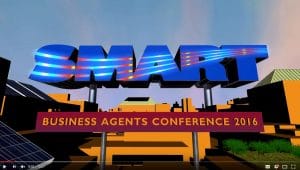 Click on the image, or here, to view how local unions are “Raising the Bar” and responding to members, the community and the needs of the industry as SMART continues to grow and enhance its operations.
This video looks at four locals in Seattle, Edmonton, New Mexico and Alabama and how they are rising up to meet different challenges and seize opportunity as it presents itself.
“Nobody will ever deprive the American people of the right to vote except the American people themselves and the only way they could do this is by not voting.”
-Franklin D. Roosevelt
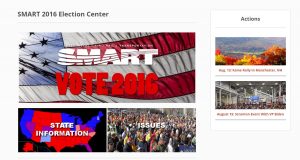 SMART has created an Election 2016 clearinghouse, specifically designed for SMART members, that provides links to state voter registration hubs where members can verify whether they are registered to vote, file an online voter registration application and also learn about the issues facing members of the sheet metal and transportation industries. Members can also learn about events occurring near where they live and participate in them.
Visit SMARTVote2016.org today to ensure your voice is heard in the November elections.