
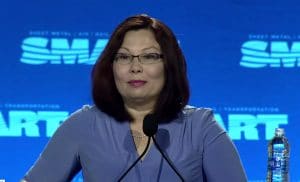
Congresswoman Tami Duckworth, currently running for U.S. Senate in Illinois, delivered a heartfelt and inspirational address on Tuesday at the SMART Sheet Metal Business Agents’ Conference in Chicago, IL.
Her speech detailed not only the experience she faced when her helicopter was shot down over Iraq, but also included her strong praise for her fellow service members who used their resourcefulness and skill garnered from their training as building trades members to ensure their unit was kept safe and battle ready. This included the sheet metal workers who reinforced their vehicles with their know how garnered during their civilian life and the electricians who rewired the faulty electricity and protected their fellow service members from injury and electrical shock.
Click here for the full video.
Author: paul
The union labels are an essential tool for enforcing contracts and protecting jobs, wages, and benefits. Union officials work hard to negotiate the best contracts possible, and the labels are essential to protecting those contracts, union jobs, and wages. They play a central part in preventing a race to the bottom in which contractors try to use non-labeled products or pay union workers less and less.

By using the labels, we protect existing union jobs, secure more work, and protect union wages. And when more sheet metal workers participate in the union’s health care plan and pension fund, those benefits are better for everyone. In other words, all union members are better off if we work together to make the label system work. By standing up and supporting each other, we stand up and support ourselves. Solidarity works.
For individual sheet metal workers, it means more work, better pay, and healthier benefits. The job you save may be your own. And the more union members participating in the health care and pension systems, the better those benefits will be for each union member.
Visit the Label It. Scan It. Report It site for more information.
You can also text SMART to 90975 to download a copy of the SMART Union Label app.
For decades, when a member of the International Association of Sheet Metal Air, Rail and Transportation Workers, or SMART, had a personal problem, they would turn to a fellow member for help. For small issues, friends and mentors dispensed good advice just fine. However, for those members with deeper problems such as thoughts of suicide or drug and alcohol abuse and substance use disorder, friends and mentors were lost as to what advice to give.
The Sheet Metal Occupational Health Institute Trust (SMOHIT) is working with SMART’sMember Assistance Program (MAP), formally the Union Member Assistance Coordinator (UMAC) program, to train members to guide their peers in the direction of professional assistance such as therapy, rehabilitation and eventual recovery. Volunteers in local unions undergo four-day training sessions to learn how to speak to those in distress, where to find services and how to navigate health benefits.
Training sessions began in 2013, and they have been a consistently offered every year since 2014. In 2015 and 2016, in six training sessions, 250 members were trained as MAP volunteers. Remaining training sessions for 2016 are Oct. 3-6 in Fort Lauderdale, Florida and Nov. 7-10 in San Diego.
“Before, there was an informal way of taking care of each other,” said Chris Carlough, education director for SMART. “The country is riddled with drug and alcohol abuse. It’s a huge problem, and our union is taking the lead in addressing this vital issue that has become a national epidemic.”
“The MAP program takes trusted members in their locals – people members already turn to – and gives them the tools they need to actually help their brothers and sisters,” added Randy Krocka, SMOHIT administrator. “It enables them to save lives, save jobs and save families.”
The recession took its toll at Sheet Metal Workers Local No. 85 in Atlanta, where there were more issues to tackle than drug and alcohol abuse. For Randy Beall, business representative for the local, the training gave him the answers to questions members have been asking him for years.
“I’ve seen a need. I’ve seen many people fail a drug test. I’ve seen many people have troubles. I’ve seen many people lose a job,” said Beall, one of two MAP volunteers at the local. “But it’s more than seeing a need. It’s more than drug problems. Most of the time, the issues we’ve dealt with in the last four years have been along the lines of depression and loss of work, which leads to marital issues as well.”
It’s not easy to get sheet metal workers to open up, Beall said. Building a trusted network inside the local has helped Beall seek out members in crisis instead of waiting for them to knock on his door. Knowing what not to say is just as important as what to say, he added. Training also provided him avenues to seek out community services and benefits to help members.
“We’re not sharers,” Beall said. “But at any given time anyone can go through a bout of depression. Many people battle their way out of it. It’s the person who can’t dig out of it. That’s who we’re looking for.”
Bill Salvatore, a part-time MAP coordinator at Local No. 28, which serves Metropolitan New York and Long Island, came out of retirement to take the position. During his career, he left the union for five years to become a peer counselor at Beth Israel Medical Center, after battling his own addictions.
“This is something that has been a long time coming. It’s been needed for awhile,” Salvatore said. “I absolutely feel like this program can save lives and enhance the quality of life for members who don’t know what to do.”
Salvatore’s office was renovated at Local No. 28 to allow for a private entrance to encourage more members to come forward with any problem on their minds.
“I never know what’s going to be on the other end of the phone when someone calls me,” Salvatore said. “It’s very rewarding work. It’s the opportunity of a lifetime to be part of a program like this. And I was enjoying my retirement. I recommended it to everyone. To come back to work and do this was a privilege.”
Although the program has been active for two years, it’s a slow process – training members and advertising it to those who need help takes time. In Atlanta last year, Beall said the MAP program helped an average of 10 people. In this case, he added, the numbers don’t tell the whole story.
“It doesn’t sound like a lot, but if you keep one person from turning to a bottle or one person from dying by suicide, that’s a lot,” Beall said.
It’s all a part of SMOHIT and SMART’s master plan to expand the program across all locals, Carlough said. In 2017, trainings will move to locals requesting it, giving them more volunteers to help more members.
“We’re building the awareness of the issue, and then we’re going to go deep into the unions and train as many people as we can to build that network of support,” he added. “It is one of our most popular programs right now. There’s a strong need for it. It’s a big problem going on in our members’ families’ lives right now. That’s what we really like to focus on – it’s all about the health and well-being of our union family.
The Sheet Metal Occupational Health Institute Trust (SMOHIT) was founded in 1986 to address the impact of decades-long asbestos exposure on those working in the sheet metal industry. To date, more than 55,000 sheet metal workers have been screened as part of its ongoing Asbestos Screening Program.
SMOHIT has since expanded its mission to operate on four separate but related tracks: monitoring and documenting the health of sheet metal workers as it relates to workplace exposures and hazards; providing safety information and training related to best safety practices on and off the job; acting as an aggressive advocate for the health and safety of its members with government and through likeminded allied organizations; and providing diet and exercise information to address the health and wellness of its members.
SMOHIT has adjusted its methods and messages to reflect feedback from local unions and the industry, and to address new safety challenges as they arise. The organization works directly with the International Training Institute (ITI) to provide training programs for the unionized sheet metal industry.
The Southwest/Gulf Coast Regional Council is Local 214, Baton Rouge; Local 68 of Dallas & Fort Worth; Local 67 of San Antonio; and Local 54 from Houston. Local leadership will not change. The new Council will be headed by Council President Tim McGrath with offices in San Antonio.

As in all U.S. markets, members of the south-central tier work for users and contractors operating in larger areas than ever. Covering from Texas to Mississippi, the Council can pursue employers and projects wherever the work or bidder may be.
General President Joseph Sellers, Jr., sees the Council as a way to leverage economies of scale for all members.
“Members deserve real efficiency in everything we do,” Sellers noted, “and the principle here is the same as member solidarity: locals will each be stronger by standing together.”
More organizing resources
With centralized operations, the Council will be able to streamline basic work of all kinds. Members will benefit from timely, efficient and effective funds collection; processing of dues; record keeping; field staff support; and from economies of scale in contracts with contractors, organizations, and outside vendors.
The largest benefit is in organizing and contractor outreach: the time and cost savings enable Locals and the Council to pursue opportunities with resources and staff from up to four Locals.
Given that SMART resources all flow from members’ hard-earned dues, the Council approach can bring added strength to priority #1: more work for more members.
This region is the heart of America’s energy industry. More processing means new projects and SMART man-hours. The new council helps us capture our share of this key sector.
Republican presidential nominee Donald Trump says he wants to bring jobs back home to America. Apparently the billionaire businessman also wants to give those jobs away to temporary guest workers.
Trump is currently looking to staff two of his Florida properties — the Mar-A-Largo resort in Palm Springs and the Trump National Jupiter golf course in Jupiter, FL — with workers who have come to the U.S. on seasonal H-2B work visas. Trump says he can’t find enough workers here at home to fill the positions, a claim that has been questioned:
An official at Palm Beach’s career services service told Buzzfeed last year that the agency had “hundreds of people in our database that would qualify for a lot of those hospitality jobs.” The agency now has 1,237 residents of Palm Beach Country interested in server, cook or chef positions, according to Buzzfeed.
Democrat Ken Woods was elected in May to a Council seat in Delaware’s New Castle County after the death of former Councilman Joe Reda. Woods defeated his Republican challenger with an overwhelming 70 percent of the vote and will serve the remainder of Reda’s four-year term, which ends in 2018.
Woods is a Business Representative for Philadelphia-based Sheet Metal Local 19, which also covers the entire state of Delaware. Reda, who he replaced, was a retired member of Local
19. Woods’ campaign focused on economic development to spur new high paying jobs for working families in his district.
In a statement on the victory, Woods noted that “special elections require a lot out of candidates, volunteers, and voters. With the help of my brothers and sisters in the labor movement, especially Local 19, we were able to secure a victory.”
Long active in political life, Brother Woods served as Chairman of the Democratic Committee in his district for nearly a decade and has also been an elected member of the Red Clay School Board since 2008.
Public and union offices run in the family; his father, J. Robert Woods, also held the positions of New Castle County Councilman and Sheet Metal Local 19 Business Representative. This is the first time in New Castle history that both a father and son have held the same position in government.

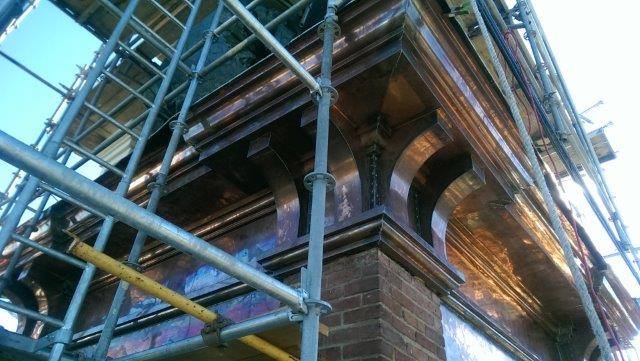
Dating back to 1863, Benson Science Hall was one of the first buildings constructed on the campus of Vanderbilt University in Nashville. Like any well-aged structure, renovations are required from time to time.
The current work was begun by members of SMART SM Local 177 (Nashville) working for Roofing Services and Solutions (RSS). The company fabricates and installs architectural sheet metal in Nashville, middle Tennessee and surrounding areas.
As is appropriate for a project on a stately 150-year-old structure, the members who work for this contractor
are highly skilled craftsmen that produce products that are not only aesthetically pleasing but exhibit a quality of craftsmanship that can only be achieved through intensive training and years of experience.
W
ith a long history of its own, RSS began in St. Louis, MO in 1895 and opened the Nashville location in 1937. Carlton McGrew who is Chairman of MHS Legacy oversees the operations; his son Matt McGrew is the Vice-President and Manager of the Nashville office. Their projects are highly specialized and do intricate work with copper, brass and other non-ferrous metals.
Jason Phy, the onsite foreman, said that due to the sensitive conditions surrounding the project, he and the field crew of Dustin Latham, Carson Ullreich and Tyler Williams had to use ropes and hand tongs to lift and lower just about everything that was used onsite. This includes the original pieces of the structure that had to be duplicated.
As the job progressed, they found out that parts of the underlying 100-year-old wood was rotted to the point of being not much more than powder. This started the process of replacing some of the existing structure.
The metal work fell to the shop crew led by shop foreman Jim Forester and journeyman/shop steward Marc Freudenthal with assistance from David Morgan, Chris Sullivan and Nick Monteleagre.
The demanding task of duplicating the existing metalwork was done by hand without the use of any plasmas, lasers or waterjets. The existing work was painted galvanized; this renovation replaced it with copper.
to actively bring manufacturing jobs back from overseas, to here in California. That’s something no one could have predicted 20 years ago.”Li concluded, “Good jobs making a quality, environmentally friendly vehicle are part of the 21st Century American Dream, and we plan to be making electric vehicles here in California for along time. I look forward to continuing to work with SMART in the years ahead.”
Eleven unions filed petitions in a local W.Va. court arguing that the state’s new “Right-to-work” law amounts to an illegal seizure of their property and resources. The bill was vetoed by Governor Earl Ray Tomblin, however, his veto was overrode by a Republican majority in the House of Delegates.
The legislation allows workers to opt out of paying union dues and instead serve as free riders – meaning take advantage of the benefits that come from a collectively bargained contract. The lawsuit contends that amounts to an illegal taking of unions’ property and resources, since state and federal labor laws require unions to negotiate contracts and provide representation to the non-union employees at “considerable cost” to union members.
The lawsuit also Brown v. Board of Education as well as the 1st and 14th Amendments:
It compares the right-to-work law with laws passed in Southern states in the 1950s as part of the massive resistance to the U.S. Supreme Court’s desegregation orders in Brown v. Board of Education, with legislation intended to discourage membership in the NAACP — laws that were ultimately overturned in court for violating 1st and 14th Amendment rights of free expression and association.
In April, a Wisconsin circuit court judge overturned that state’s right-to-work law in a case that made similar arguments. That ruling has been stayed, pending an appeal to the Wisconsin state Supreme Court.