
On April 13, 2026, Virginia Governor Abigail Span­berger signed a two-person rail crew (2-PC) bill into law, ending SMART-TD’s years-long fight for a legally mandated crew of at least two quali­fied people on all trains, locomotives or light engines transporting freight in the commonwealth.

As all rail workers know, having at least two qualified railroaders in the cab is crucial to safely operate trains, requiring an engineer to operate the locomotive and a conductor to monitor the tracks, manage the train and respond to emergencies. It is a common-sense safety measure for SMART-TD members, rail workers and communities along the tracks. However, railroad share­holders and corporate elites would happily do away with one or both of these positions, prioritizing profit over public safety.

By signing the bill, Governor Spanberger has actively ensured that in Virginia, trains are held to a high safety standard, and all crews have the required members needed to responsibly operate them.
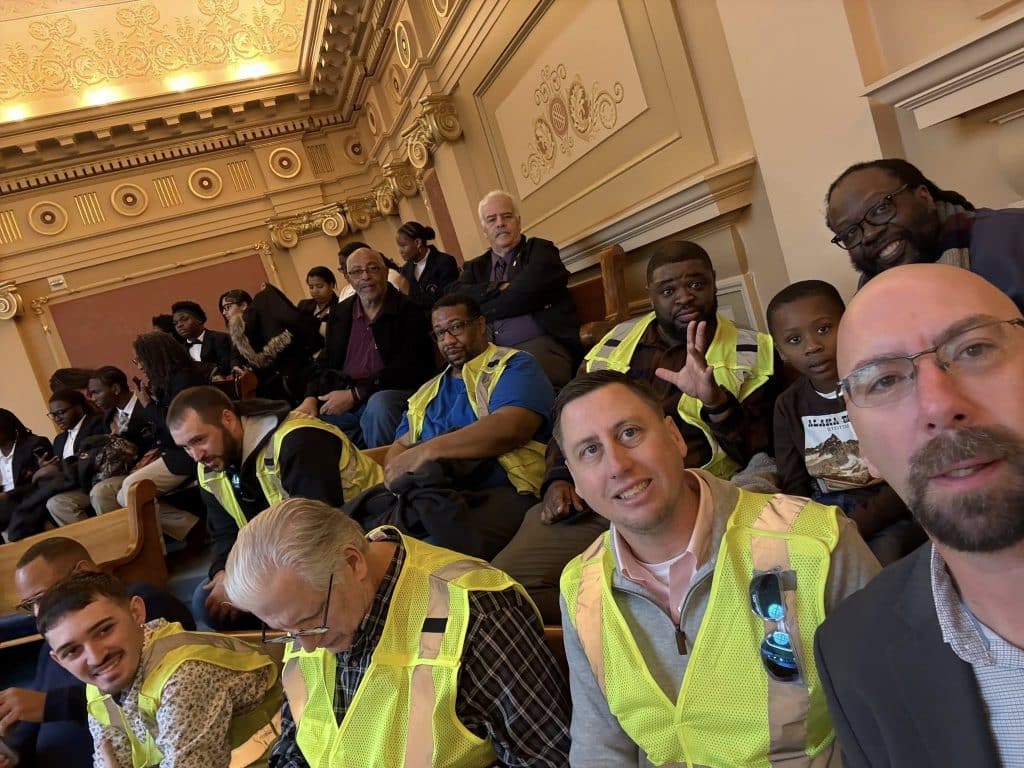
SMART-TD members packed the Va. capitol to make their voices heard

Newly elected gov. finishes the job

Cementing the 2-PC bill into Virginia law was a hard-fought battle that required a change in leadership to accomplish — demonstrating the importance of electing representatives who truly have our backs.

The same bill passed in the legislature two years ago as a bipartisan effort, but thanks to former Governor Glenn Youngkin’s late-night veto, it never became law. Youngkin’s veto showed how little he values public safety and the well-being of SMART-TD members compared to the benefits reaped by supporting big businesses and railroad shareholders.

SMART-TD members didn’t stop fighting for the bill after Youngkin’s veto. And fortunately, current governor and 2-PC supporter Spanberger righted her predeces­sor’s wrong, ensuring that trains traveling throughout the commonwealth will have a full crew on board. Spanberger’s actions proved that common sense and public safety should not be partisan issues, and that the 2-PC bill is a necessary step in the right direction when it comes to transportation rules and regulations.
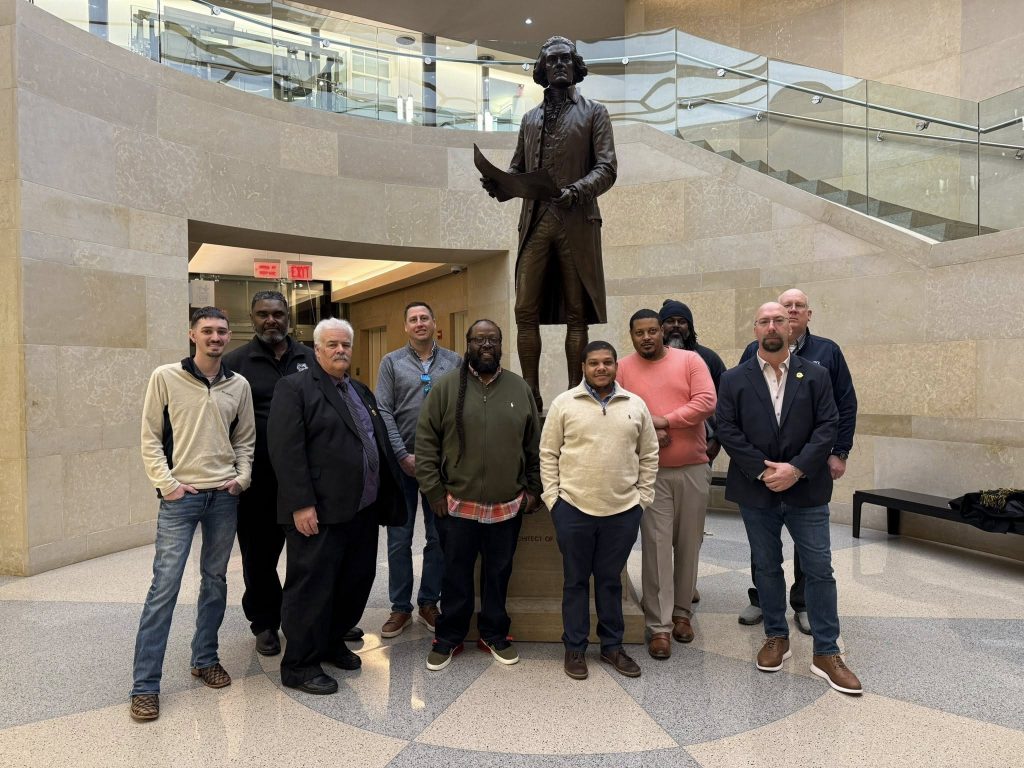
Members made this happen

This historic win was a direct result of the hard work and determination shown by Virginia Safety and Legislative Director Ronnie Hobbs and members who took action by showing up, speaking out and telling lawmakers that 2-PC benefits both rail safety and Virginia communities.

“I can’t thank our members enough for their work to get this passed,” emphasized Hobbs. “Lawmakers listened to their constituents and prioritized the safety of communities throughout the commonwealth. We’re proud to join the list of states where 2-PC is the law of the land and hope that it continues to grow!”
SMART-TD leaders, members and the public have been hit with a harsh reality. The Federal Railroad Administration is no longer on our side, and they aren’t even pretending to be a neutral party anymore.

They’ve picked a side, and they are 100% on team corporate railroads.

In the span of 48 hours in late April, the FRA dropped 11 final rules that make one thing clear: They are clearing the path for the railroads to do whatever they want, free of guidance and oversight, with hardly any consequences and even fewer workers.

You don’t need to read between the lines to see this reality. It isn’t subtle. FRA is telling SMART-TD and every railroader that the risk to your well-being is worth it for the carriers’ profit.

In fact, FRA Administrator David Fink said that he “want[s] to see the industry thrive,” and his method­ology for doing so is deregulation, noting during an April speech that “the previous administration, there wasn’t really that much done on the deregulatory side.”

Obviously, he plans to change that.

FRA administrator tells the world what he thinks

At a United States Department of Transportation (DOT) technology event hosted at DOT headquarters on Tuesday, April 28, Fink made it as clear as possible that the goal is to push new tech out “as soon as practical.” According to a report from Bloomberg, that includes autonomous railcars, additional AI monitoring of employees and systems designed to cut crews out of the picture altogether.

Fink, during his speech, specifi­cally pointed to Parallel Systems (a company actively working to operate freight trains without human crews) as the kind of inno­vation they want to move forward with. Interestingly, Parallel Systems’ testing of its technology and equip­ment was approved under the last administration. The difference, however, is that the approval came with conditional safeguards to keep the railroad system and the public safe.

This administration’s FRA is now working to reverse that.

Let’s connect the dots

They’re rolling back the rules that protect us while fast-tracking the tech­nology most likely to maximize profits.

That’s not a coincidence. That’s the plan.

The director and deputy director of SMART-TD’s National Safety and Legislative Department, Jared Cassity and Don Roach, were scheduled to be at the FRA’s technology demon­stration on April 28.

They didn’t go. After seeing what FRA pushed out as rulings in the days leading up to it, they made a point NOT to attend.

As Cassity said, “We aren’t going to be at a party celebrating the FRA’s new path and plan to eliminate our members’ safety, rights and ulti­mately their jobs.”

Roach and Cassity said they want to be clear about something: Their protest of the April 28 event wasn’t about being against technology.

It’s about what happens when you take trained railroaders out of the equation.

This job isn’t simple. It’s not predictable. It’s not something you hand off to a computer and walk away from. We move hazmat. We move heavy tonnage through cities, towns, crossings and yards every single day. Things go wrong.

Conditions change. Decisions have to be made in real time on the fly.

That’s what we do.

And now they want to strip that down while also weakening the federal regulations that are supposed to keep everything in check.

Reckless timing

On April 16, SMART-TD told rail members about a Cybersecurity Alert that we received from the FRA.

This warning was issued by the exact federal agency that stood before a microphone on April 28 and told the world that freight trains should rely on the systems most vulnerable to bad actors. It’s unfathomable that both of these statements came from the same place, 12 days apart from each other.

We’re in a world where cyber threats are real and getting worse. Systems get hacked. Networks go down. Bad actors look for ways to disrupt critical infrastructure.

And what’s the response from FRA?

Tie more of the operation to software, automation and remote systems. Allow the removal of the human beings who can actually respond when something breaks or intervene when systems get hacked.

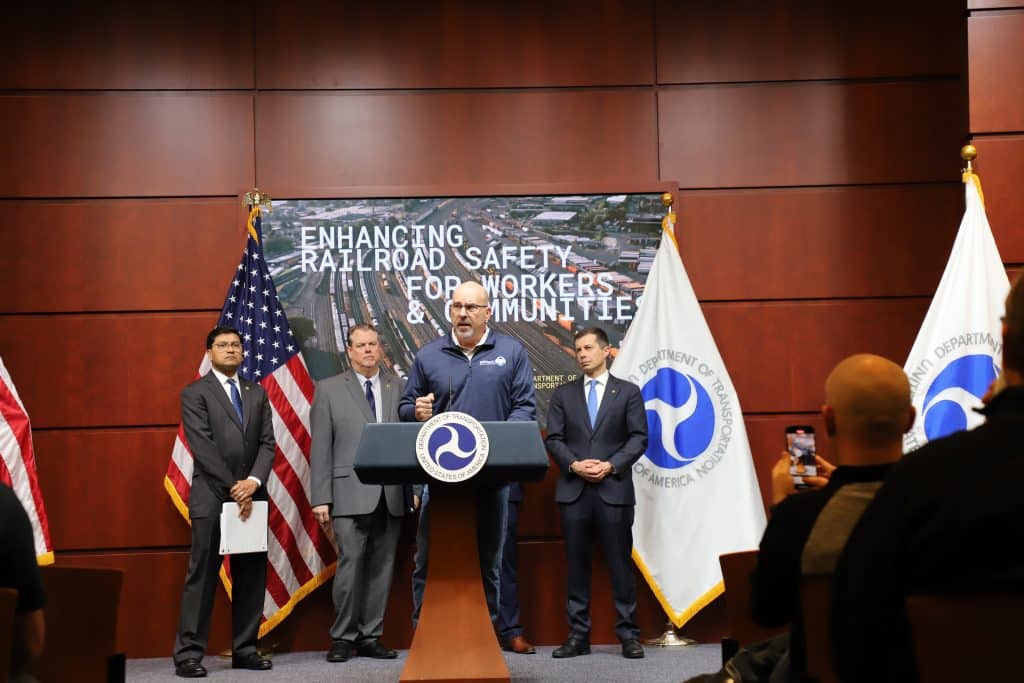
SMART-TD President Jeremy Ferguson speaks during the Biden administration FRA’s announcement of its two-person crew rule, as former FRA Administrator Amit Bose (furthest left) looks on
A new reality

It was just 2024 when the FRA finalized its two-person crew rule, a major win for common sense, communities and railroaders nationwide. Now, the FRA isn’t pretending to balance safety and industry anymore. They’re helping the industry overcome its biggest obstacle: dealing with a trained workforce and following the rules and regulations that protect it.

SMART-TD members are living this reality; you know it better than anyone. The railroads don’t want to train us. They don’t want to pay us. And they definitely don’t want to be held accountable to anyone but themselves.

We, their employees, are the “problem” they’re trying to solve.

And now we know Administrator Fink — who, not surprisingly, was the CEO of a railroad in his past job — is publicly pledging that the United States FRA is here to help them realize that vision of the future.

That was made clear in April.