President Donald J. Trump last week formally called on Congress to include the Railway Safety Act in the Surface Transportation Reauthorization Bill, urging Republicans to support the amendment before the House Transportation & Infrastructure Committee.
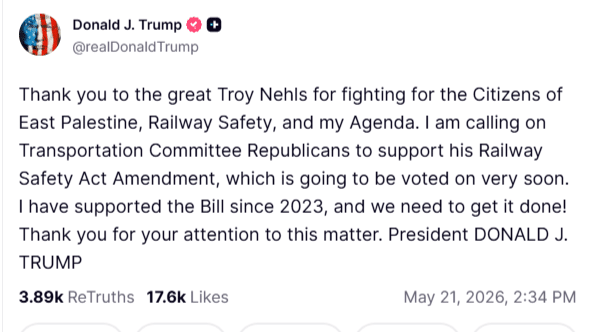
The statement immediately drew attention across the rail industry and among SMART-TD members who have spent years fighting for stronger safety standards, better working conditions, and protections against the relentless hedge fund cost-cutting that has reshaped the industry.

Most importantly, that support proved to be a major turning point in one of the most important rail safety fights in generations. On Thursday, May 21, the committee voted overwhelmingly to include key Railway Safety Act provisions in the Surface Transportation Reauthorization bill by a resounding 54-11 margin.
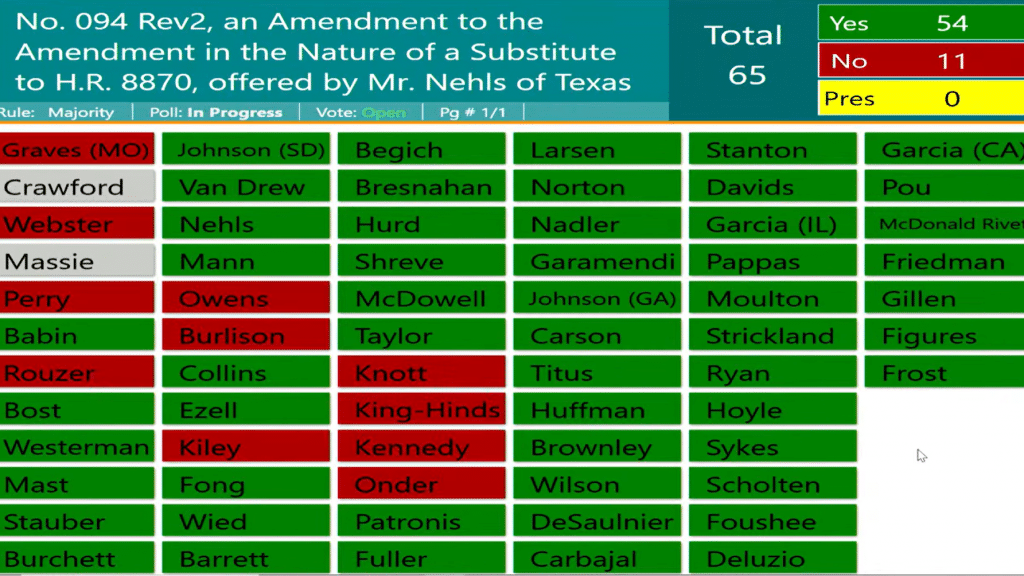
Even more significant, 23 out of the committee’s 34 Republicans voted in favor of the amendment alongside all 31 Democrats.  That delivered a powerful bipartisan victory for railroad workers, communities, and rail safety reform.

Why Has Rail Safety Reform Been Delayed for So Long?

SMART-TD has consistently argued that many of these safeguards should have been implemented years ago, but efforts have repeatedly faced resistance from the Association of American Railroads (AAR) and the major corporate railroads.

Despite overwhelming support from labor and many local communities, railroad corporations continued pushing operating models like Precision Scheduled Railroading (PSR) that place profits and efficiency ahead of workforce safety and quality of life, backed by money and their lobbying machines in Washington.

Leading up to Thursday’s markup, SMART-TD’s National Safety and Legislative Department worked tirelessly alongside our state legislative boards and labor allies to secure the votes needed for passage.

But nothing in Washington is ever certain.

The railroads and the AAR spent heavily trying to stop the amendment. Millions of dollars were poured into lobbying, media campaigns, political pressure, and coordinated messaging efforts aimed at convincing Republicans to side with the railroads over railroad workers.

President Trump’s public support mattered

Tuesday’s Truth Social post cut directly through the pressure campaign the railroads were trying to create and gave lawmakers political cover to stand with railroad workers and first responders instead of Wall Street-backed corporate interests.

And when the votes were finally counted Thursday afternoon, the result was bigger than anyone could have hoped for.

The railroads were handed a crushing defeat.

After spending millions trying to stop rail safety reform, they walked away from the committee with only 11 Republican votes to show for it.

Meanwhile, railroad workers, labor advocates, and bipartisan supporters of safety reform secured a commanding 54-11 victory and major momentum heading into future votes before the full House and Senate.

Policy Over Ideology

Whether members agree with every political position in Washington or not, there is broad recognition that having the Administration publicly support these reforms gave rail labor critical momentum at exactly the right time.

SMART General President Michael Coleman emphasized that the union’s approach has remained consistent regardless of who occupies the White House.

“From day one, we’ve said that we will work with any administration to benefit our members, and that we will keep calling balls and strikes on the policies that impact our members. This is a strike. We have stayed true to our commitment, and we welcome the White House’s support for including the Railway Safety Act in the Surface Transportation Reauthorization bill,” Coleman said.

“The Railway Safety Act is just common sense: for SMART-TD members, railroaders and communities nationwide. We applaud this administration for supporting this legislation, and we urge Congress to swiftly pass the Railway Safety Act as part of the final Surface Transportation Reauthorization bill.”

SMART-TD responded shortly after the President’s post, thanking the Administration and Congressional leaders from both parties who helped push the legislation to this point.

Truth Details | Truth Social

What Comes Next

SMART-TD leadership also highlighted the bipartisan coalition behind the effort, including Congressman Troy Nehls (R-TX) and Congressman Chris Deluzio (D-PA). Both lawmakers have stayed true to the vision Vice President JD Vance and former U.S. Senator Sherrod Brown laid out when they worked together to author the Railway Safety Act of 2024, which became the foundation for the bill now poised to become law in 2026.

Regardless of politics, one thing is becoming increasingly clear: railroad workers’ concerns are finally being heard at the highest levels of government.

After decades of fighting for these protections, this is our opportunity to finish the job and finally make these common-sense rail safety protections federal law.

We encourage all SMART-TD members to use our Legislative Action Center to send the Trump/Vance Administration a message thanking them for their support and for standing with railroad workers during this historic moment.

SMART News will keep you posted as we carry this momentum into floor votes in both the U.S. House and Senate.
SMART-TD’s General Committee of Adjustment (GCA) 457 has concluded the ratification vote on the proposed Tentative Agreement (TA) covering members in the Central and Southern Regions of CPKC Railway.

The membership voted to reject the agreement.

Final certified results are as follows:

  • YES — Accept the Tentative Agreement: 266 votes (41.96%)
  • NO — Reject the Tentative Agreement: 368 votes (58.04%)
  • Total Ballots Cast: 634

The ratification vote closed on May 21, 2026, at 5:00 p.m. Eastern Time.

Most notably, 91.5% of all eligible members participated in this vote, an exceptionally strong turnout that reflects the seriousness with which our members approached this decision. SMART-TD leadership is encouraged to see this level of engagement and participation from our brothers and sisters, especially when considering an agreement that would have established long-term terms and conditions affecting members for years to come.

SMART-TD thanks every member who took the time to stay informed, review the agreement, and participate in the vote. SMART News will keep you updated as this situation moves forward.

After years of hearings, public participation, and extensive review of rail operational safety concerns, the Federal Railroad Administration (FRA) finalized its Train Crew Size Safety Requirements Rule in April of 2024.

Establishing a federal minimum standard that requires two-person train crews (2-PC) except in narrowly defined circumstances, this rule was based on more than 13,500 public comments, including testimony from rail workers, emergency professionals, members of the public, and multiple labor organizations, including SMART-TD.

This common sense rule ensures that trains have a full crew on board, protecting communities and emphasizing what the FRA made clear: two-person crews are necessary to ensure baseline safety.

Now, this rule is under threat as two short-line railroads petition the agency to waive that federal standard and operate with one-person crews, a request that has the potential to result in deadly consequences.

Multiple Inconsistencies, Ambiguity in Petitions Raise Serious Concerns

Based on an operational model that removes the conductor from the locomotive and instead places them in a highway vehicle “shadowing” the train by roadway, Georgia Central Railway and First Coast Railroad’s individual petitions present a stunning lack of clarity around the concept of “close proximity” and how the conductor factors into it.

This includes…

  • What distance is considered acceptable?
  • How will compliance be gauged?
  • What happens when uncontrollable situations (traffic, disabled vehicles, weather conditions, etc.) prevent the conductor from maintaining the vague “proximity?”

This is not a concept that should be left up to interpretation; doing so would make it nearly impossible for FRA inspectors to verify in real time whether this is happening, ultimately making it unenforceable.

Beyond that, the carriers’ reliance on the locomotive alerter system to fill the safety void when the conductor is removed from the cab is ridiculous.

Let’s be clear: an alerter is not even remotely close to having a certified conductor on board and only useful after the engineer has become incapacitated.

Removing the second human element from the cab is a recipe for disaster: conductors exist to help prevent emergencies from escalating into catastrophes, and the FRA’s own rule recognized the importance of both crew members.

There’s a reason why states across the country are locking 2-PC rules into law: nothing can substitute for having a certified conductor and engineer in the cab to make critical decisions in situations where every second counts.

SMART-TD Asks Questions That Deserve Thoughtful Responses  

In our public comments directly responding to the petitions, SMART-TD poses several questions, including…

  • Do the carriers intend to equip company vehicles with hands-free communication technology specifically designed to minimize distracted driving hazards for conductors shadowing trains by roadway?
  • If not, how do the railroads intend to mitigate the known safety risks associated with operating a motor vehicle while actively engaged in railroad radio communications?
  • What procedures will govern situations requiring the crew to receive and copy mandatory directives or other dispatcher-issued instructions?

As we’ve always done, SMART-TD will continue fighting to ensure that trains have a full crew on board, protecting communities and underscoring the role that our members play in the safe operation of our nation’s rail network.

Now is the time for all of us to meet the moment and ensure that this rule withstands baseless challenges that jeopardize rail safety.

Read both public comments below

There are moments when solidarity is tested.

This is one of those moments.

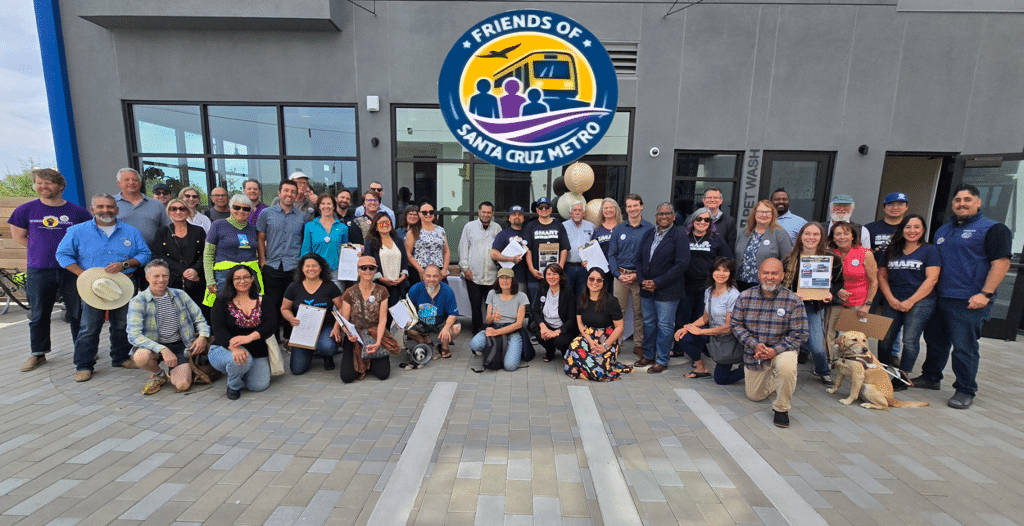
Friends of Santa Cruz METRO officially confirmed this week that the campaign will not meet the timeline necessary to place its transit funding measure on the November 2026 ballot. But the campaign itself is very much alive, and in many ways, stronger than ever.

The effort has already collected approximately 7,000 signatures entirely through volunteer labor, putting the campaign ahead of pace to qualify the measure within the full 180-day signature gathering window ending August 7.

That means the mission now is clear: SMART-TD members, transit advocates, riders, and working families still have the power to help secure the remaining 5,500 signatures needed to protect the future of Santa Cruz METRO and the union jobs that depend on it.

This fight did not end on May 11.

It simply entered a new phase.

The Math Is Simple and Powerful

The campaign needs approximately 12,500 valid signatures by August 7.

Roughly 7,000 signatures have already been gathered through grassroots volunteer efforts.

That means approximately 5,500 signatures remain.

Now break that down:

  • More than 100 union jobs remain connected to the long-term future of this system.
  • 5,500 signatures remain to be gathered.
  • Every 55 valid signatures collected represents a brother/sister’s job protected.
  • SMART-TD Local 23 has more than 250 active members.
  • If every member collected just 22 signatures between now and August, the remaining goal will be reached.

That is achievable.

This campaign has already demonstrated something powerful. Working people can build a serious grassroots movement when they believe their community is worth fighting for.

The Stakes Have Not Changed

Without sustainable local funding, Santa Cruz METRO still faces the possibility of devastating operational cuts over the coming years.

Those cuts threaten service, routes, reliability, and the livelihoods of more than 100 SMART-TD members represented by Local 23.

These are operators and transit professionals who have dedicated themselves to serving Santa Cruz County through difficult years that included the COVID-19 pandemic, staffing shortages, inflation, and operational uncertainty.

Now they are fighting to protect the transit system they helped build.

And the need for that system has never been clearer.

According to Friends of Santa Cruz METRO, ridership is now at its highest level in more than a decade. Total ridership increased 42.5% from late 2024 to late 2025, while local non-student ridership surged by more than 86%.

The Youth Cruz Free program has also helped produce a staggering 500% increase in student ridership.

People are using transit because they need transit.

Working families need it.
Students need it.
Seniors need it.
People with disabilities need it.
And increasingly, working-class communities priced out by rising costs of living depend on it every single day.

This Is About More Than One Election

The reality is that qualifying for the November 2026 ballot became impossible because of timing constraints involved in Sacramento legislation and county election deadlines.

But that does not mean the measure failed.

Far from it.

In fact, the campaign is now positioned to qualify for the March 2028 primary election ballot or a special election if county leaders choose to act sooner.

That matters because we clearly have the public’s support.

Volunteers report overwhelmingly positive reactions from riders and residents. Many community members already understand that Santa Cruz METRO is an essential public service and that losing routes or reducing operations would hurt the entire county.

The mission now is to finish what was started.

What SMART-TD Members Can Do Right Now

This is the stage of a campaign where unions prove who they are.

Not through statements.
Not through slogans.
Through action.

SMART-TD members can help by:

  • Volunteering at transit centers and community events.
  • Encouraging registered Santa Cruz County voters to sign.
  • Helping ensure signatures are complete, legible, and valid.

Get In The Fight

If every SMART-TD member treats these next three months as if the future of our union family depends on it (because it does), then this campaign is absolutely within reach.

If you want to get involved and help save jobs, please contact Friends of Santa Cruz Coordinator, Ella Beck, at (831) 471-7291. She can get you plugged in, get the correct petition in your hands, and help coordinate its return.

Sister Beck can be reached at ellamarevabeck@gmail.com or by phone at (831) 471-7291.

Accuracy Matters

Every valid signature brings the campaign one step closer to protecting service and preserving union jobs.

The New Deadline Is August 7

The pressure facing transit agencies across America is real.

But so is the solidarity inside SMART-TD.

The newest members of Local 23 joined this union because they believed in what their brothers and sisters had built in Santa Cruz over the past decade. Many changed careers and left previous employers because they believed this union movement was worth being part of.

And moments like this are when unions either reinforce that belief or lose it.

This Fight Is Winnable

The campaign is alive.
The support is real.
The momentum is still there.

Now comes the hard part: finishing the job.

So make the calls.
Take the petitions.
Talk to riders.
Talk to neighbors.
Talk to your coworkers.
Bring friends and family into the effort.

Because solidarity is not measured by what we say when things are easy.

It is measured by what we do when the fight gets harder.

For years, railroaders across this country have raised the alarm about the growing use of drones by railroad management inside active rail yards and around moving trains. SMART-TD took those concerns directly to the Federal Aviation Administration last fall, warning that these practices create serious risks, undermine safety culture, and normalize drone activity over some of the nation’s most critical infrastructure.

Now, the FAA has announced a proposed rule that could significantly restrict drone operations around transportation facilities, including rail infrastructure. While this proposal is broader than rail alone, it’s clear that the concerns raised by frontline transportation workers are finally getting attention at the federal level.

This is progress, but the job is not finished. The FAA has opened a public comment period on this proposal through July 5, 2026, and this is the moment for railroad workers to make our voices heard.

The FAA needs to hear from the True Rail Safety Experts: YOU

Many of us have stories about unsafe drone operations by trainmasters or MTO’s who sit on their lawn chairs in the parking lot acting like they are Maverick and Goose. Members have watched trainmasters fly drones through switching operations, over active crews, and around hazardous environments where concentration and communication are critical. Those concerns cannot stay in the break room anymore.

SMART-TD is asking every member who has ever spoken up about these dangers to now tell that same story directly to the FAA. We got the door open, and now we need you to walk through it.

It’s easy to ignore one railroader, but when 100,000 railroad workers speak together, the federal government listens.

Railroaders are the field experts on rail safety in this country. Not consultants. Not corporate safety officers. Not managers standing behind a joystick in their aviator sunglasses.

The men and women working the ground, handling hazardous materials, building trains, and moving freight every day are uniquely qualified to explain what is safe (and what is not) inside America’s rail yards.

How You Can Make Your Voice Heard

You do not need to write a long statement, and it doesn’t have to be poetry.

Tell the FAA:

  • Your craft and years of railroad experience.
  • That active rail yards are already dangerous enough without drones creating distractions overhead.
  • That frontline railroad workers are the true experts on rail safety.
  • That drones used for surveillance and operational testing create unnecessary hazards and security concerns.
  • That railroad workers deserve to be consulted before these practices are normalized in critical infrastructure environments.
  • That normalizing drones flying over the thousands of gallons of hazardous chemicals can’t be allowed to happen, because we won’t know when we are seeing an act of terrorism in progress vs. an MTO trying to conduct O-Tests.
  • Tell them your truth about drones in rail yards anyway you see fit.

This is our opportunity to advocate for ourselves and for each other.

SMART-TD has already put these concerns on the record. Now we need the voices of the membership to reaffirm them.

Please Submit your public comment to the FAA here:

Regulations.gov FAA Drones Public Comments

Together, we can finish the job.

There is a growing trend in America where wealthy political commentators and media personalities suddenly decide they are experts on railroading.

Steve Forbes did it.

The Washington Post editorial board did it.

Now, lifelong lobbyist and D.C. influencer Grover Norquist is doing it.

And every time they do, they prove the same thing. They don’t know jack about this industry, the people who work in it, or the dangers that come with it.

Rail safety is not optional for railroaders. It is life and death.

SMART-TD President Jeremy Ferguson explained that clearly earlier this year in his response to the Washington Post’s attack on the Railway Safety Act. Safety regulations exist because railroad corporations have repeatedly shown they will cut safety when it helps profits.

That is proven time and time again in the history of railroading in America.

Don’t Fake Your Qualifications On This Territory

This year, every few weeks, another outsider with no railroad experience decides to lecture railroad workers about what “real” rail safety should look like.

Grover Norquist’s recent Washington Times column is just the latest example.

Norquist completely misrepresented the federal two-person crew rule. He framed it as though unions are demanding railroads add extra workers onto trains and pass the cost onto consumers.

He accused rail unions of trying to enrich themselves by supporting the Railway Safety Act. Apparently, he misread his talking points from the AAR and thinks the RSA is trying to “ add a second crew member to freight trains that already operate safely with one.”

I guess he didn’t bother having someone with knowledge of railroading OR the bill itself proofread his article before publishing it.

His whole argument is that the union is pushing this bill so that overnight we will double our membership, and therefore our dues money. He is obviously a subject matter expert that we should all listen to and take notes!

As we all know, freight trains already operate with two-person crews every day across America. The Railway Safety Act does not add another crew member. It simply prevents the railroads from reducing crews to one person, or eventually none at all.

Don’t Talk East Palestine If You Don’t Understand It

Anyone who actually understands railroading knows crew size becomes critical when disaster strikes.

The train that derailed in East Palestine had a three-person crew. Those railroaders immediately secured the train, coordinated with dispatchers, helped establish evacuation zones, and protected first responders from walking into a hazardous materials disaster blind.

Compare that to Lac-Mégantic, Quebec, where a one-person crew operation ended in catastrophe. A runaway train exploded in the center of town, killing 47 people and destroying much of the community.

Crew size does not stop every derailment. But it absolutely affects what happens afterward. Railroaders and anyone else with common sense and no political agenda understand that.

Norquist also claimed automated track inspection technology is obviously superior to human inspection, treating the issue like it is a settled fact.

Again, this is what happens when outsiders pretend they know more than the people doing the work.

Track Inspection Is Not Where You Cut Corners

Automated Track Inspection, or ATI, can help inspect more track more quickly. Railroaders are not against this technology for that use.

But there is a difference between speed and quality.

When railroaders are riding equipment in the middle of the night with a lantern in one hand, paperwork and a radio in the other, they want to know the rail underneath them was inspected carefully by trained human beings, not just scanned quickly by a machine looking for major defects.

Because when that rail breaks, railroad workers are the ones who end up in the closed casket.

And here is the part Norquist ignored, or doesn’t know because he’s faking his qualifications:

Studies have shown ATI systems can miss up to 73% of the defects trained human inspectors are able to identify.

That is not “obviously better.” That is not “irrefutable.” That is a serious concern.

Technology should support track inspectors. Not replace them.

But railroad corporations want fewer workers because fewer workers mean lower labor costs. And too many of these media personalities with no railroad experience keep repeating those corporate talking points like they are facts.

Americans should ask themselves why so many wealthy commentators and editorial boards are suddenly so desperate to attack rail safety legislation.

The answer is simple:

Because they do not have to live with the consequences, and don’t know any better than to weigh in on shit they have no knowledge of.

Stay In Your Lane

Grover Norquist has spent decades in Washington politics. He grew up comfortably as the son of a corporate executive, went straight to Harvard, and built a career in political influencing and lobbying.

He is not a railroader.

And if he wants to avoid embarrassing himself, he should stop pretending he understands an industry he has clearly never experienced firsthand. Workplace safety means more than avoiding papercuts for us.

Railroaders will handle railroading.

In railroading, there are two distinct kinds of new hires.

The ones who succeed are the ones who keep their mouths shut, listen to the old heads, and respect that there’s a reason why things are done the way they’re done.

Then there’s the other guy. The ones who come in thinking they’re the smartest guy in the room, hitting you with the classic, “I know that,” or even “That’s dumb, we should do it this way.” Those are the new guys who wash out quick or get somebody hurt.

Right now, CSX CEO Steve Angel (with a whopping seven months in railroading behind him) is acting like the second kind.

Who Is Steve Angel?

Angel didn’t come up through the ranks. He’s not a railroader. He built his career in boardrooms, not on ballast. And yet from day one, he came in guns hot, changing operations, ignoring the workforce, and now even trying to influence what other railroads do with their business.

That’s not how our industry works.

“There’s a right way to learn this craft, and it starts with listening,” said SMART-TD President Jeremy Ferguson. “What we’re seeing right now is the opposite of that.”

Instead of focusing on the real issues like safety, customer service, and a workforce with worse morale than any other, Angel has CSX launching public campaigns against the proposed Union Pacific–Norfolk Southern merger.

You’ve got to love that.

Fix Your Own House

CSX’s own train is in emergency, it’s all over the ground, and its CEO is worried about what the UP and NS are doing?

“CSX has real problems right now,” Ferguson said. “Our members, CSX customers, and the American economy would all be a hell of a lot better off if Mr. Angel focused on his own railroad instead of trying to play politics. If he was anybody else, he’d still be wearing his new hire hi-viz orange hat. It’s probably a good idea for him to focus on the task at hand.”

The reality on the ground at CSX tells a very different story than the one in its press releases.

Federal regulators have already flagged gaps in CSX’s safety culture. Workers are raising concerns at a pace that makes it clear things are not stable. Adding insult to injury, recent operating decisions are making matters worse, not better.

CSX Customers Are Now At Risk

The shutdown of Barr Yard in Chicago, a facility that handled around 1,400 cars a day, has created immediate problems. The plan to shift that work to short lines that can barely handle half that volume instantly led to backups, congestion, and ripple effects spreading across multiple states. The way Angel’s move in this situation is looking right now, it could easily back up traffic out of Chicago in every direction. You know you made a bad call when something you did in Chicago jams up the nation’s supply chain from New York City to Kansas, and even up into Canada.

That’s not innovation. That’s a misread of how a railroad works in real life. It might make sense on whatever AI simulator your “experts” ran it through, but any railroader in the Midwest who was around for a decade or so could tell you this doesn’t work when it goes from the drawing board to the rails. We’ve seen this kind of move fail more than once before.

This time, under Angel’s leadership, it’s already gotten so bad that the Surface Transportation Board (STB) should be looking into how it can help remedy the situation. Something needs to get fixed before we starve out our customers or lose them over this bad call. 

“You don’t make anything better in railroading by tearing out capacity and hoping it works,” Ferguson said. “Progress comes from understanding why that capacity was put there in the first place.”

Why Is CSX Really Fighting the UP–NS Merger?

We all know that arrogance in a new hire ends badly on the rails and in the crew rooms. One of the classic trademarks of new managers hired off the street is that they tend to add a dash of hypocrisy to their arrogance to give it that unique Trainmaster feel.

Don’t worry, Angel is bringing plenty of that to CSX, too.

Angel is publicly positioning CSX as a defender against consolidation in the UP–NS merger fight. But his own career was built around large-scale corporate mergers, including leading the high-profile merger of Praxair and Linde.

He wasn’t hand-picked by ANCORA to run CSX because he opposes large-scale mergers. He was brought in after hedge fund pressure from investors who have been very clear about wanting big moves, including potential mergers.

So which is it, Steve?

Is he against consolidation, or just against the ones that don’t meet the likely conditions for his millions in stock performance bonuses, which are probably in his contract?

“You don’t build a career on mergers and then suddenly act like you’re against them,” Ferguson said. “That’s not principle. That’s playing to his self-serving agenda.”

Intentionally Out of Touch

Meanwhile, Angel hasn’t even taken the time to sit down with the largest union representing his workforce. SMART-TD tried, but the meeting never happened.

That sends a clear message, and not a good one.

“If you won’t even listen to the people who run your railroad every day, you’re not going to understand the problems you’re supposed to fix,” Ferguson said.

And those problems have definitely been growing since he took over in September of 2025.

CSX remains the only Class I railroad without a settled agreement or a tentative deal in place for workers. Service issues are mounting. Industries are getting cut off. Safety concerns are rising. The people doing the work are being ignored, furloughed, and forced to chase work across the country.

That’s not leadership. That’s a failure to engage.

You’re Not in Kansas Anymore

Railroading isn’t like any other industry. You don’t walk in from the outside and start rewriting the playbook. This craft has been built over more than 160 years through experience, trial and error, and lessons learned the hard way.

There are reasons things are done the way they’re done, and those reasons are often written in our blood.

The leaders who succeed in this industry understand that. They listen first. They learn. They earn the respect of the workforce.

Right now, Steve Angel is doing none of those things.

He’s acting like the new guy who thinks he knows better, while the railroad around him, his employees, and customers are feeling the consequences.

“This isn’t complicated,” Ferguson said. “Focus on safety. Respect your workforce. Run a good railroad. That’s how this industry has succeeded for generations.”

CSX doesn’t need a CEO campaigning about another railroad’s merger.

It needs one who understands the job he already has.

“Fix your own house,” Ferguson said. “That’s the job.”

SMART-TD leaders, members, and the public have been hit with a harsh reality this week. FRA is no longer on our side, and they aren’t even pretending to be a neutral party anymore. We all need to stop pretending.

After what we saw this week, there’s no gray area left. The FRA and DOT have abandoned their role as neutral referees and are no longer here to balance safety and business.

They’ve picked a side, and they are 100% on team Corporate Railroads.

In the last 48 hours, the FRA dropped 11 final rules that make one thing clear: they are clearing the path for the railroads to do whatever they want, free of guidance and oversight, with hardly any consequences and even fewer workers.

You don’t need to read between the lines to see this reality. It isn’t subtle. FRA is telling SMART-TD and every railroader that the risk to your well-being is worth it for the carriers’ profit.

In fact, Fink said that he “want[s] to see the industry thrive,” and his methodology for doing so is deregulation, noting during his speech that “the previous administration, there wasn’t really that much done on the deregulatory side.” Obviously, he plans to change that.

FRA Administrator Tells the World What He Thinks of Us

At a DOT technology event hosted at DOT headquarters on Tuesday, April 28, FRA Administrator David Fink made it as clear as possible that the goal is to push new tech out “as soon as practical.” According to a report from Bloomberg, it includes autonomous railcars, additional AI monitoring of employees, and systems designed to cut crews out of the picture altogether.

Fink, during his speech, specifically pointed to Parallel Systems (a company actively working to operate freight trains without human crews) as the kind of innovation they want to move forward with. Interestingly, however, is that Parallel Systems’ testing of its technology and equipment was approved under the last administration. The difference, however, is that the approval came with conditional safeguards to keep the railroad system and the public with which it intersects safe. FRA is now working to reverse that.

Let’s connect the dots

They’re rolling back the rules that protect us, while fast-tracking the technology most likely to maximize profits.

That’s not a coincidence. That’s the plan.

SMART-TD was supposed to be at that event. The Director and Deputy Director of SMART-TD’s National Safety and Legislative Department, Jared Cassity and Don Roach, were scheduled to be at the FRA’s technology demonstration on Tuesday.

They didn’t go.

After seeing what FRA pushed out as rulings in the days leading up to it, they made a point NOT to attend.

As Cassity said:

“We aren’t going to be at a party celebrating the FRA’s new path and plan to eliminate our members’ safety, rights, and ultimately their jobs.”

That’s exactly what it was. A celebration. A showcase of a future where railroads run with fewer people, less accountability, and more risk pushed onto whoever’s left standing and the American Public.

Roach and Cassity told SMART News they want to be clear about something. Their protest of Tuesday’s event wasn’t about being against technology.

It’s about what happens when you take trained railroaders out of the equation.

This job isn’t simple. It’s not predictable. It’s not something you hand off to a computer and walk away from.

We move hazmat. We move heavy tonnage through cities, towns, crossings, and yards every single day. Things go wrong. Conditions change. Decisions have to be made in real time on the fly.

That’s what we do.

And now they want to strip that down while also weakening the federal regulations that are supposed to keep everything in check.

Timing Isn’t Just Dumb, It’s Wreckless

Less than two weeks ago, on April 16, SMART News relayed to our rail members a Cybersecurity Alert that we received from the FRA.

This warning was issued by the exact federal agency that stood before a microphone on Tuesday and told the world that we want our freight trains to rely on the systems most vulnerable to bad actors. It’s unfathomable that both of these statements came from the same place, 12 days apart from each other.

We’re in a world where cyber threats are real and getting worse. Systems get hacked. Networks go down. Bad actors look for ways to disrupt critical infrastructure.

And what’s the response from FRA?

Tie more of the operation to software, automation, and remote systems. And while we’re at it, let’s remove the human beings who can actually respond when something breaks or intervene when systems get hacked.

Cybersecurity threats get more plentiful and complex all the time, but right now, Fink and the FRA are pushing for this move while we are in an active war with Iran. For obvious reasons, this underscores the need to be aware of cybersecurity in the rail industry.

Even outside the current global situation, Fink and the FRA are well aware that the railroads have not acted on urgent notices from the Cybersecurity & Infrastructure Security Agency (CISA), which has been warning of heightened cyber threats that require immediate attention.

The next time you are having a hard time staying awake, do a quick Google search of  CISA and the warnings they have issued to the rail industry lately. You won’t be nodding off for a long time. Yet, in the face of all of this information about your safety and the safety of the public, the FRA is out there in a room full of press talking about how we should be in the 8th notch going full speed ahead on turning control of the nation’s railroads over to the very automation he has been told is most vulnerable.

I suppose none of this matters to FRA or the Railroad Corporations hoping to free themselves of the burdens associated with safe train operations. We can’t forget the final ruling they just made on Monday. They addressed it by rewriting the regulatory enforcement process. Their new “prosecutorial discretion” policy means that if this ridiculous strategy is implemented on America’s rail network and inevitably results in disasters that put the public and the few railroaders left at risk, railroads can just negotiate their way out of violations (Final Rule FRA-2025-0077). No set penalties. Just legitimized backroom deals.

So, when something goes wrong, the companies won’t pay the price.

We will.

That’s the reality now more than ever.

The FRA isn’t pretending to balance safety and industry anymore. They’re helping the industry overcome its biggest obstacle: dealing with a trained workforce and following the  rules and regulations that protect it.

You’re living this reality, and you know it better than anyone. The railroads don’t want to train us. They don’t want to pay us. And they definitely don’t want to be held accountable to anyone but themselves.

We, their employees, are the “problem” they’re trying to solve.

And now we know Administrator Fink (who, not surprisingly, was the CEO of a railroad in his past job) is now publicly pledging that the United States FRA is here to help them realize that vision of the future.  

That was made clear on Tuesday.

What is the Railroad Retirement Fairness Act?

The Railroad Retirement Fairness Act isn’t just another bill in Washington. For railroaders and our families, it’s a chance to fix something that never should have been broken in the first place.

Right now, under current law, some railroad retirees and our spouses see our Tier II retirement benefits reduced if we keep working for the same non-railroad employer after retirement. That means money they already earned, over years and decades on the rails, (and putting up with a spouse who is on the rails,) can be taken away because of a technicality in federal law.

To our brothers and sisters who experience this every month, it’s like standing there and watching your wife get pick-pocketed by Uncle Sam, and not being able to do a thing about it.

That’s been the reality for too many railroad families for far too many years.

How does the Railroad Retirement Fairness Act Help Railroaders?

The Railroad Retirement Fairness Act puts a stop to these unfair penalties. This bill would make sure retirees and our spouses receive the full Tier II benefits we have all earned. We’re talking no penalties, no fine print, no games.

As it’s laid out in Senator Chris Coon’s Press release about the bill’s introduction to Congress.

The Railroad Retirement Fairness Act would:

  1. Eliminate the arbitrary “last prior employer” deduction
  2. Allow railroad retirees and their spouses to continue working in non-railroad jobs without losing earned retirement benefits
  3. Ensure more equal treatment for retirees regardless of where they choose to work in retirement

Obviously, it will be good in our current economy to see our take-home income on the rise, but this is about more than just numbers on a check.

The Family Sacrifice Behind Tier II Benefits

Railroading isn’t a normal job. It never has been. The long hours, the missed holidays, the constant calls, the stress. We all know what it takes. But we also know we don’t do it alone.

Our spouses live this life right along with us.

They’re the ones who adjust their schedules. They’re the ones who pick up the slack at home. They’re the ones explaining to the kids that Santa is going to come a day early this year because Mom or Dad is going to be at the away-from-home terminal on the 25th.

In a lot of cases, being married to a railroader with our lack of stable schedules also means that our spouses alter their career paths to make sure someone is available to cover the basics on the home front. They might take part-time work or leave the fast track to maintain schedule flexibility, or work from home. A lot of our spouses end up having to leave the workforce altogether for these reasons.

Brass tax is that the 401K’s and pensions that many of our spouses would have otherwise been in line for were sacrificed to make it so we could answer a 2-hour call to work at the drop of a hat for 3 decades.

Tier II benefits are part of how that sacrifice is recognized. It’s not just retirement. It’s compensation for a lifetime of putting family plans second to the railroad, and it is an acknowledgment that our wives and husbands have not been given an opportunity to work untethered in their own careers.

Anyone who’s been married to one of us long enough to qualify for Tier II benefits has sure as hell earned them.

So when those benefits get reduced just because a spouse chooses to work after we have hit retirement, (and everything they’ve already given,) it is plain wrong.

The current rule can force retirees and spouses to leave jobs they want to keep or switch employers, simply to avoid losing benefits they earned. In many cases, it discourages our retirees and their spouses from working at all.

That’s why this bill matters. It’s how we finally do something about it and stop being forced to watch our spouse get robbed by the government every month, or have their job take a backseat to the railroad one last time.

United Front With Bipartisan Support

SMART-TD is proud to announce the leaders who stepped up to make this happen. They are Senators Josh Hawley (R-MO) and Chris Coons (D-DE), along with Representatives Troy Nehls (R-TX) and Chris Deluzio (D-PA).

Two Republicans. Two Democrats.

That’s not by chance. That’s the path SMART-TD has been building for years. Railroad issues aren’t partisan, and we like to keep it that way.  

These Representatives and Senators have taken the time to listen. They’ve worked with SMART-TD on rail safety, quality of life, and retirement issues for long enough that they understand our issues and our values.

And they know this much for sure. Railroaders will put up with a lot. But we’re not going to sit quietly while our families get short-changed.

A Matter of Respect

Providing for our families and having something solid at the end of a long career are the two main reasons we stick with this life. When that gets chipped away, it hits home.

The Railroad Retirement Fairness Act is about putting a stop to that.

Fairness is the word they used in the bill title, but it just as easily could have been Respect. It’s about both, and after decades on the rail, we have earned them.