SMART-TD members have the opportunity to shape the future of their local by electing the brothers and sisters who will represent, protect and serve them. In 2026, locals across the country will elect officers and committeepersons who keep our union running, defend our agreements and ensure every member has a voice.
Whether you’re thinking about running for office, nominating a fellow member or simply casting your ballot, understanding what each position does is one of the most important parts of the election process.
The strongest locals are built by members who step up to serve.
If you’ve ever thought about getting involved, SMART-TD is committed to developing strong leaders through regional training seminars and officer education programs. We provide position-specific training, so every local officer has the tools and knowledge needed to succeed and serve their brothers and sisters.
Positions on the 2026 ballot
Local President Provides general supervision of the local, enforces the Constitution and bylaws, chairs meetings, signs official documents, and oversees the work of the local.
Vice President Supports the president in carrying out the business of the local and assumes the president’s duties whenever necessary.
Secretary Maintains meeting records, handles official correspondence, manages notices and election paperwork, and keeps members informed of important local business.
Treasurer Safeguards local finances, maintains financial records, prepares reports, and ensures members’ dues are properly managed and accounted for. In most locals, the positions of secretary and treasurer are combined.
Board of Trustees Provides financial oversight by auditing the treasurer’s records and helping ensure accountability to the membership.
Local Chairperson Serves as the primary representative for the local committee of adjustment by handling claims, discipline hearings, and grievances. Local chairpersons protect members’ contractual rights every day.
Vice Local Chairperson Assists the chairperson with claims and member representation while standing ready to assume those responsibilities whenever needed.
LCA Secretary Provides administrative assistance, specific to the LCA.
Safety and legislative representatives (SLRs) and vice SLRs will be elected in 2027.
No one understands the needs of your local better than the members who work there every day. That’s why local elections matter. Choosing leaders who share your priorities and have earned your trust is one of the most important responsibilities of union membership.
But your voice can only be heard if we can reach you and get you your ballot.
Your voice starts with staying connected
Please take a few minutes today to make sure SMART-TD has your current contact information, including your email address (as required by SMART Constitution Article 21B, Section 45). Members may update their contact information in the SMART App or in the Member Portal. Even if you think everything is correct, it’s worth checking. Our union only succeeds when members participate. That means staying informed, sharing ideas, voting in local elections and choosing leaders who will work every day to protect safety, ensure fair treatment and strengthen our union.
A strong union starts with you
Every local is different. Every property has its own challenges. The best solutions come from the members who live those challenges every day. When members stay engaged and elect strong local leadership, our entire organization becomes stronger.
As we prepare for this important election year, help us make sure your voice is counted.
Verify and update your contact information today. It’s a simple step that helps keep you connected, informed and ready to participate in the future of your local union and SMART-TD.
Every office matters. Every officer contributes. Every member benefits.
SMART-TD’s Bus Department continues to go to bat for members.
In the matter of SMART-TD Local 1594 and Southeastern Pennsylvania Transportation Authority (SEPTA), an operator was terminated following an incident involving a pedestrian while the vehicle was en route. Subsequently, SEPTA alleged that the grievant violated safety rules regarding pedestrian hazards and safe vehicle operation, resulting in the grievant’s termination. SMART-TD contested the action, arguing that just cause was not established because SEPTA failed to impose progressive discipline, engaged in disparate treatment compared to other operators and did not consider mitigating or extenuating circumstances.
After reviewing the evidence and arguments, the arbitrator concluded that the termination was unjust. Accordingly, the discharge will be reduced to a 45-day suspension, and the grievant will be reinstated to the former position with uninterrupted seniority and full back pay, minus the suspension.
This arbitration was advanced by General Chairperson Anthony Petty, with the assistance of Vice President James Sandoval.
In the matter of SMART-TD Local 0172 and First Student Inc., an operator was terminated due to an altercation with another operator while on duty. First Student upheld the termination, even though the operator was defending themselves against the other operator. SMART-TD challenged the termination throughout the grievance process, and First Student offered a settlement in lieu of the arbitration hearing. The operator accepted the monetary settlement offer, and the discharge was expunged from their records.
This arbitration was advanced by General Chairperson Kathy Sitongia, with the assistance of Vice President Alvy Hughes.
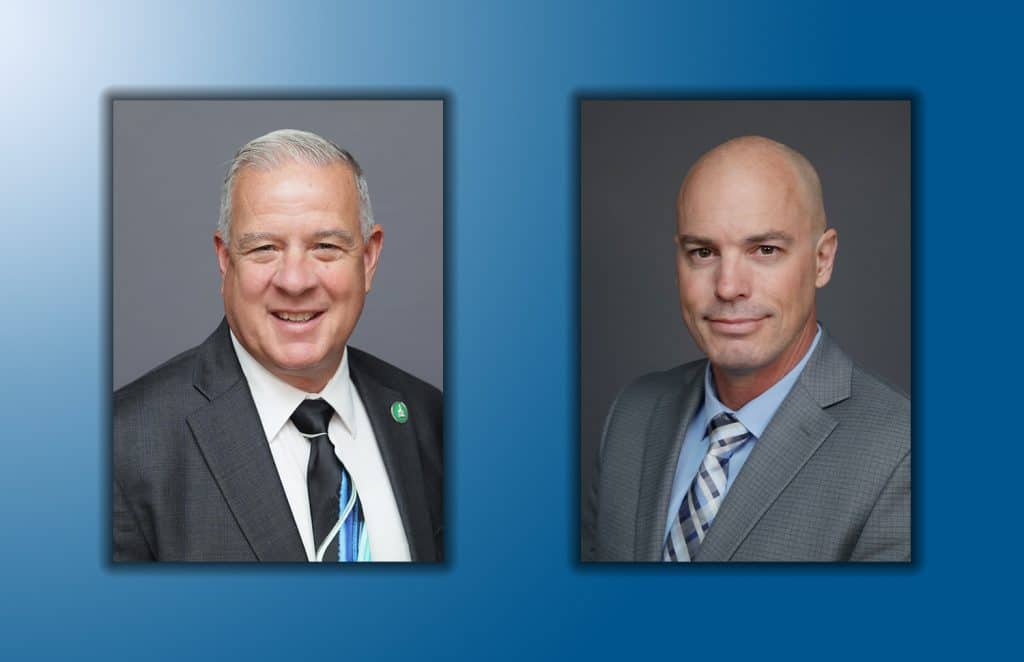
Brother Leingang began his sheet metal apprenticeship on May 18, 1987, with the Hermanson Company after graduating from the Welding Program at Lake Washington Technical College. He spent the first two and a half years of his apprenticeship in the field before transitioning into the shop, where he went on to serve 10 years as a shop foreman. Leingang then launched the Specialty Metals Division at Hermanson, where he spent 12 years managing and selling specialty metals projects. In total, he dedicated 31 years of his career to Hermanson.
In 2018, Leingang was elected to serve the membership of Local 66 (Seattle, Wash.) as a business representative, a role he held for five and a half years. On July 1, 2023, he was appointed regional manager of Local 66, where he served for two years. On September 1, 2025, Leingang was appointed SMART Northwest Regional Council president, a position he continues to hold today.
In addition to his leadership roles within SMART, Leingang serves as secretary/ trustee of the Northwest Pension Trust, trustee of the Northwest Healthcare Trust, vice president of the Washington State Building and Construction Trades Council and is a member of the Board of Directors for Qualstar Credit Union, where he also chairs the Audit Committee. He additionally serves on the board of the Local 16 Healthcare & Pension Trusts.
“What BE4ALL is about — for me, it’s about respect. It’s about respect for each and every person in this room, everybody out on the jobsites, in the shops, wherever you may be … To me, it boils down to the respect that each and every one of us should have for each other, because we’re part of an organization. We’re part of a family.”
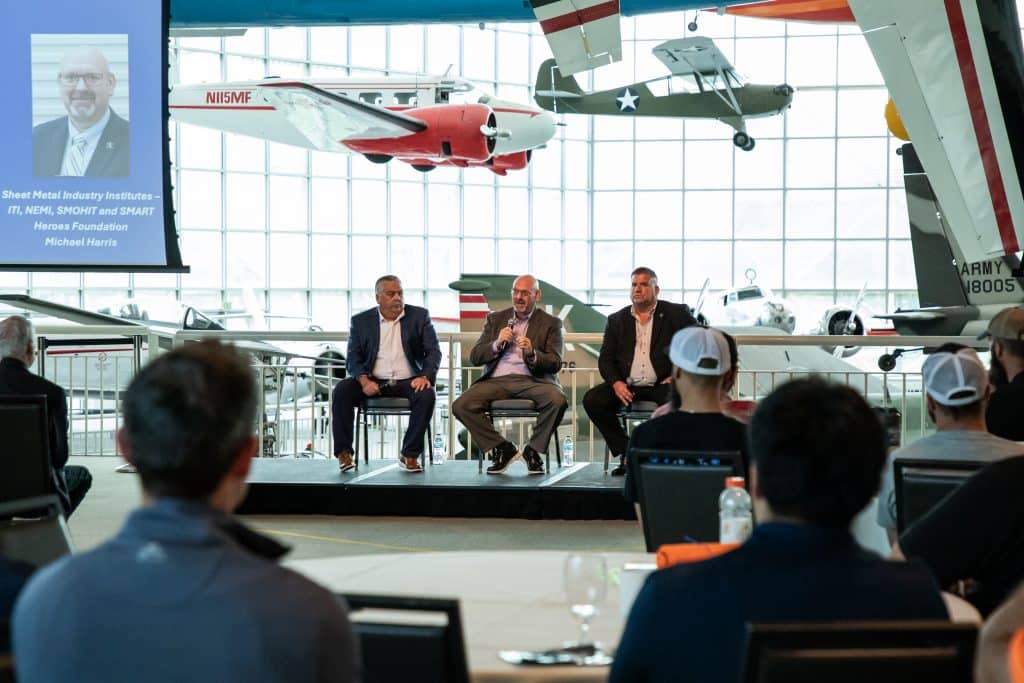
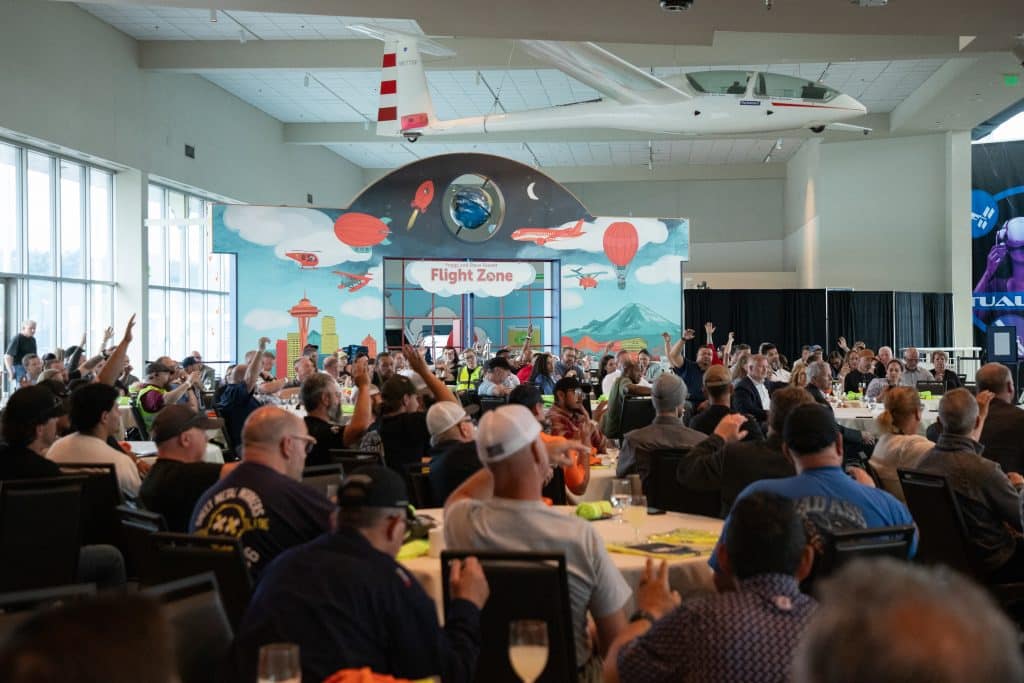
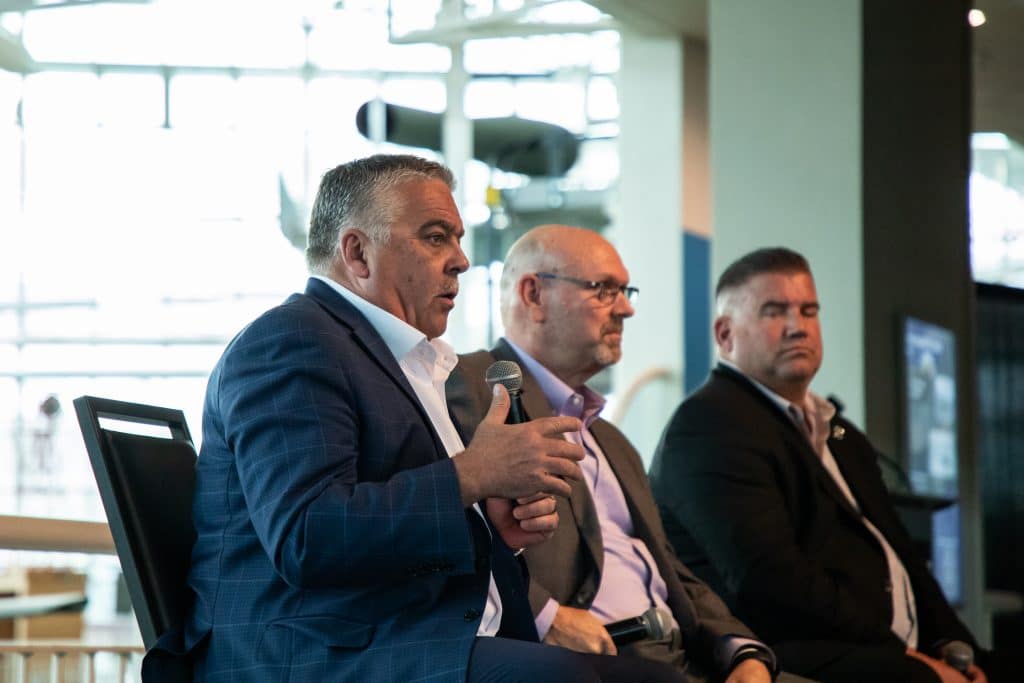
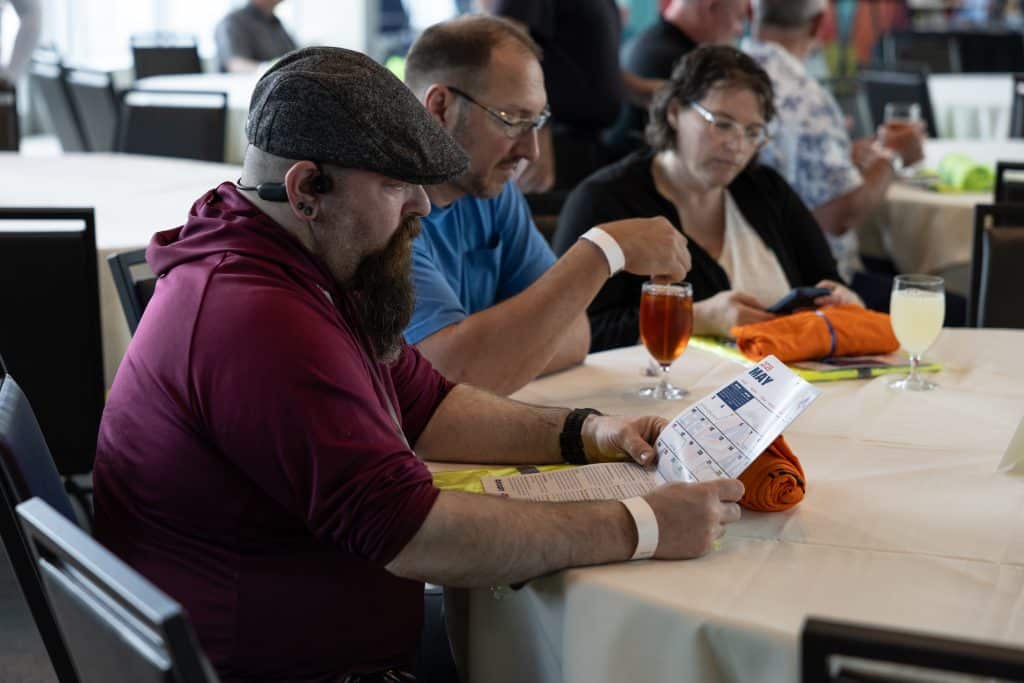
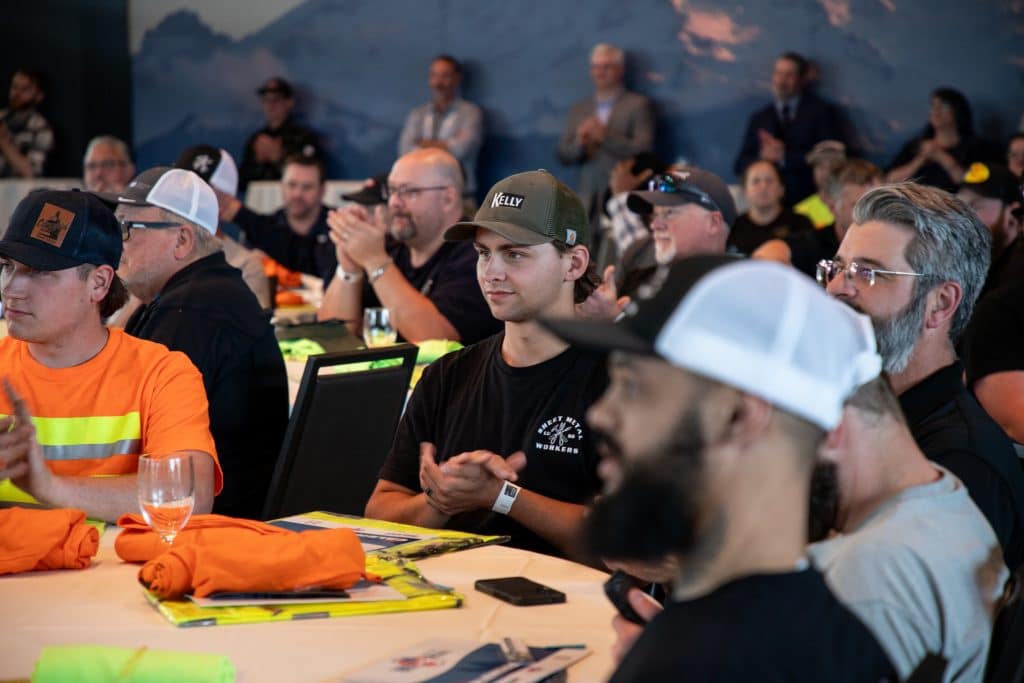
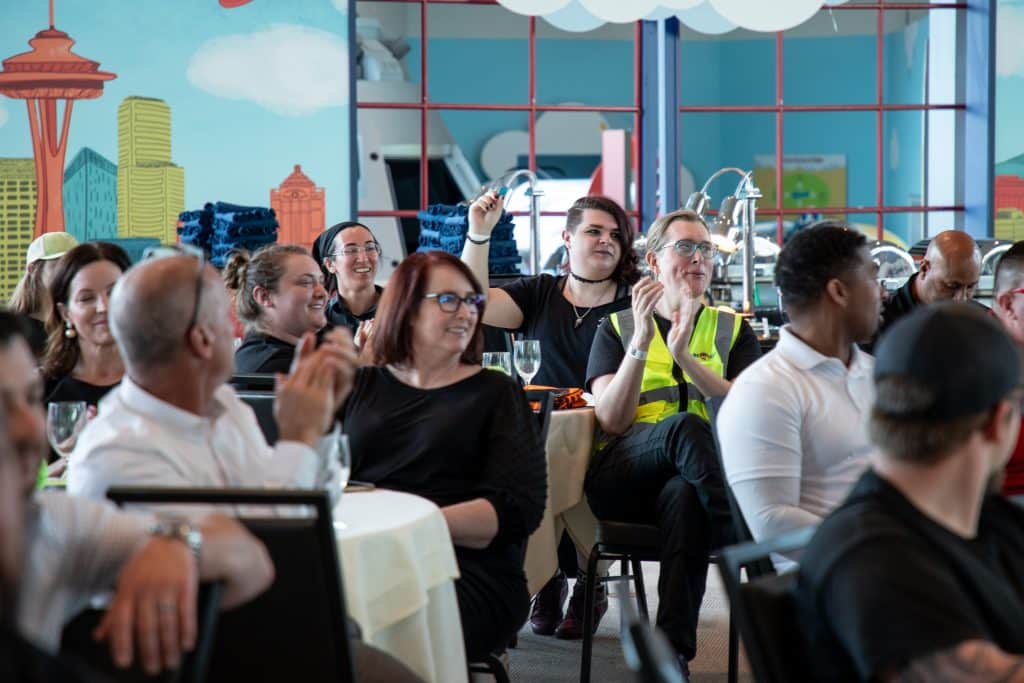
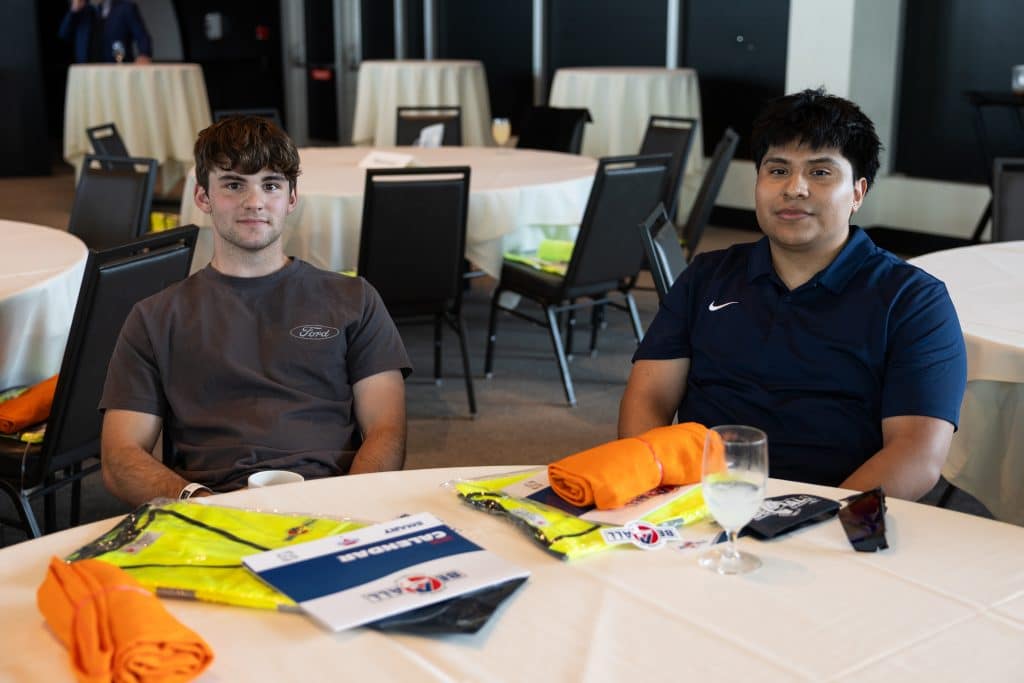
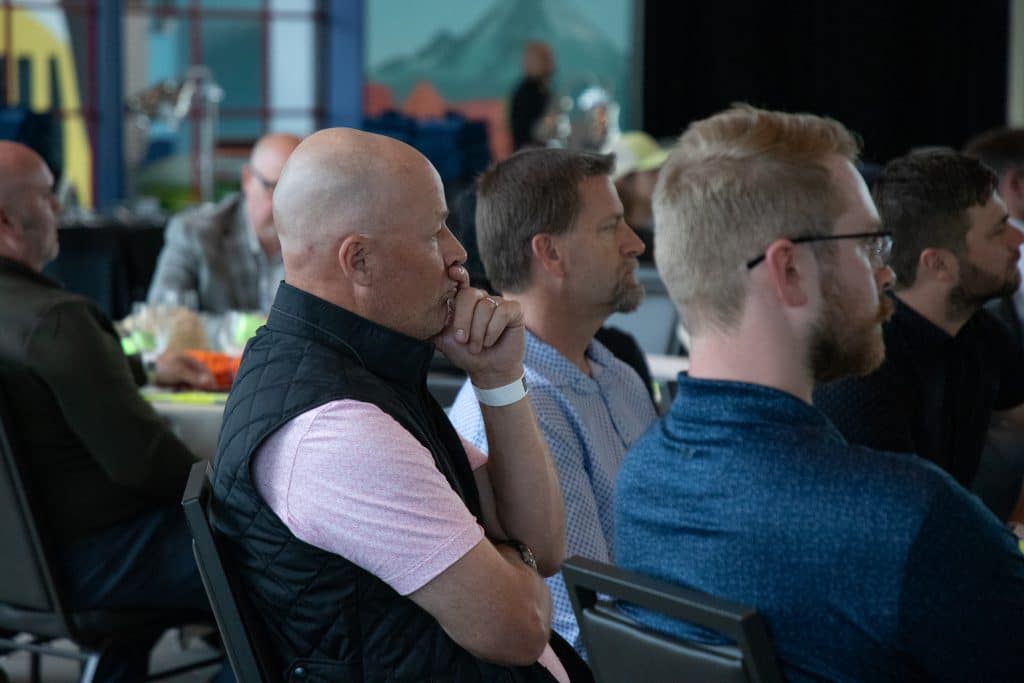
Those words, spoken by SMART General President Michael Coleman, summed up the second-ever Belonging and Excellence for All (BE4ALL) Town Hall, which took place May 28, 2026, in Seattle, Washington. The Town Hall — featuring General President Coleman, SMACNA President Todd Hill and Funds Executive Director Michael Harris — brought nearly 200 SMART members and SMACNA contractors together at Seattle’s Museum of Flight to speak directly with leadership about an important initiative to strengthen the unionized sheet metal industry.
BE4ALL, a joint effort by SMART, SMACNA and the International Training Institute (ITI), started in 2021. Its goals are indicated by its title: Belonging and Excellence for All. In order to maintain the strength of our union, our signatory contractors and our market share, SMART locals need to be able to recruit and retain workers in communities across the United States and Canada. But that can only happen if all of us — from new apprentices to organized journeyworkers to longtime members to retirees, regardless of gender, race, sexual identity, political beliefs or country of origin — feel like we belong: on the jobsite, in the shop and at the union hall.
Coleman, Hill and Harris delved into the importance of BE4ALL during the Town Hall. The event, moderated by Dushaw Hockett, was divided into two parts: a conversation between Hockett and the three leaders followed by a question-and-answer portion, in which Local 66 members spoke directly with International leadership about BE4ALL.
In dialogue with Hockett, the three sheet metal industry leaders talked about what BE4ALL is — and what it is not — and why it is so important to every single member of our union. As General President Coleman said repeatedly throughout the event, BE4ALL is really very simple: It’s just about being a good human being. Being kind to one another, one and off the job. Making sure we all feel welcomed, in our union and in our workplaces.
But it’s also about taking specific actions and implementing strategies to counteract real issues that our industry is facing. With large portions of the skilled trades workforce approaching retirement, we need to recruit and retain members to maintain and grow our strength. That can’t happen if people come into our industry and immediately feel like they don’t belong. And the ugly truth of the matter is that, for too long, many talented individuals have left the trade because rather than being welcomed, they were met with hostility.
Those are people we lose to other trades or the nonunion sector. And that weakens our union.
To that end, the three leaders explained, BE4ALL has developed specific campaigns and resources to create a culture of belonging and excellence for every single member. A Rapid Response Protocol to help prevent and respond to hazing, bullying, harassment, discrimination and other harmful instances. Constitutional amendments, proposed and ratified by delegates to the last two SMART conventions, to take action against those same instances. Toolbox Talks and Learning Journeys to provide education and awareness around what we can do to welcome one another in the industry.
“It’s about all of the membership being exposed to [BE4ALL],” said Harris. “BE4ALL has a website, beforall.org. I challenge everybody in this room to go to that website, because all the resources we’ve talked about … are available on there.”
Early in the conversation, both SMART Northwest Regional Council President Devin Leingang and Heavy Metal Summer Experience President/cofounder Angie Simon told Local 66 members not to be afraid of bringing tough questions to the leaders on stage. Sheet metal workers took that to heart, asking for specific metrics for measuring BE4ALL’s success, inquiring about the specific problems BE4ALL was aiming to counteract, and more.
“Everything sounds good, but it seems like it’s more for the future than the present,” said Local 66 member Jerome. “What is happening now, for individuals who are in the situation now?”
In response, Coleman, Harris and Hill were open and honest with attendees. All of the resources discussed are available now, they reiterated. The BE4ALL Committee is working hard to develop both immediate, actionable items and forward-thinking strategies. But the culture change and the long-term work is just that: long term. And it needs to be adopted by all of us to be effective.
In the end, the three leaders emphasized, the stakes are clear. On one level, BE4ALL is strategic. If we don’t recruit and retain, we will lose talent, our contractors will be unable to go after the work that supports members, our market share will suffer, and ultimately, our pension and benefit funds will feel the impact.
On another, more important level, it’s about our union’s values. Solidarity. Having each other’s backs. Brotherhood and sisterhood.
“This organization is my family,” said General President Coleman, adding later: “It’s just not that hard, it really isn’t, to be a good person.”
With around 180 in-person attendees at the Museum of Flight, plus 296 views via livestream, the event had its intended impact: raising awareness about a crucial effort to strengthen our union and our industry. As Harris noted, BE4ALL — like our union and the labor movement — has to be an initiative driven by the members, for the members. Union sheet metal workers in every state and province need to engage with BE4ALL in order to accomplish the initiative’s goals and create opportunity for all members.
Judging from reactions at the Town Hall, that message resonated.
“I’m a first year apprentice, I’m 24, I don’t know sh*t — and so you guys are telling me what’s expected of me,” said Local 66 member Carlos. “So, thank you.”
In April 2026, SMART members and workers across the United States experienced the kind of month that can define entire lives. Foreign policy decisions and chaos at the national level sent gas and diesel prices spiking. Conflict abroad affected the construction industry. And in the backdrop, Election Day 2026 marched steadily closer, bringing with it the usual ads, commercials and mailers.
In the middle of all that activity, SMART leaders and fellow building trades officers gathered in Washington, DC, April 19-22, for the annual North America’s Building Trades Unions Legislative Conference: attending plenary sessions, breakout workshops and meeting with elected leaders on Capitol Hill.
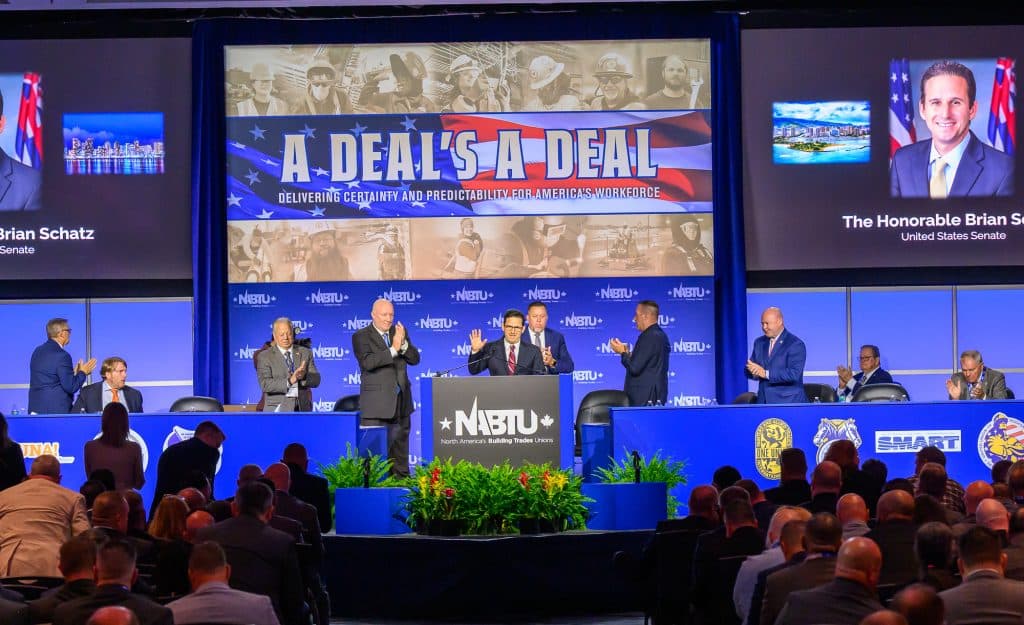
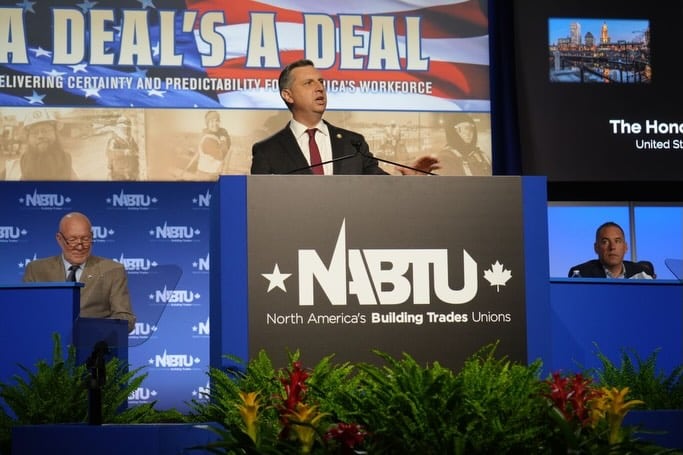
The conference theme, “A Deal’s A Deal,” reflected core principles of our nation and our movement.
First, the building trades will always provide a path forward for working people nationwide; that’s the deal we make for our communities and members.
Second, the workers who build the United States deserve to be supported by the people elected to represent them: no more broken promises, canceled projects and ripped-up contracts.
That’s the deal SMART members are owed, and the one that union leaders work tirelessly to secure.
SMART leaders hear from politicians, build knowledge in workshops
NABTU President Sean McGarvey, a longtime ally of SMART members across North America, spoke about the stakes of that deal in his keynote address on Tuesday, April 21. McGarvey minced no words talking about the crisis American workers face today: contracts and commitments getting walked back, uncertainty, shifting goalposts. In other words, deals getting broken.
“At a time when too many forget their own signature, the building trades are here to remind America: A deal is a deal,” McGarvey said.
Canceled construction projects — from Flint, Michigan, to ports nationwide— are attacks on the jobs and livelihoods of SMART members and fellow working Americans. They undermine communities, and they slow our nation’s progress. But despite these challenges, McGarvey said, the building trades continue to look forward. Whether expanding pre-apprenticeship programs, aggressively recruiting veterans into our trades, using mechanisms like the AFL-CIO Housing Investment Trust to fund union-built affordable housing developments, or working overtime to reduce overdose and suicide deaths in the construction industry, SMART and fellow building trades unions are fighting tirelessly to support members and communities nationwide.
“This is what unity and solidarity looks like,” McGarvey said, after telling attendees that overdose deaths in the construction industry dropped nearly 30% in one year. “This is what the building trades do … when we all come together, we make each other’s lives better.”
There is no use sugarcoating the challenges we face. Decisions made at the federal level have thrown the construction industry into disarray, sent prices skyrocketing and squeezed working Americans. That’s why organized labor is more important than ever, McGarvey concluded.
“Our movement has seen moments like this before … and every single time, the building trades rose to the occasion,” he said, adding: “We built this nation before, and we’ll build it again.”
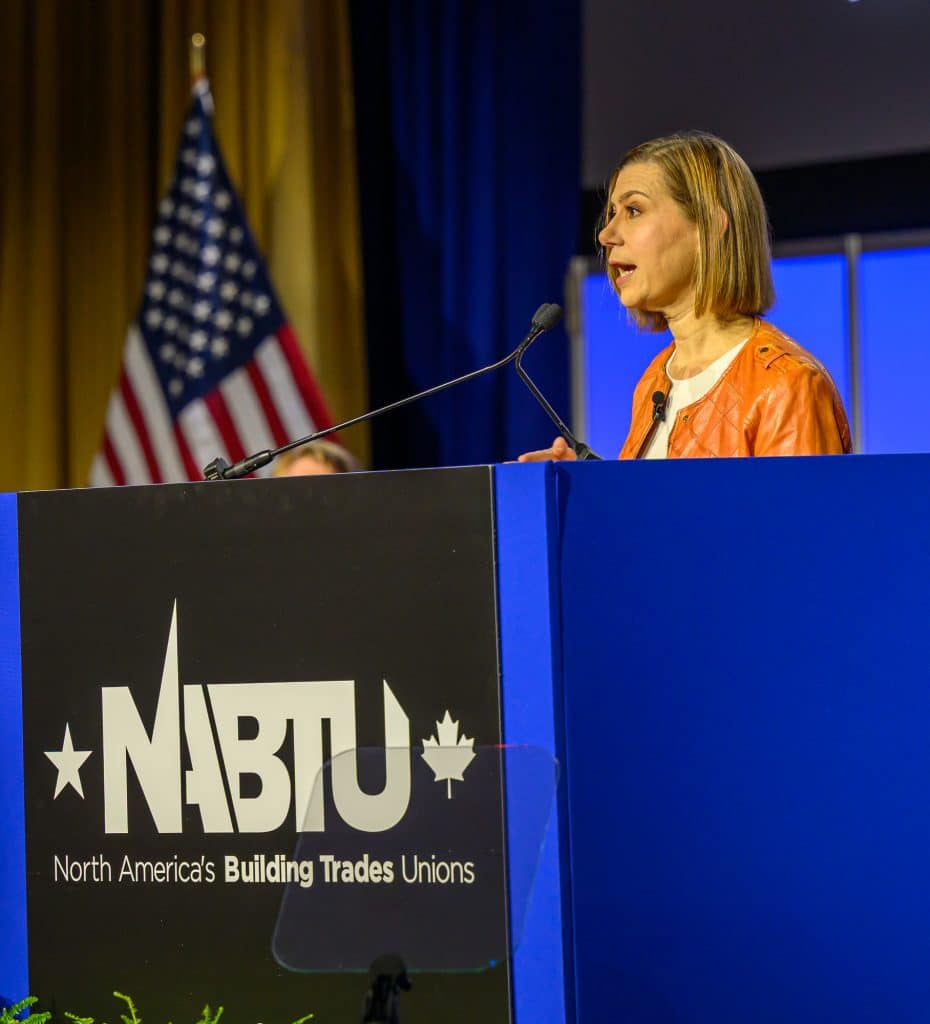
Along with McGarvey, union leaders also heard from Liz Shuler, president of the AFL-CIO, who focused her remarks on the growing presence of artificial intelligence and advanced technology in our work, our industries and our personal lives. Union members don’t want to be constantly surveilled by AI programs, or have their jobs threatened by technology. We also don’t want to stop forward progress for our country.
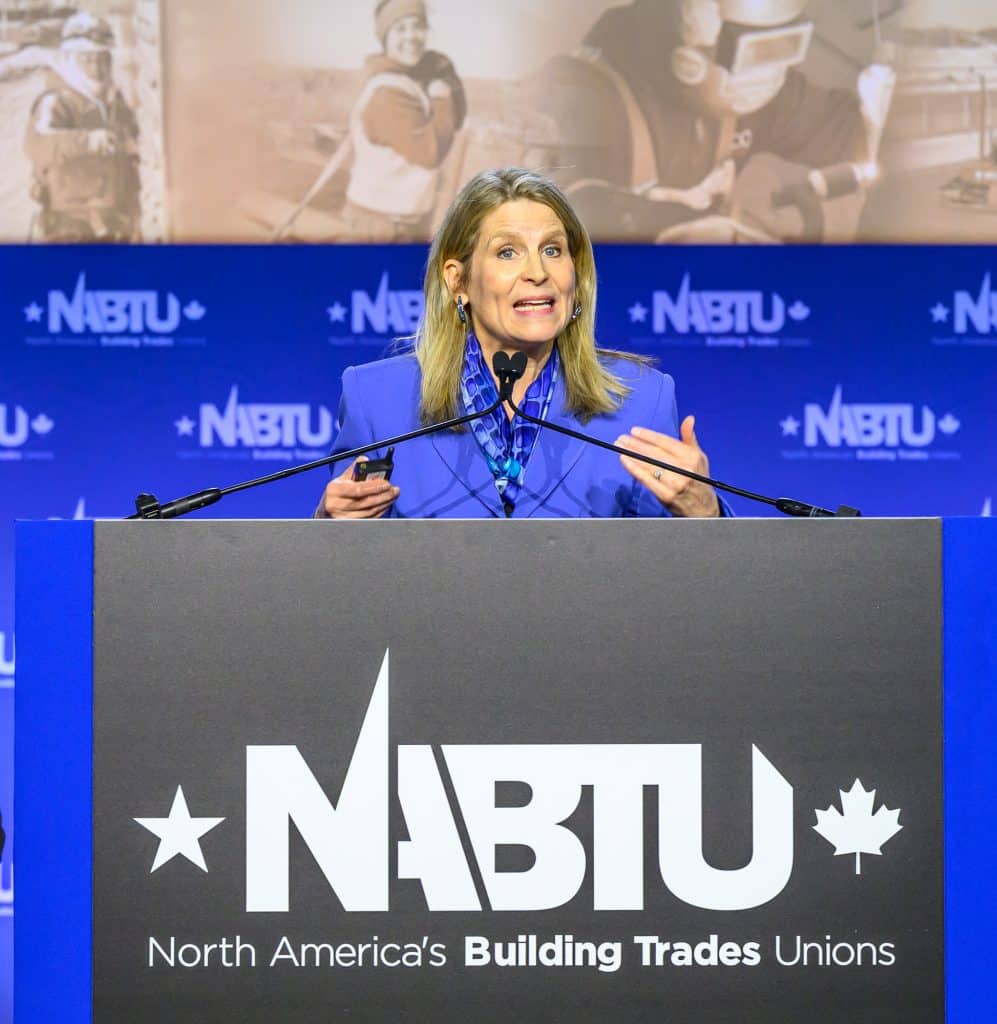
Chang Suh of the AFL-CIO Housing Investment TrustAFL-CIO President Liz Shuler
What we want, she said, is for working people to build the economy of the future.
We want technology to help working-class Americans, not force them into unemployment. We want data centers built with project labor agreements and community benefit agreements in place — creating good, union jobs and ensuring that communities aren’t subsidizing corporate profits at the expense of the places they call home.
“We are at the most important fork in the road our economy has faced in 100 years,” Shuler said. “Are we going to put workers in the driver’s seat to decide our future?”
She concluded: “Labor is going to lead again.”
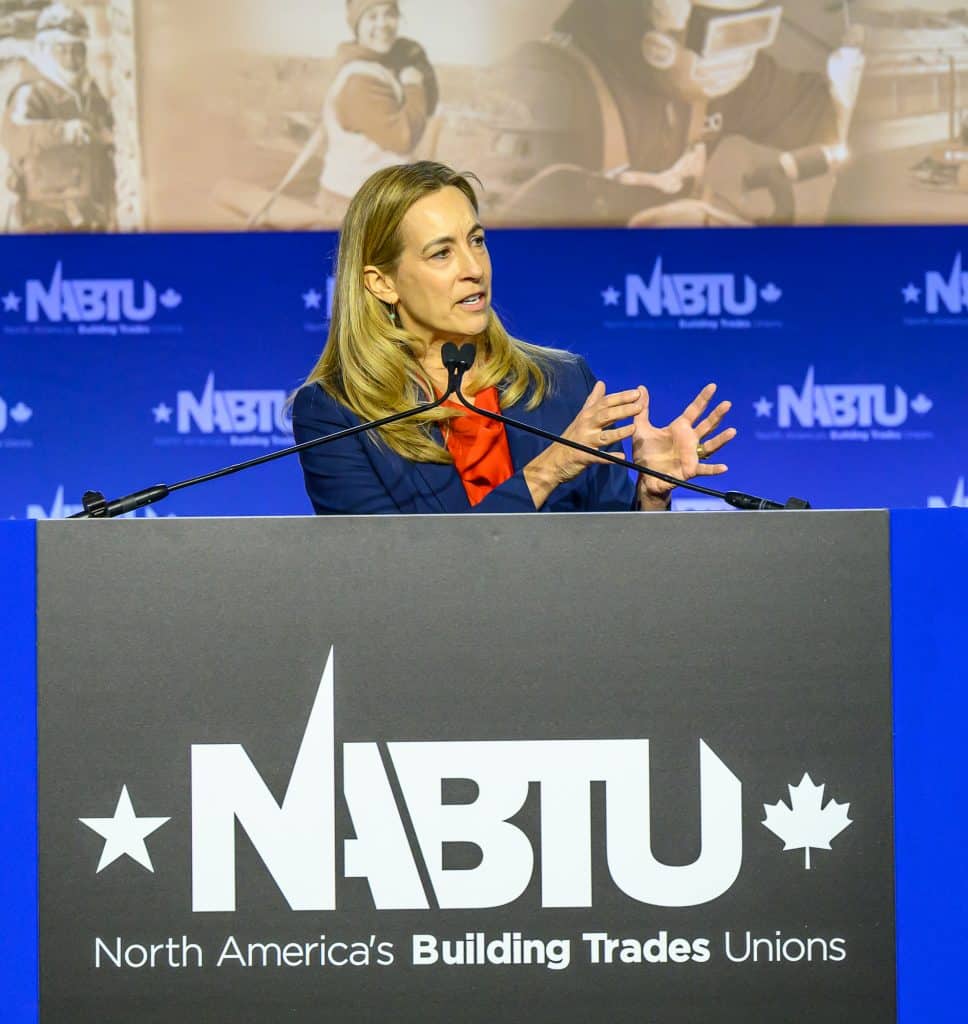
SMART leaders advocate tirelessly in the halls of power, bringing members’ voices to politicians regardless of political party. On Tuesday, elected leaders returned the favor: NABTU attendees heard from New Jersey Governor Mikie Sherrill, Senator Elissa Slotkin of Michigan, Senator Brian Schatz of Hawaii, Senator Chuck Schumer of New York and Representative Greg Casar of Texas.
Sen. Schatz
Holding a range of positions and representing vastly different geographic areas, the political speakers talked about different topics in their remarks. But there were consistent throughlines. First, recognizing the failures of both political parties to truly support workers by creating jobs, lowering prices and building housing, among other examples. Second, the importance of keeping the promises our country and its leaders have made to working people: making sure deals are followed through, not abandoned on the campaign trail.
“Workers are getting screwed every single day, so we need to fight back with everything we have — and win,” said Senator Schatz. “The best way to support the building trades is to actually build things.”
Representative Casar agreed.
“If you make this country run, you should have a union wage and the ability to retire and take care of your kids,” he said in his remarks.
“In Washington, every single day, rich and powerful people wake up like it’s their job to pit working people against each other. They do it because they want to rob us blind,” Casar added. “That’s our money created by our labor.”
While the plenary session offered the opportunity to hear directly from elected members of Congress, afternoon workshops were just as valuable.
SMART leaders and fellow attendees attended breakout sessions on data center construction and the importance of winning the work; updates on White House, agency, and congressional initiatives affecting multiemployer pension and health plans; investing in union-built affordable housing through the AFL-CIO Housing Investment Trust; and much more. Whether workshops focused on artificial intelligence training, peer mental health support, benefits for veterans or any of the other topics available, there was one common theme: working proactively and innovatively to secure the future for union building trades workers.
Wednesday speakers demonstrate bipartisan support
As SMART General President Michael Coleman has said repeatedly, our union’s issues aren’t Red or Blue — they are about improving the lives of SMART members and their families. During the final day of the NABTU Legislative Conference, that principle was put on display, with elected officials and candidates from across the political spectrum speaking to attendees about the issues that matter to building trades workers. Union leaders heard from Congressmen Seth Magaziner, Mike Lawler and Brian Fizpatrick.
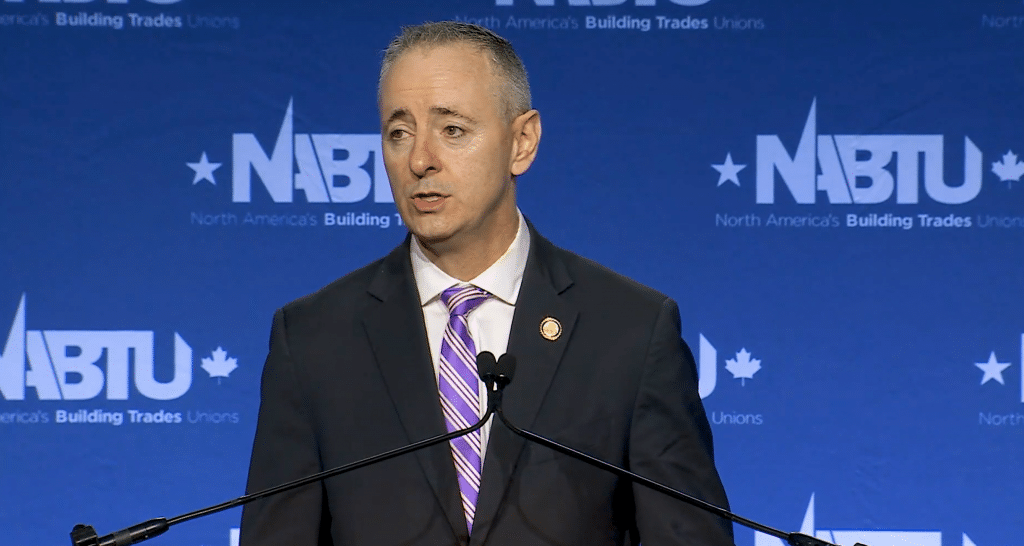
Congressman FitzpatrickCongressman Magaziner
Republican Rep. Fitzpatrick has been a longtime friend of the union building trades, oftentimes bucking his party leadership in order to support SMART members and working families. Fitzpatrick helped draft one of several pro-worker laws passed under the Biden administration, the Bipartisan Infrastructure Law, to help put SMART members to work building our country.
“Infrastructure is not separate from American strength. Infrastructure is American strength,” he emphasized.
On the morning of his NABTU remarks, Fitzpatrick introduced a bill to revive Inflation Reduction Act tax credits, which would create jobs for SMART members.
Fitzpatrick was joined at NABTU by fellow Republican Rep. Mike Lawler, who has also prioritized several pro-worker votes despite the majority of his party doing the opposite — including the Protect America’s Workforce Act to restore collective bargaining for federal workers. The presence of Lawler and Fitzpatrick alongside Rhode Island’s Rep. Magaziner, a Democrat, demonstrated that our union will work with any leader, regardless of party, on behalf of SMART members.
“Thank God that in our free country, workers can join together and achieve power. Organized labor built this country, and organized labor will save this country,” Magaziner said. “We need to build again.”
Senator SlotkinGovernor SherrillDelegate Melissa Wells
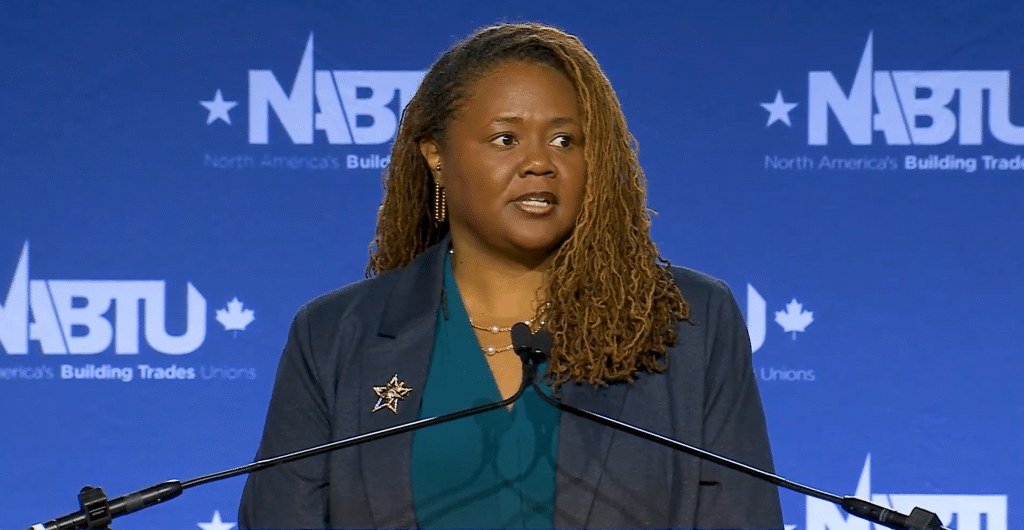
The plenary session ended in fitting fashion: with a spotlight on building trades brothers and sisters who have stepped up to serve working people in elected office (or who are currently running for office). Attendees heard from Maryland State Delegate Melissa Wells, former Alaska State Senator and current candidate for governor Click Bishop, Canton, Ohio, Mayor William Sherer, Oak Creek Mayor and Wisconsin Assembly candidate Dan Bukiewicz, and Jason Shedlock, president of the Maine Building Trades and candidate for Maine House.
All of these leaders are proud union members, working to bring the voice of building trades workers to the halls of power.
“If we don’t start treating the halls of power like the rat jobsites that they are, nothing will ever change for us,” Shedlock bellowed.
SMART reception honors top PAL locals, welcomes candidates
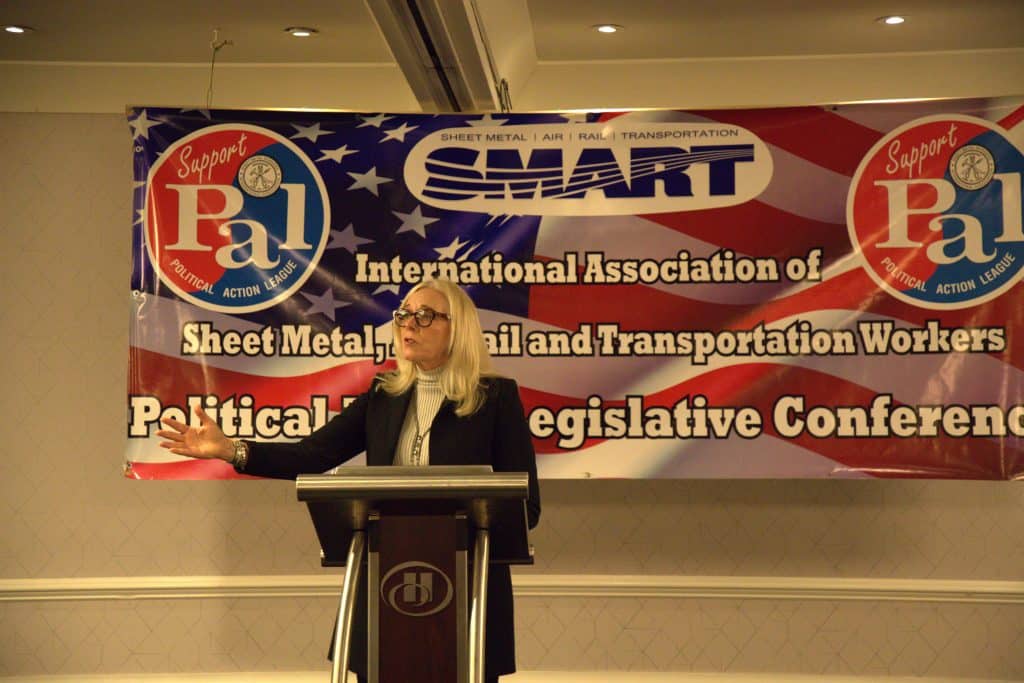
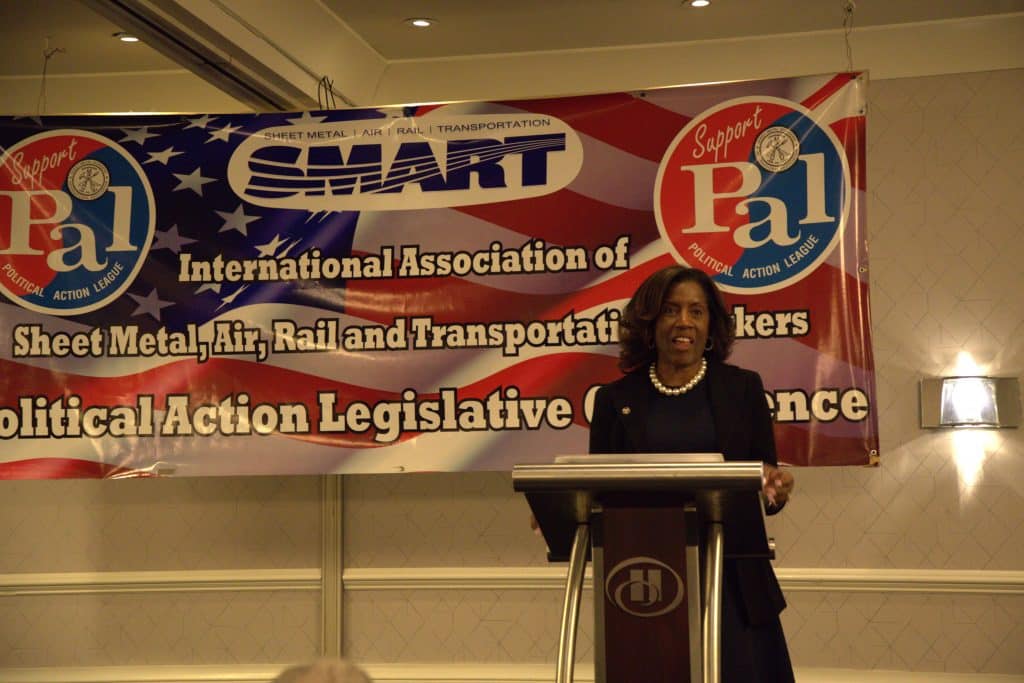
Each year, SMART holds a reception during the NABTU Legislative Conference to honor the top 31 local unions with the highest donations, per capita, to the Political Action League (PAL). During the 2026 reception, SMART also heard from candidates seeking office: Illinois candidate for Congress Donna Miller and House of Representatives candidate Shannon Taylor of Virginia.
Shannon TaylorDonna Miller
SMART engages with officeholders and candidates early and often for one reason: to ensure their support for our members and their families. During their remarks to SMART leaders, Miller and Taylor pledged to do exactly that.
The top 31 PAL locals:
Local 434 (Los Angeles, Calif.)
Local 27 (Southern New Jersey)
Local 66 (Seattle, Wash.)
Local 71 (Buffalo, New York)
Local 265 (DuPage County, Illinois)
Local 112 (Elmira, New York)
Local 17 (Eastern Mass.)
Local 22 (Union, Morris, Somerset, Sussex Counties, N.J.)
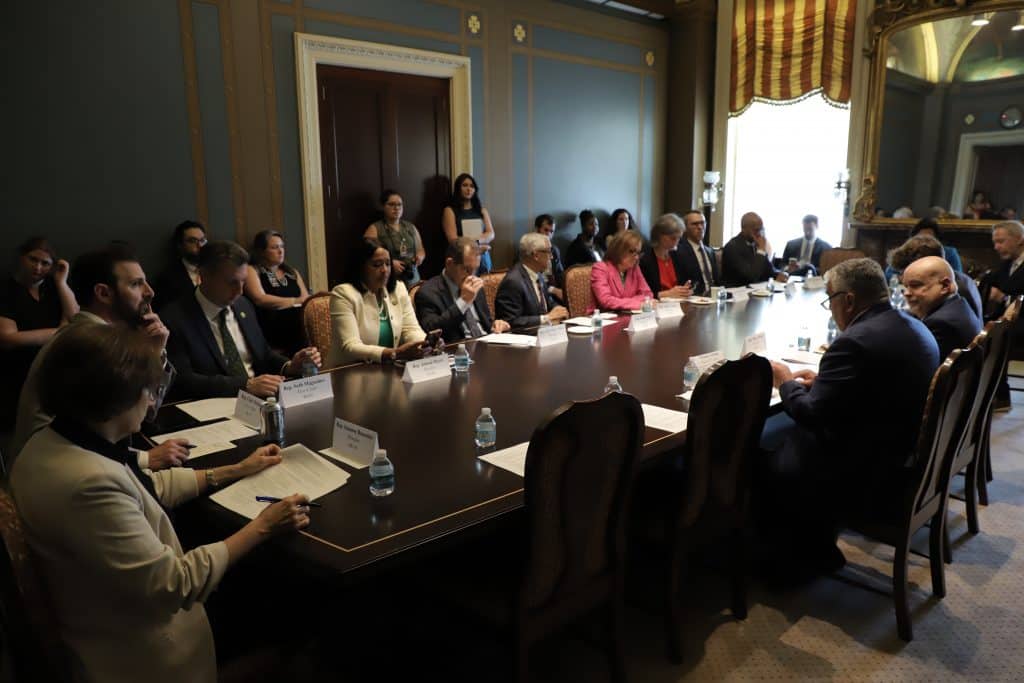
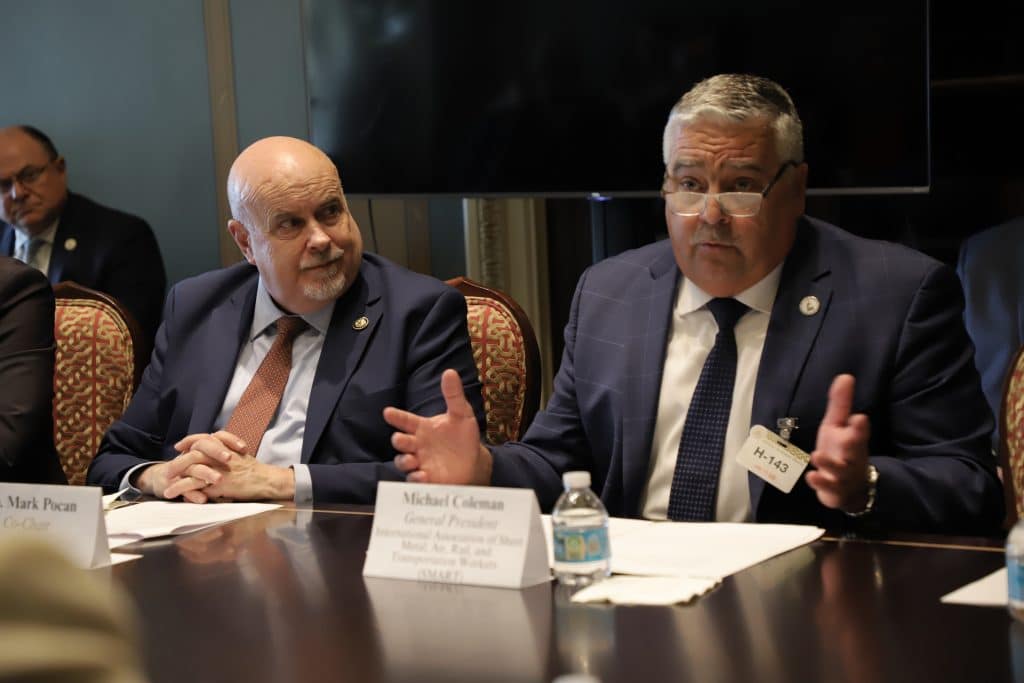
SMART General President Michael Coleman joined the United States Congressional Labor Caucus on April 15, 2026, to bring the voice of SMART members to Congress.
The Congressional Labor Caucus is co-chaired by Representatives Mark Pocan, Donald Norcross, Debbie Dingell and Steven Horsford. The caucus has more than 120 members of Congress working to protect workers’ rights, to advance the priorities of workers and the labor movement, and to connect legislators directly with workers and unions.
From rail safety legislation to investments in infrastructure, elected representatives have a real impact on SMART members nationwide — which is why it’s important that they hear from us directly. In his meeting with congressmembers and staff, General President Coleman discussed the importance of strengthening and expanding registered apprenticeships, rail and transit operator safety, the need to pass laws that create jobs for sheet metal workers, and more.
“[Registered apprenticeships] build a strong pipeline of skilled workers for in-demand industries while opening the door to high-paying careers without student debt,” Rep. Pocan said on X after the meeting. “Expanding access to apprenticeships is how we create opportunities for every American, and I will continue to support these critical programs.”
Bringing member priorities directly to the people who represent them: That’s leadership in action!
On April 13, 2026, SMART General President Michael Coleman announced the appointment of Josh Garner as SMART’s new director of business and management relations, following the retirement of outgoing director Tom Fischbach. Garner began his new position on May 1, 2026.
Fischbach’s retirement followed nearly five decades of service and solidarity. His journey began on October 16, 1979, when he entered the apprenticeship program at Local 22 in New Jersey. Over the years, he steadily rose through the ranks — serving as foreman, project manager/estimator, trustee, Executive Board member, vice president and president. He later was elected business agent/financial secretary-treasurer, then business manager/president, before ultimately advancing to the International as director of business and management relations, a position he held with distinction for six years.
Fischbach (left) and Garner
In addition to his leadership roles within SMART, Fischbach has been a committed advocate for the broader labor movement. He served as president of the Mechanical Allied Crafts Council, president of the Metropolitan Association and as financial secretary-treasurer for the Union County Building Trades in New Jersey, strengthening partnerships and advancing opportunities for working men and women across the region.
Fischbach’s commitment to service extends beyond his professional life. For 20 years, he served his community as a volunteer firefighter in his hometown — an often-overlooked role that requires the same rigorous training, discipline and readiness as full-time firefighting. Rising through the ranks from trainee to lieutenant and ultimately captain, he exemplified courage and dedication in service to others.
“We thank Tom for his service to this union and wish him the best in this next chapter,” said General President Coleman when announcing the transition.
New Director of Business and Management Relations Josh Garner has been a member of Local 18 (Wisconsin) since 1998. In 2020, he was appointed an International organizer and was subsequently promoted to regional organizing director for Region II in 2025. Prior to his position at the International, Garner served as a Local 18 statewide organizer for 10 years, where he led strategic campaigns, political outreach and membership education efforts. He also served as the local’s financial secretary-treasurer and as a business representative.
“Josh has demonstrated strong leadership skills as regional director. He will be a great fit for this very important position,” said General President Coleman in his announcement.
On Monday, March 9, the Trump administration’s Department of Labor (DOL) issued new guidance regarding registered apprenticeship programs. SMART General President Michael Coleman gave the following statement in response:
“I’ve said since January 2025 that I’m committed to calling balls and strikes with this administration. Calling for one million new apprentices? That’s a strike. Getting to one million apprentices by lowering the standards and potentially damaging our union’s apprenticeship programs? That’s a ball, no question.
“Our union’s registered apprenticeship programs are the bedrock of the sheet metal industry — for workers, for union contractors and for our country. Through our strong registered apprenticeships, working Americans get trained at the highest standards, make a living while learning the trade, and build the infrastructure that our communities rely on. This has set the bar for our industry and our nation for generations.
“But this model depends on rigorous standards that apprenticeship programs must meet to avoid undermining our high-quality training — and the Department of Labor’s guidance puts those standards at risk. This guidance would encourage apprenticeship programs to focus on speed instead of skill development, create a 30-day ‘shot clock’ for the DOL to rubber stamp new programs in a rush, and increase flexibility for employers — potentially reducing the current emphasis on protecting workers and creating opportunity for all apprentices.
“There’s a lot more to be said about this dangerous guidance. But I’ll get straight to the point: This is a threat to SMART members, our families, our apprenticeship programs and tradespeople everywhere. We urge the Department of Labor to change course, and we call on the president to stand up for our nation’s workers by strengthening the standards that protect them.”
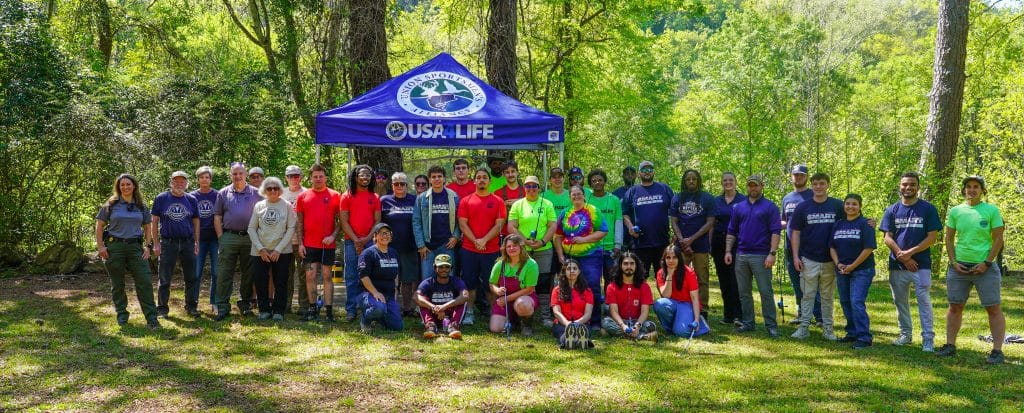
SMART members across the United States and Canada regularly enjoy all that the great outdoors has to offer: hunting, fishing, hiking and beyond. In a demonstration of our union’s values, SMART Local 85 (Atlanta, Ga.) member Dee Lee recently extended that same passion to area families.
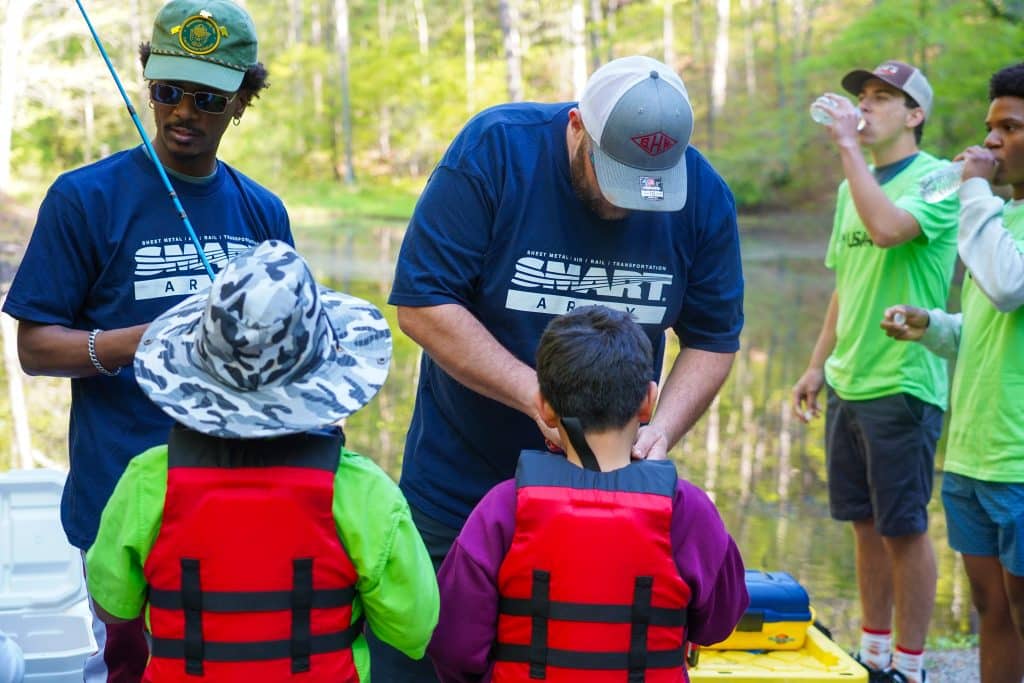
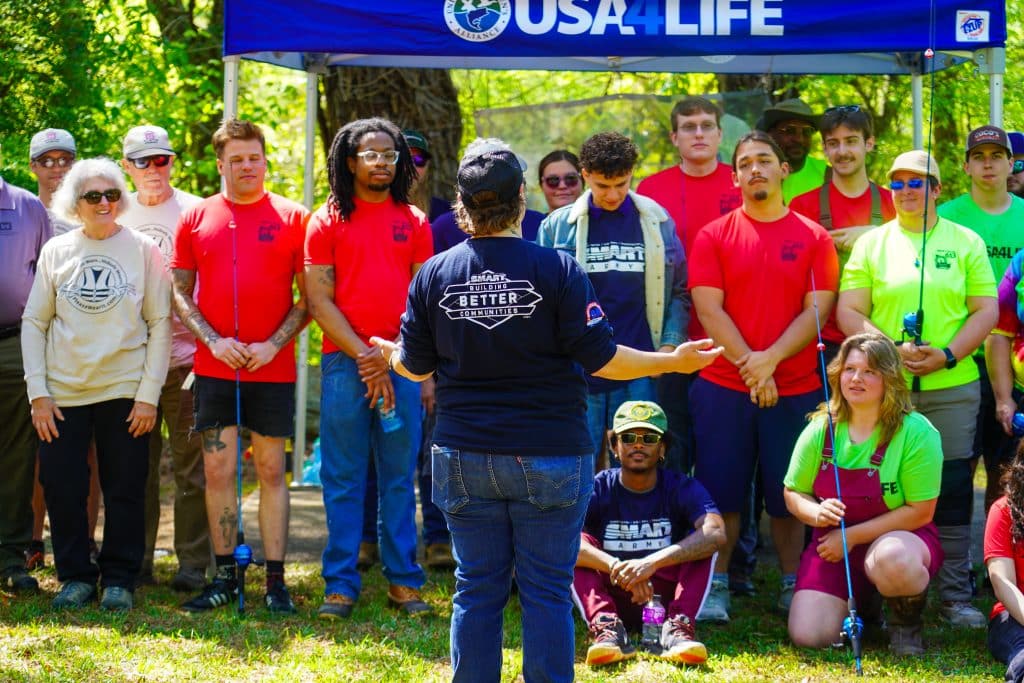
On April 11, 2026, Lee worked with the Union Sportsmen’s Alliance (USA) and fellow union volunteers to put together the inaugural Greater Atlanta Kids Nature Day. Alongside the United States Army Corps of Engineers, union volunteers introduced 100 attendees to the joys of fishing and getting outside.
“I relived the excitement, accomplishment and achievement of catching my first fish,” Lee said. “It’s special knowing that these kids are going to have something they can look forward to for the rest of their lives.”
Kids Nature Day was the third community service effort Lee has helped organize in the last several years. Previously, Lee and fellow union workers installed an AccuDock boat dock at Lake Allatoona near Atlanta, and Lee and Local 85’s Nathan Allred put together a 5k for suicide prevention and mental health awareness just last year.
The 2026 Kids Nature Day event was part of a series of free, community-based youth outreach events organized under USA’s flagship conservation program, Work Boots on the Ground. Each kid took home a free rod and reel, plus a drawstring bag full of goodies.
Community member Renee White saw Kids Nature Day as the perfect opportunity to connect her nephew, Josiah, with the outdoors. As Josiah danced in his black cowboy hat and brown boots after catching a fish, she took in the moment and the time they spent together as a family.
“It means everything,” she said. “We’ll cherish the memories forever.”
SMART-TD leaders, members and the public have been hit with a harsh reality. The Federal Railroad Administration is no longer on our side, and they aren’t even pretending to be a neutral party anymore.
They’ve picked a side, and they are 100% on team corporate railroads.
In the span of 48 hours in late April, the FRA dropped 11 final rules that make one thing clear: They are clearing the path for the railroads to do whatever they want, free of guidance and oversight, with hardly any consequences and even fewer workers.
You don’t need to read between the lines to see this reality. It isn’t subtle. FRA is telling SMART-TD and every railroader that the risk to your well-being is worth it for the carriers’ profit.
In fact, FRA Administrator David Fink said that he “want[s] to see the industry thrive,” and his methodology for doing so is deregulation, noting during an April speech that “the previous administration, there wasn’t really that much done on the deregulatory side.”
Obviously, he plans to change that.
FRA administrator tells the world what he thinks
At a United States Department of Transportation (DOT) technology event hosted at DOT headquarters on Tuesday, April 28, Fink made it as clear as possible that the goal is to push new tech out “as soon as practical.” According to a report from Bloomberg, that includes autonomous railcars, additional AI monitoring of employees and systems designed to cut crews out of the picture altogether.
Fink, during his speech, specifically pointed to Parallel Systems(a company actively working to operate freight trains without human crews) as the kind of innovation they want to move forward with. Interestingly, Parallel Systems’ testing of its technology and equipment was approved under the last administration. The difference, however, is that the approval came with conditional safeguards to keep the railroad system and the public safe.
This administration’s FRA is now working to reverse that.
Let’s connect the dots
They’re rolling back the rules that protect us while fast-tracking the technology most likely to maximize profits.
That’s not a coincidence. That’s the plan.
The director and deputy director of SMART-TD’s National Safety and Legislative Department, Jared Cassity and Don Roach, were scheduled to be at the FRA’s technology demonstration on April 28.
They didn’t go. After seeing what FRA pushed out as rulings in the days leading up to it, they made a point NOT to attend.
As Cassity said, “We aren’t going to be at a party celebrating the FRA’s new path and plan to eliminate our members’ safety, rights and ultimately their jobs.”
Roach and Cassity said they want to be clear about something: Their protest of the April 28 event wasn’t about being against technology.
It’s about what happens when you take trained railroaders out of the equation.
This job isn’t simple. It’s not predictable. It’s not something you hand off to a computer and walk away from. We move hazmat. We move heavy tonnage through cities, towns, crossings and yards every single day. Things go wrong.
Conditions change. Decisions have to be made in real time on the fly.
That’s what we do.
And now they want to strip that down while also weakening the federal regulations that are supposed to keep everything in check.
Reckless timing
On April 16, SMART-TD told rail members about a Cybersecurity Alert that we received from the FRA.
This warning was issued by the exact federal agency that stood before a microphone on April 28 and told the world that freight trains should rely on the systems most vulnerable to bad actors. It’s unfathomable that both of these statements came from the same place, 12 days apart from each other.
We’re in a world where cyber threats are real and getting worse. Systems get hacked. Networks go down. Bad actors look for ways to disrupt critical infrastructure.
And what’s the response from FRA?
Tie more of the operation to software, automation and remote systems. Allow the removal of the human beings who can actually respond when something breaks or intervene when systems get hacked.
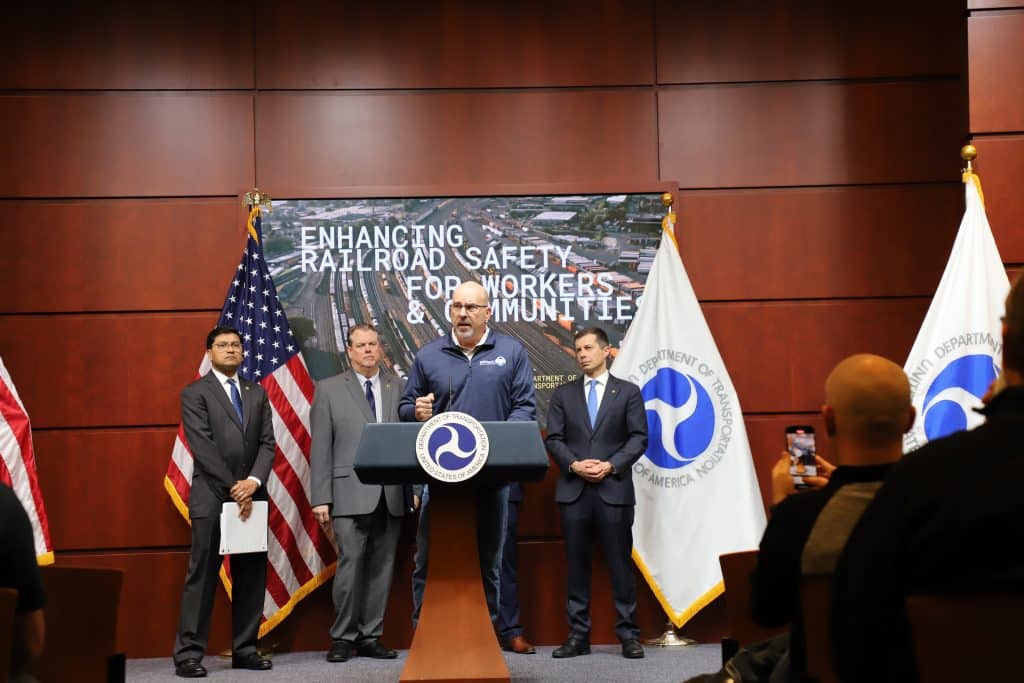
SMART-TD President Jeremy Ferguson speaks during the Biden administration FRA’s announcement of its two-person crew rule, as former FRA Administrator Amit Bose (furthest left) looks on
A new reality
It was just 2024 when the FRA finalized its two-person crew rule, a major win for common sense, communities and railroaders nationwide. Now, the FRA isn’t pretending to balance safety and industry anymore. They’re helping the industry overcome its biggest obstacle: dealing with a trained workforce and following the rules and regulations that protect it.
SMART-TD members are living this reality; you know it better than anyone. The railroads don’t want to train us. They don’t want to pay us. And they definitely don’t want to be held accountable to anyone but themselves.
We, their employees, are the “problem” they’re trying to solve.
And now we know Administrator Fink — who, not surprisingly, was the CEO of a railroad in his past job — is publicly pledging that the United States FRA is here to help them realize that vision of the future.