As the largest rail labor organization in the United States, SMART Transportation Division (SMART-TD) remains deeply engaged in evaluating the implications of the proposed merger between Union Pacific (UP) and Norfolk Southern (NS). We approach this development with measured skepticism rooted in the real-world impact such consolidation could have on rail workers, safety, service quality, and the long-term health of the freight rail industry.

Freight Rail Service Quality at Risk

Class I railroads continue to grapple with persistent service challenges as a result of Precision Scheduled Railroading (PSR). The Surface Transportation Board’s (STB) recent decision on reciprocal switching could further strain operational fluidity and responsiveness. Merging two large carriers, particularly one with an entrenched PSR framework, risks exacerbating these issues, not improving them.

Worker Safety and Operational Culture

Under its current leadership, Union Pacific has developed a troubling safety record. Publicly available data from recent years reveals UP leads the industry in accidents, incidents, injuries, and fatalities. This trend reflects a broader corporate culture that, in our view, prioritizes aggressive operating ratios over worker and public safety. In stark contrast, Norfolk Southern in recent years has moved toward more progressive labor and operational policies that prioritize training and transparency and have publicly pledged not to furlough conductors or engineers during economic slowdowns.

Labor Relations and Discipline Practices

UP’s approach to labor engagement and disciplinary procedures reflects a pattern of disengagement and hostility. Disciplinary actions at UP have reached excessive levels, raising serious concerns about harassment and retaliatory behavior. Furthermore, UP was found to have misled the Federal Railroad Administration during a recent safety audit. This is not the foundation upon which a safe, efficient, and equitable national rail system can be built.

While NS has made efforts to improve its labor relations practices, including more transparent negotiations and a constructive stance on workforce retention, folding it into a UP-led structure raises the risk of reversing these advances.

Threats to Infrastructure Access and Local Service

Union Pacific has demonstrated an alarming willingness to lease yards and even mainline trackage to non-union Class II and Class III railroads in pursuit of short-term financial gains. These actions reveal a pattern of divestment that is incompatible with a sustainable, service- oriented freight rail system. The prospect of UP operating a coast-to-coast network intensifies concerns that the company will continue to lose focus on shippers’ needs in favor of operational centralization and financial engineering.

By leasing off infrastructure crucial to servicing industries (especially in the first-mile/last-mile context) UP not only threatens the availability of work for our trained, FRA-certified union members, but also endangers the safety and efficiency that shippers depend on to keep their operations running. This abdication of their responsibilities under the common carrier agreement may very well lead to the degradation of localized service. It would be a direct blow to the competitive viability of American manufacturers and suppliers who rely on high-quality rail connectivity to reach markets.

Impact on Shippers and Network Access

UP’s strategy of leasing off properties and focusing heavily on long-haul operations suggests a departure from vital first-mile/last-mile service. Shippers reliant on tailored, local service could see a decline in responsiveness and flexibility, especially as terminal rationalization and network simplification increase.

Moreover, such a merger would encourage further consolidation across the Class I rail system, triggering another wave of transcontinental mergers creating a duopoly. Both history and logic suggest this would drive higher rates, fewer service options, and diminished competition.

Shippers and communities deserve more than a monopoly in disguise.

Labor Practices in Flux

UP has repeatedly shown a willingness to furlough or lay off craft workers (conductors, engineers, and others) even during periods of stable or growing traffic. This practice undercuts workforce stability and signals a disregard for long-term investment in skilled rail labor. By contrast, NS leadership has committed publicly to retaining and developing its workforce during economic slowdowns. This is a difference that highlights how dramatically labor strategies could diverge under a combined system.

Conclusion

SMART-TD urges all relevant regulatory bodies, elected officials, and stakeholders to conduct a rigorous, transparent, and labor-informed review of this proposed merger. Our labor organization has every intention to oppose this merger when it comes before the Surface Transportation Board for approval.

Media Inquiries

If you are a member of the press and would like to speak to someone in our office directly on this topic, please reach out to Dan Banks, who oversees the SMART-TD Public Relations Department. He can be reached at dbanks@smart-union.org or on his cell phone at (330) 322-5949.
You can help report blocked railroad crossings in your community thanks to a new tool from the Federal Railroad Administration (FRA), whether you’re on the job or off the clock.   
 
Because there are no federal laws or regulations on the books that deal with blocked crossings, the FRA wants to learn where, when, and for how long these incidents are happening and the resulting impacts.  
 
However, the FRA notes that there may occasionally be valid operating and/or safety-related reasons that a crossing is blocked by a slow or stopped train.  
 
The goal is to share this information from the reports with relevant organizations, including railroads, state and local governments, and other federal agencies.  
 
Respondents are asked to use a digital form to submit the requested information and to only report each blocked crossing once.  
 
To do so, follow these steps:  

  • Visit the FRA’S Blocked Crossing Incident Reporter ► 
  • Check “I Understand” and click on “Continue to Report” 
  • Once the map appears, click on the Location icon to find crossings near you or use the “Search” feature at the bottom of the page to look up crossings by address 
  • After finding the crossing that you want to report by clicking on the appropriate yellow railroad crossing sign, you’ll be prompted to answer several questions, including whether you’ve contacted the railroad, why the crossing was blocked, and when the incident occurred 
  • Click the green “Report Blocked Crossing” button 

Click here to track the data that’s already been submitted and filter by state, region, railroad, or incident type. ► 

Please note that the FRA does not confirm the accuracy of the blocked crossing reports submitted to the portal.  

Thank you for providing valuable information that directly impacts communities across the country.  

There’s just over two weeks left to submit your photos for SMART-TD’s 2026 calendar! 

All images must be received by Sunday, August 31 to be included for consideration.   

If your photo is selected as one of the best submitted, it will be featured by SMART News and you will receive some SMART swag!   

Mail printed photographs to:  

SMART-TD News  
6060 Rockside Woods Blvd. N, Suite 325  
Independence OH, 44131  

High resolution digital photos should be in JPG format at the largest, highest quality setting available to you. Email them to news_td@smart-union.org. We prefer horizontal compositions.  

Tell us about your photos — please include a document listing your name, local, when and where the photo was taken, what’s going on and the names of anyone in the picture. List names as they appear in the photo, left to right.   

All photographs submitted become the property of SMART, which allows us to publish them in the calendar, newspaper, social media, and other places.

Remember to review your employer’s policies regarding the use of cameras and other electronics on property or during work hours.  

From the moment the Senate passed the One Big Beautiful Bill Act (OBBBA) without including transportation workers in the overtime tax relief, labor unions across the country recognized the need for action. 

A broad coalition of labor organizations is now urging Congress to fix a technical flaw in the legislation that unfairly blocks millions of transportation workers, including railroaders, airline crews, truckers, and delivery drivers, from accessing new tax relief provisions intended to benefit hourly workers. 

What’s the Issue?

The OBBBA created a new section of the tax code (26 USC § 225), which allows hourly employees to deduct up to $25,000 in overtime from their taxable income. However, the law’s reliance on a nearly century-old definition of “overtime” from the Fair Labor Standards Act (FLSA) means that workers whose overtime is defined by other laws were simply left out. 

This definition doesn’t reflect the nature of work in transportation and logistics, where extended shifts and unconventional schedules are the norm. As a result, workers in industries that keep our country moving are being denied tax relief that their counterparts in other sectors are able to claim. 

Even first responders like firefighters and EMTs are largely left out under the current definition. The omission is supposedly unintentional, but the consequences are significant. 

Standing Shoulder to Shoulder with Our Union Family

In a strong display of unity, SMART-TD, along with more than 20 unions representing over 3 million workers, has sent a joint letter to Congressional leadership on both sides of the political aisle urging a bipartisan fix to the law. The letter emphasizes the need for a technical correction to ensure the law achieves its intended goal: to support the hardworking Americans who are putting in long hours to keep our economy running. 

Among the signatories are unions from across the transportation spectrum, including SMART-TD, the Air Line Pilots Association, the Teamsters, the Seafarers International Union, and the United Steelworkers, among many others. Together, this coalition stands shoulder to shoulder to advocate for fairness, equity, and recognition for all transportation professionals. 

A Call for Fairness

This effort isn’t about political victories or accolades. It’s about fairness and respect. It’s about making sure that the essential workers who power our supply chains, move our goods, and transport our people are not penalized by an outdated statute. 

SMART-TD’s National Safety & Legislative Director Jared Cassity said “We are proud to be part of this fight on behalf of our nation’s hardworking railroaders. SMART-TD worked to get our men and women included to begin with, and we’ll be the last to stop fighting until every transportation worker in this country gets the recognition—and the tax relief—we’ve earned.”  

The joint labor effort has earned bipartisan attention in Congress, and support continues to grow. Legislative offices are engaging with unions to understand the scope of the problem and identify ways to ensure the law reflects the realities of today’s workforce. 

This work is ongoing, and the coalition remains committed to seeing it through. 

This is what solidarity looks like. 

Brother Alfred Stinnett, an Amtrak conductor and member of Local 166 (Salt Lake City, UT), needs our help as he continues to recover from an injury received on the job that’s left him unable to work.  
 
In January 2025, Brother Stinnett, who also serves as a trustee for Local 166, tore his shoulder after slipping on ice and underwent two surgeries.  
 
As he continues physical therapy with the goal of returning to work, his medical bills are piling up.  
 
To financially assist Brother Stinnett, Local 166 President and fellow Amtrak conductor Klaus Hahn has set up a GoFundMe campaign.  
 
Click here to donate to Brother Stinnett’s GoFundMe ► 
 
After learning about the GoFundMe, Brother Stinnett shared a message with his fellow union brothers and sisters.  
 
“I want to thank everyone for all your great and very much appreciated help. It was a kind and blessed surprise when [President Hahn] had told me what he had started. It wouldn’t have been possible without everyone involved to make it happen.” 
 
President Hahn thanks SMART-TD members in advance for any help that they’re able to provide to our union brother as he continues his recovery and rehabilitation.  
 
Let’s show Brother Stinnett that we have his back as he works hard to get back on the job! 

The National Transportation Safety Board (NTSB) has concluded its investigation into the June 2023 death of a CSX conductor trainee in Baltimore, Maryland, highlighting dangerous gaps in the railroad industry’s approach to safety and training. The agency’s findings align closely with long-standing concerns raised by SMART-TD about the failures of Class I railroads to provide adequate and effective training for newly hired employees. This union is accelerating steps to take matters into our own hands. 

An Avoidable Tragedy Born of Inadequate Training

According to the NTSB’s final report, the trainee was killed after losing his footing while riding on a railcar during a shoving movement at the Seagirt Marine Terminal. The unsafe riding position, lack of secure footing, and absence of proper training on intermodal railcar configurations were all cited as contributing factors. CSX had failed to adequately train or evaluate the trainee’s ability to safely perform his duties. 

Not only is this unsettling and unacceptable, but it also exposes a pattern of lapses throughout the rail industry.  

Moreover, investigators found glaring deficiencies in CSX’s safety rules and training programs. These findings reflect a systemic problem across Class I railroads: peer conductors who serve as mentors or trainers are given no structured instruction on how to effectively teach, supervise, or assess new hires. They are not trained to recognize signs of fatigue, confusion, or uncertainty among their trainees. These issues have life-or-death consequences in such hazardous working environments. 

Whether it’s at the local, state, or federal level, our union fights like hell to ensure that safety is always a priority from Day 1, starting with training. 

SMART-TD Acts Where Railroads Have Failed

Recognizing these dangerous gaps, SMART-TD has proactively secured federal funding through the FRA’s CRISI grant program. These resources are being spent on the kinds of training programs Class I carriers neglect to provide. When complete, our goal is for all peer trainers to receive standardized instruction on mentoring, safety assessment, fatigue recognition, and clear communication. These are areas where the railroads have consistently fallen short. 

Confidential Close Call Reporting: A Missing Safety Net 

Another avenue for systemic improvement is through wider adoption of the Confidential Close Call Reporting System (C3RS). CSX and many other Class I carriers have refused to fully participate in this voluntary program. C3RS provides a safe, confidential way for railroaders to report close calls and safety hazards without fear of discipline. Expanding this program would give the industry vital insights into the recurring issues that continue to plague new hire training and all other aspects of our safety on the job. 

A Call for Meaningful Partnership with Labor 

Brother Jared Cassity, SMART-TD’s National Safety & Legislative Director, participated in this investigation and countless others like it.  

“I’ve been a party to many rail investigations involving injuries and fatalities. But the two CSX trainee deaths in Maryland last year haunt me more than any others. These were preventable,” Cassity reflected. “Railroads need to acknowledge the shortcomings in their training programs. Our members’ blood is being shed unnecessarily because of these avoidable failures. We need better training, clearer yard markings for close clearance hazards, and a renewed partnership between carriers, the FRA, and labor unions like SMART-TD to finally prioritize safety in new hire training programs. We stand ready and eager to lead this work.” 

Our lives depend on one thing above all else: safe tracks. That’s why SMART-TD is pushing back against a new waiver request from the Association of American Railroads (AAR) and the Class I Railroads it represents. 

The AAR wants permission from the Federal Railroad Administration (FRA) to reduce human visual track inspections by 75%, claiming it will replace the human inspectors with Automated Track Inspection (ATI) systems. But here’s the truth: ATI misses 73% of defect types that human inspectors catch.  

That’s not safety, it’s a shortcut. When shortcuts fail on the railroad, people die. 

We filed a full public comment with the FRA to stop this waiver. You can read it below, but here’s what you need to know. 

The AAR Wants to Cut Inspections in Half — Then Do It Again 

Current rules require that tracks get two human inspections per week. Under the AAR’s waiver request, that would drop to two per month.  

As a result, potentially broken tracks would remain in service for days on end, with nothing more than a computer readout and a 72-hour wait-and-see policy if a defect is found. 

Ask yourself this. Would you want your train to be the 12th or 200th one to run over a piece of track flagged by a machine for a defect but not fixed for three days?   

Technology Should Help, Not Replace, Human Judgement 

SMART-TD fully supports innovations that make the railroad safer.  

During a June Congressional hearing, Brotherhood of Maintenace of Way Employees (BMWE) President Tony Cardwell spelled it out clearly: ATI can only identify track defects related to track geometry and misses 73% of the derailment-causing defect types that trained track inspectors regularly identify. Letting this waiver through would mean blind spots—big ones—on nearly every mile of track. 

This means they can’t detect loose bolts, worn ties, damaged switches, track obstructions and more.  

President Cardwell also cited the Bible in his testimony, quoting Ezekiel 33:6.

“But if the watchman sees the enemy coming and does not sound the alarm to warn the people, he is responsible for their death.” 

At SMART-TD we have been sounding the alarm for years. We see what’s coming, and we’re calling on the FRA to heed our warning.  

This Waiver Isn’t About Safety, It’s About Profit (As Always) 

Don’t be fooled by the AAR’s language. They’re not asking to use ATI. They already can, and as often as they like. There is no regulation that prevents it.  

What they’re really asking for is permission to get rid of track inspectors’ paychecks, which are an investment in employees who know the tracks the best.

We won’t stand by while that happens. 

This will increase the risk, and our members will be the first to experience the consequences. The men and women of SMART-TD are not data points in a risk manager’s spreadsheet. The communities we run through are not acceptable collateral damage. The risk of one preventable derailment (let alone dozens) is too high to justify a little extra in a stockholder’s dividend check. 

We’re Standing Up for Our Members and the Public 

SMART-TD stands with our BMWE brothers and sisters, and we won’t back down. Your safety is not negotiable.  

The FRA must reject this waiver, keep inspections by certified track inspectors intact, and refuse to gamble on rail safety. 

We’re proud to fight for the lives, dignity, and future of our members. 

Read our full comment below and stand with us. 

By a strong majority, the members of SMART-TD Local 1785 (Santa Monica, California) have ratified a new, five-year contract with Santa Monica Municipal Bus Lines.  

Members Wanted to be Paid Their Worth

One of the most notable highlights is a significant cost-of-living adjustment over the lifetime of the agreement, which includes a wage opener in January of 2029 to go back to the bargaining table and possibly secure an additional increase.  
 
Leadership for the General Committee of Adjustment for Santa Monica Municipal Bus Lines (GCA SMB) points out that earning salaries that reflect their worth was top-of-mind for members and this agreement delivers on that priority.  
 
“I think that’s [the COLA and wage opener] going to benefit the operators financially in a significant way when we talk about transit,” explained GCA SMB General Chairperson Markeisha Haynes. “So, to possibly get us into making a substantial amount of money by 2029 is amazing.”   
 
Some of the other gains made in the agreement include… 

  • Sick Leave: New hires receive six days of six leave instead of waiting six months for sick leave accruals. 
  • Performance Evaluations: These have been removed from the contract and substituted with guaranteed step increases. 
  • Attendance Policy: Allows for a temporary step reduction in pay in lieu of a suspension. 
  • Holidays: Addition of one floating holiday 

Teamwork Gets Things Done

GCA SMB Vice Chairperson Christine Ivey praised James Sandoval, Vice President of the SMART-TD Bus Department, for his input during the negotiations.  
 
“We had a great team. James did a fantastic job,” said Vice Chairperson Ivey. “I couldn’t have been prouder of him. He understood the assignment. He went in and he did his best, and I commend him for all the effort that he put into it.” 
 
With yet another ratified agreement for SMART-TD’s Bus Department, VP Sandoval says this is proof that the momentum that’s been building in 2025 isn’t about to slow down any time soon.  
 
“During the first half of the year, SMART-TD’s Bus Department ratified several strong tentative agreements that showed that our brothers and sisters aren’t willing to settle for the bare minimum,” said VP Sandoval. “These contracts reflect our members’ worth and the professionalism, knowledge, and skill that they bring to the job. I’m very proud of Sister Haynes, the entire bargaining team, and the members of Local 1785 for their tenacity in fighting for what they deserve and becoming the latest addition to our growing list of wins for our bus operators!”  
 
General Chairperson Haynes says this contract is only the tip of the iceberg when it comes to the enthusiasm building at Local 1785.  
 
“We’re doing great things at our property, not only contract-wise but just overall as far as growth, as far as elected new officers,” explained General Chairperson Haynes. “This is the first time that our local has ever had a female cabinet. More people are starting to get involved because they’re starting to see that 1785 is moving in a great direction, so as long as we keep doing what we’re doing, getting the participation of membership, I’m really, really happy with where this is going.”  

It’s no secret that the railroad industry has never been thought of as “safe” or concerned with the well-being of its workers. 

History speaks for itself.  

One out of every 35 railroaders were injured each year in the late 1800s. There were few laws, little regulation and the railroads couldn’t be bothered to care for the family of an injured or disabled railroader. Deaths were all too common. Widows and orphans were left to fend for themselves.  

As they spread across the country, the railroads were considered a grand investment, but the dangers of the work made the railroaders themselves uninsurable and financially untouchable.  

As late as 1892, Senator Henry Cabot Lodge observed that railroaders “suffer as if they were fighting in a war.” In those early days of our industry — 1830 through 1900 — improvements to workers’ safety and security were carved out by the railroaders themselves.  

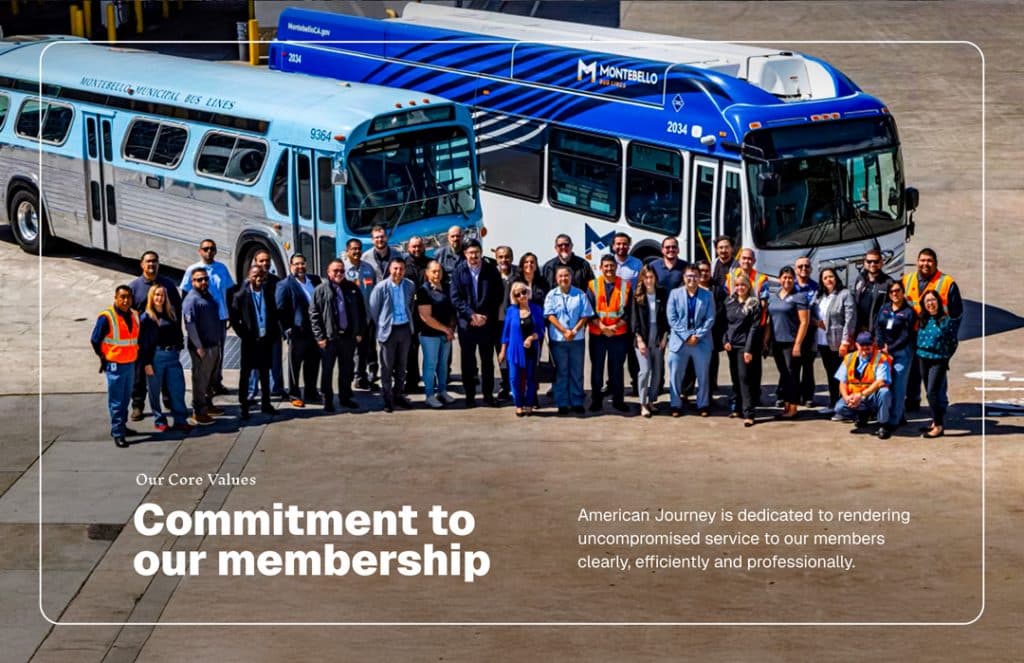
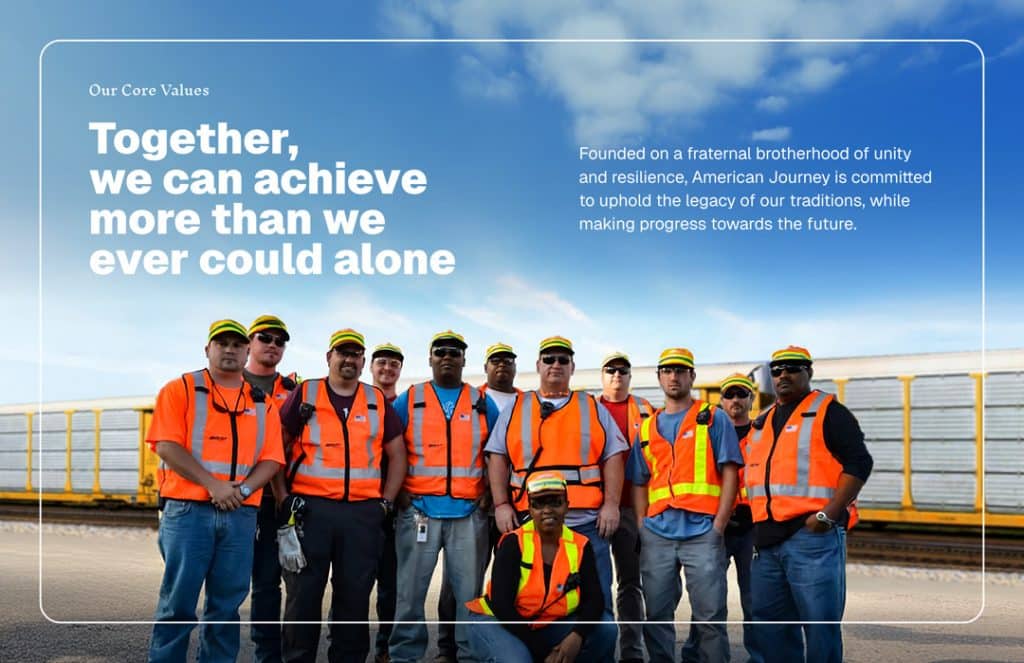
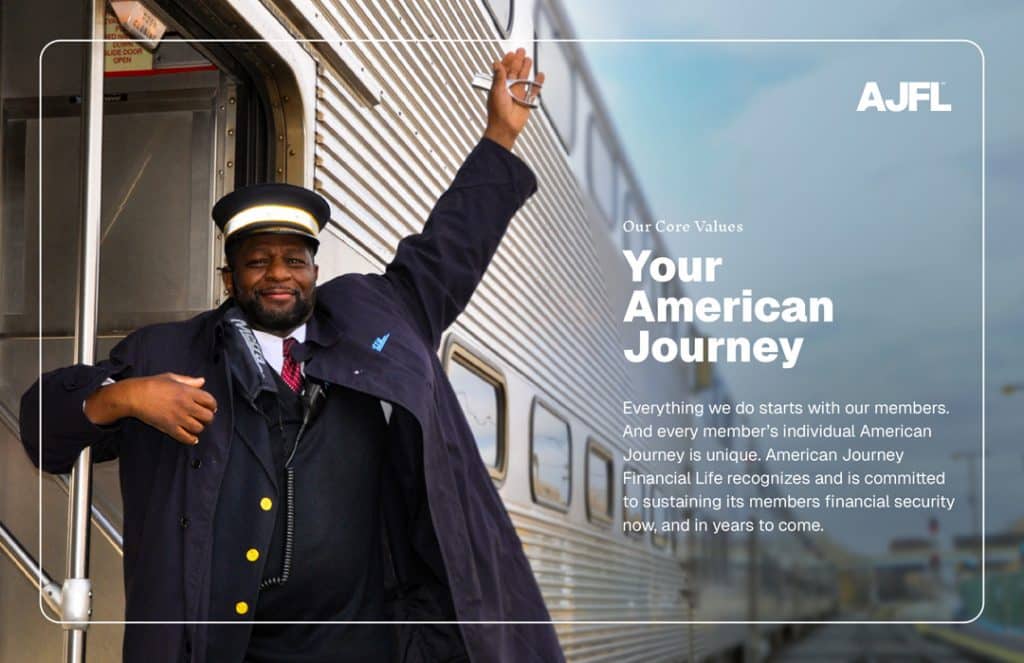
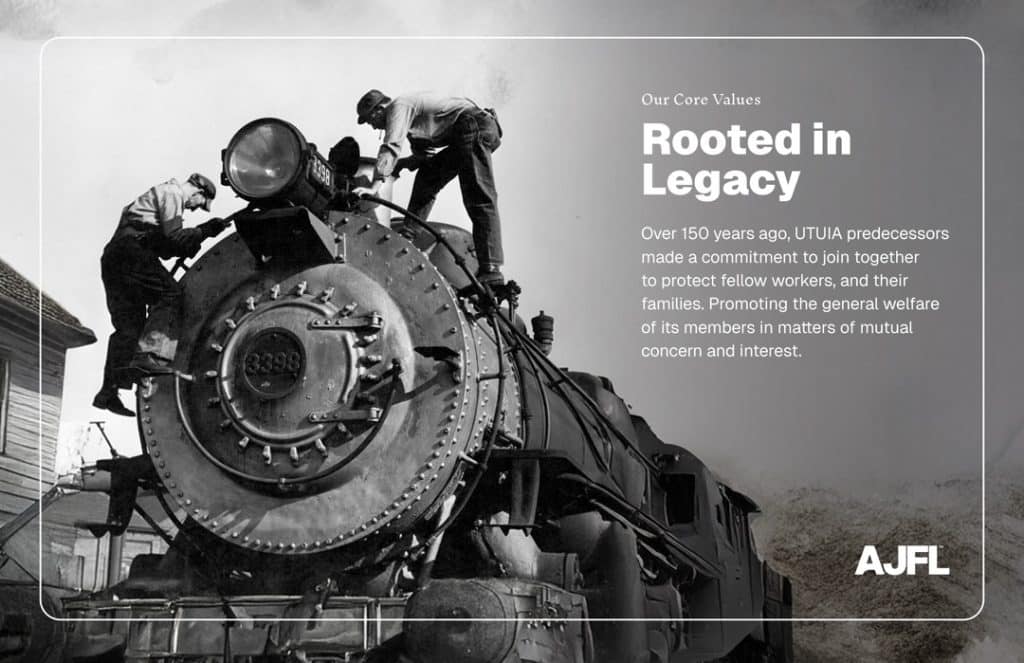
The following images are from a booklet produced by American Journey Financial Life announcing its new name and logo.

Every rule in the book was written in our blood. Every institution that makes our lives bearable today was formed when old-heads stood together to make it happen. They formed the fraternal benefit societies from which our own union was born.  

Labor unions and fraternal benefit societies serve different purposes. Unions wield collective power to force justice from unwilling management. Fraternal benefit societies focus on pooling financial resources to form a safety net. Sometimes a single organization will combine both functions; other times it is more effective to form separate organizations with the same or similar membership. The two are fundamentally intertwined, even though they may merge, split, or rename themselves over time. 

In 1969 the Brotherhood of Locomotive Firemen and Enginemen (est. 1873), the Order of Railway Conductors and Brakemen (est. 1868), the Brotherhood of Railroad Trainmen (est. 1883) and the Switchmen’s Union of North America (est. 1894) merged to form the United Transportation Union (UTU). These organizations also pooled their financial operations into a new agency: the United Transportation Union Insurance Association (UTUIA).  

With size comes strength and resiliency. In 2014, the UTU merged with the SMWIA to form the Sheet Metal, Air, Rail, and Transportation Union (SMART), with the Transportation Division of the new union growing to embrace an increasing number of bus and transit workers. The UTUIA has kept pace, welcoming bus, transit, and SMART’s sheet metal and other building trades to the organization.  

This year, the UTUIA honors its expanded membership with the unveiling of a new name: American Journey Financial Life (AJFL).  

The change was introduced to UTUIA’s members in a letter from AJFL President Kenneth Laugel, who explained that “Over the years, we have made substantial gains in improving the infrastructure of the organization, modernizing our technology and enhancing our member benefits. Now, it is my pleasure to inform you of [this] exciting change to our organization. As we approach sixteen decades of existence, we welcome all those who labor tirelessly in the hazardous trades to join with AJFL in solidarity, as we seek to protect and enhance the lives and financial security of our members and their families.” The new name will begin appearing in all correspondence with the agency. You may learn more about American Journey Financial Life at ajlife.org 

Rail Industry Testifies on Safety and Regulation at Senate Hearing 

In June, the U.S. Senate Committee on Commerce, Science, and Transportation held a high-profile hearing titled “On the Right Track: Modernizing America’s Rail Network.”  

Representing freight rail interests were both the Association of American Railroads (AAR) and the American Short Line and Regional Railroad Association (ASLRRA). While the ASLRRA didn’t appear in person, a representative from a holding company owning seven short lines testified on their behalf. 

Unsurprisingly, the message from both Class I and short line freight rail interests stuck to a familiar script: “We’re vital to the economy and we’re thriving—but please stop regulating us.”  

This well-rehearsed narrative once again called for fewer safety rules and less government oversight, even as these companies continue to post strong profits. The contradiction between portraying themselves as economic juggernauts and claiming to be victims of federal oversight was on full display. 

Freshman Senator Moreno: A Troubling Moment for Public Transportation 

However, the most headline-grabbing moment didn’t come from railroad execs. It came from freshman Senator Bernie Moreno (R-Ohio) during his five minutes of questioning. 

Moreno, who now sits on a key committee that helps shape the future of transportation in America, made it clear where he stands on the future of public transportation.  

His vision: everyone should go buy a car. The best solution to America’s mass transit issues is for every citizen to purchase their own vehicle. 

To many, this might sound like an out-of-touch rookie mistake and with the price of cars in 2025, it is a little bit like the famous “Let them eat cake” line from the French Revolution.  

But for SMART-TD members, and all who support public transportation, this is no joking matter. It is a flashing warning light.  

Why? Senator Moreno wasn’t a policymaker before stepping into office. He wasn’t a mayor, a state senator, or even a city council member. He was… a car dealer. 

It gets worse. 

Follow the Money: $750,000 from the Auto Industry 

According to the non-partisan transparency site OpenSecrets.org, Moreno’s campaign received over $750,000 in contributions from the automotive industry. That’s a steep sum from an industry that stands to benefit from defunding or discrediting public transit. 

So when Moreno launched into a tirade against Amtrak, calling it the equivalent of a “1970s Russian car,” it felt less like genuine concern and more like an infomercial. When you’ve only sold one product your entire life, maybe everything starts to look like the same old sales pitch. 

This kind of logic, if left unchecked, poses a serious risk to SMART-TD’s members across Amtrak, commuter rail, and even our bus divisions. 

Where Do Moreno’s Loyalties Lie? 

Here’s where it gets ironic. 

While Senator Moreno was promoting private cars and badmouthing trains, his home state of Ohio, under fellow Republican and (SMART-endorsed) Governor Mike DeWine, is actively pushing for expanded passenger rail service. Plans are already underway for a high-speed rail line linking Cleveland, Columbus, Dayton, and Cincinnati. If successful, it could become one of the country’s most significant passenger rail expansions. 

So, which path will Senator Moreno choose? 

Will he listen to his own state, his constituents, his voters, and the future of transit in the Midwest? Or will he let the powerful auto industry steer Ohio’s destiny? 

A Chance for Education and Engagement 

To be fair, Moreno is new to the Senate, and SMART-TD believes there is still time to reach him. Our Safety and Legislative Departments, both at the national level and in Ohio, are ready to meet with Senator Moreno and explain how public transportation is a necessity for millions of Americans.  

We urge Senator Moreno to engage with the facts, to listen to the voices of Ohioans who rely on transit, and to work with us—not against us—to build a better, more connected transportation system. 

Let’s make sure the tracks ahead stay clear for public transportation, for rail labor, and for working families everywhere.