
For many years, the mainstream narrative around entering the United States job market has been straightforward: Go to college, get a degree and join the white collar workforce.

Today, as demand for skilled workers continues to grow, that narrative is changing: More and more tradespeople are needed to build the infrastructure, data centers and public facilities that Americans rely on.

In Wheeling, West Virginia, SMART Local 33 and the Heavy Metal Summer Experience (HMSE) are taking advantage, not just telling but showing young people in the area what it’s like to earn a great living while working in the sheet metal trade.

The experience paid off at Wheeling’s 2026 HMSE camp, which brought students to Local 33 to try their hand at a variety of sheet metal work. Out of 19 participants, nine are now working as apprentices for Local 33 contractors, and three more are on the list of apprentices to start soon.

Heavy Metal Summer (HMSE), cofounded by former SMACNA President Angie Simon, provides an opportunity for young people across the U.S. and Canada to get hands-on experience with the trades: HMSE students work with skilled craftspeople at shops, jobsites and local union training centers, discovering for themselves whether they may want to pursue a future in the union.

“Heavy Metal Summer [Experience] is a program meant to bring in kids age 15 to 19 to teach them a little bit about the sheet metal trade and what we do, get them a little hands-on projects, help them get a better understanding [and] see if this is something they want to pursue,” said Local 33 Partnership Development Representative Steve Hancock.

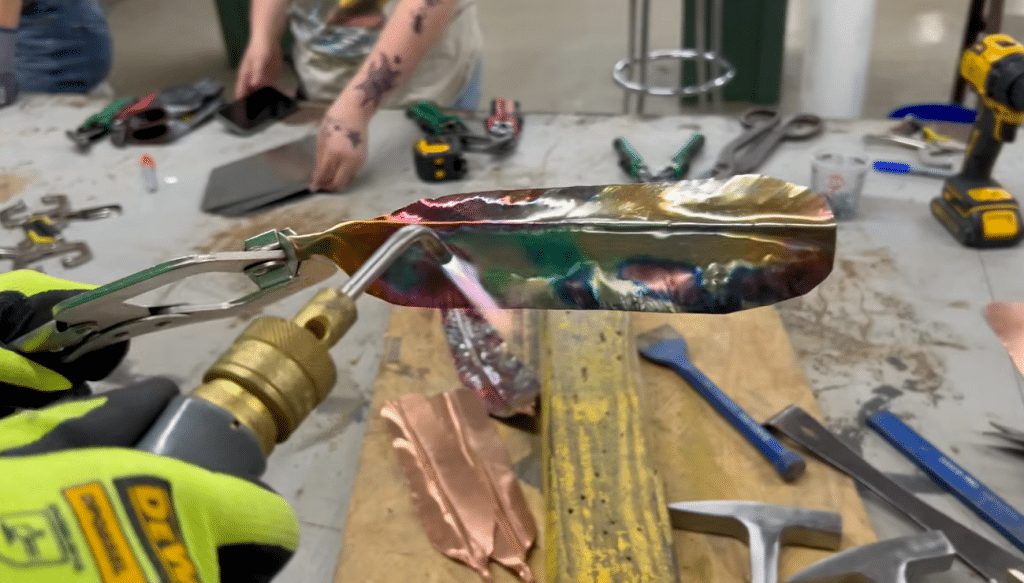
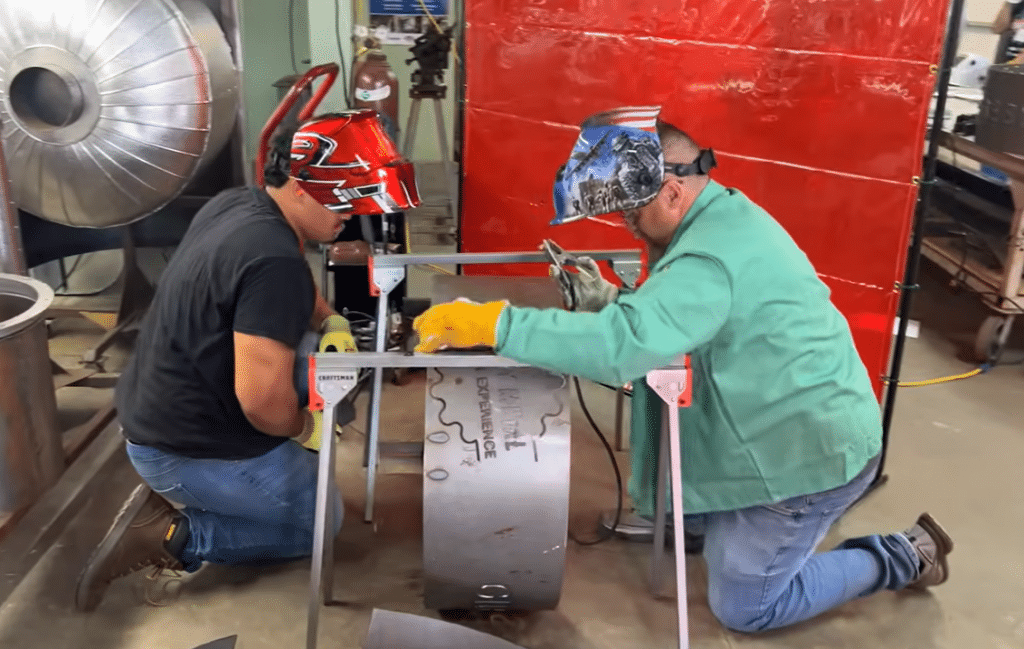
In Wheeling, that meant exploring just a preview of all that the sheet metal trade has to offer. Students learned welding by making a fire ring out of eight-inch black iron; formed, cut and put all the extrusions on an architectural metal panel; formed, cut and put together an architectural metal star; and worked with softer metal to make a copper feather from scratch.

“I made [the] fire pit, or fire ring, the other day, so I thought that was pretty cool,” said 2026 HMSE student Landon. “I was pretty proud of myself.”
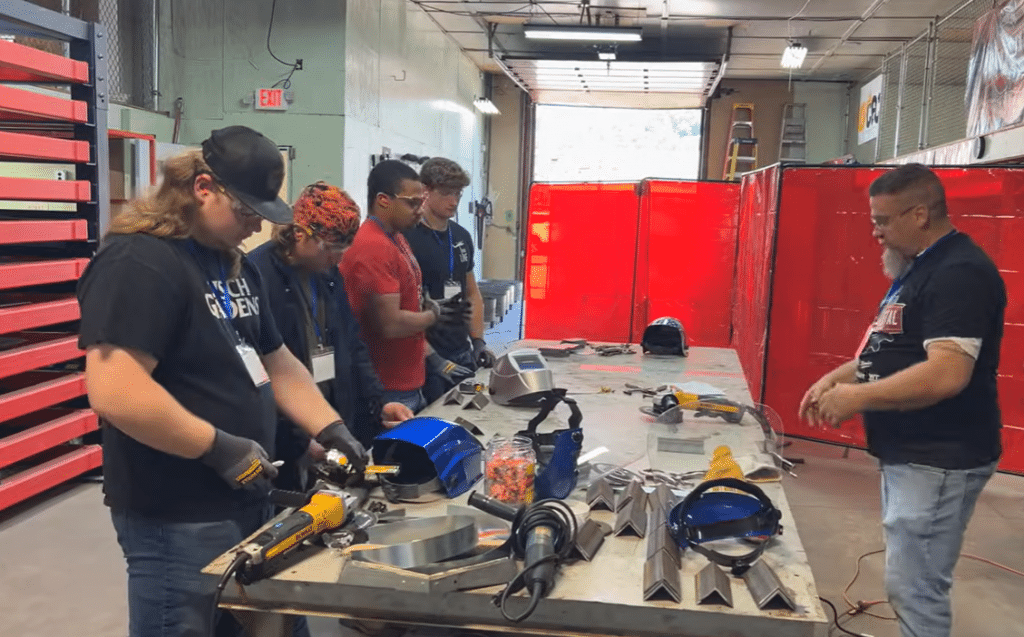
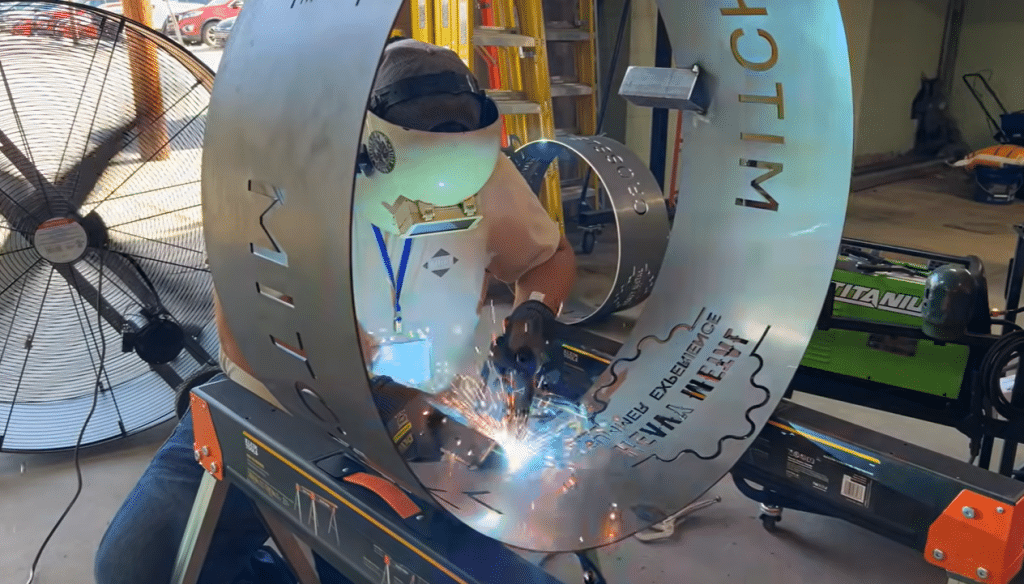
Welding, fabricating, forming, cutting, hammering — the Wheeling HMSE students got to do some of it all, plus hear about the many, many more options that exist in the sheet metal trade. From detailing to architectural sheet metal work, the unionized sheet metal industry has a lot to offer. And for many members, it all starts in the earn-while-you-learn apprenticeship program.

“Programs like Heavy Metal Summer [Experience] are extremely important because it gives the younger generation a vision into what it’s actually like to be in an apprenticeship program … before they actually even potentially graduate high school or decide a career path,” said Josh Jablonski, Local 33 partnership development representative.

In 2026, 19 Wheeling HMSE students experienced that vision — and at least 12 decided that they liked what they saw.

“A lot of kids are pushed from high school straight to college … so the trades are often the best-kept secret in towns, especially like this one here,” concluded Scott Mazzulli, Local 33 Wheeling business representative. “Heavy Metal Summer helps put us on the map.”
By Shane Vermilye, SMART International organizer

Local 33 (Northern Ohio, West Virginia) has started 2026 with strong organizing momentum, signing six new contractors to date and continuing to grow the local’s market share across multiple districts. These victories are especially significant in West Virginia, where organizing success in a “right-to-work” state requires persistence, relationship-building and commitment from the local’s staff and potential new partners.

And while these wins are tough to achieve, they lead directly to more work opportunities and strengthened collective power for members and families.

One of Local 33’s biggest wins came early in the year in the Parkersburg District, where we signed RW Miller after nearly a year of organizing efforts, meetings and relationship-building. This success brought 17 new members into Local 33 and strengthened our position in the residential market throughout the region.

We also secured agreements with two additional residential contractors, adding seven new members at each company. One contractor was organized in the Charleston District and the other in the North Central District, further expanding Local 33’s union residential presence and creating new opportunities for members in both markets.

Another major milestone came from a long-term organizing effort. Back in 2022, Local 33 organized Wood Commercial and welcomed them into our union family. After experiencing the benefits of being a successful union contractor, the company made the decision to bring its residential company, Wood Heating and Air Conditioning, into Local 33 as a signatory contractor this year. This achievement demonstrates the value of our partnership with contractors and the strength of the union business model.

These organizing victories are helping Local 33 grow our membership, strengthen market share and create more opportunities for sheet metal workers throughout our jurisdiction. We look forward to building on this momentum throughout the rest of 2026.

FRA_logo_wordsOn Feb. 22 the U.S. Department of Transportation’s (DOT) Federal Railroad Administration (FRA) announced that is now able to move forward with its full-scale forensic investigation into the derailment outside of Montgomery, W. Va., followed by a slower start earlier this week hampered by weather and safety concerns.

During a media conference in Boomer, W. Va., FRA announced next steps in its ongoing investigation into the incident, which includes participation from the Pipeline and Hazardous Materials Safety Administration (PHMSA). The FRA is the lead Federal agency charged with investigating Monday’s derailment.

“With the response and recovery effort now complete, and the dangers associated with the initial derailment now minimized, the FRA will now begin its thorough investigation into the derailment,” said Transportation Secretary Anthony Foxx. “I thank the emergency responders who stepped into harm’s way to evacuate the affected communities, and I am eternally grateful that no residents were seriously injured.”

On Monday, Feb. 16, a 109-car unit train pulled by two locomotives derailed 27 tank cars carrying Bakken crude oil near the Kanawha River, approximately 30 miles southeast of Charleston, WV. The Department’s FRA and PHMSA, the Environmental Protection Agency, the U.S. Coast Guard, and West Virginia state agencies have been at the site of the derailment since Monday evening.

“We are grateful to the first responders for evacuating residents safely, and grateful to the Coast Guard, the EPA and state and local agencies that worked together to immediately address urgent conditions at the derailment site,” said Sarah Feinberg, acting Administrator of the Federal Railroad Administration. “Now it is time for the FRA to begin our investigation into this incident in earnest, to identify any warranted enforcement actions, and to continue our work to ensure accidents like these do not continue.” 

A full team of FRA investigators will remain in the Montgomery area for several days, and possibly weeks, as the investigation continues. 

Initial activity at the derailment site focused on response and recovery, including controlling fires, containment of the crude oil release into surrounding areas, and protection of communities and drinking water sources near the derailment site. Although inclement weather, safety concerns for the community and its water supply, evacuations and fire containment limited the DOT’s initial steps in its investigation and data collection, the Department is now moving aggressively with a full-scale, thorough investigation into the cause of the derailment.

The FRA will now inspect all damaged tank cars, recover damaged rail from the accident site, and review maintenance and inspection records for rolling stock, track, signals, and locomotives. Equipment recovered from the accident site, including tank cars, tank car wheels and trucks, and damaged rail will be reassembled, documented, or reconstructed by FRA investigators at a location near the derailment site.

The FRA will systematically examine all recovered components to either eliminate or identify issues related to wheels, track, axles or other components that could have caused or contributed to the accident.

Additionally, the PHMSA is conducting testing of the crude oil product involved in the derailment to determine gas content, volatility, tank car performance and to ascertain compliance with federal hazardous material regulations related to proper product classification. The results of the inquiry will be included in FRA’s final investigative report.

“We continue to look into the composition of Bakken crude oil, which is why we took samples of the product to verify appropriate classification and whether emergency responders received the accurate information to respond to this derailment,” said Tim Butters, Acting Administrator of the Pipeline and Hazardous Materials Safety Administration.

Investigations into derailments can take significant time and resources. A full team of FRA investigators will remain in the Montgomery area for several days, and possibly weeks, as the investigation continues.

As the Department’s investigation continues, other federal and state agencies will continue to monitor the derailment site and surrounding areas to ensure it remains safe for residents. The EPA and the West Virginia Department of Environmental Protection will continue to work closely with the U.S. Coast Guard to test and monitor water quality and atmospheric conditions in the vicinity of the derailment.


oil-train-railVideo images of a fireball billowing from the wreckage of a derailed train hauling Bakken crude are adding to pressure on federal regulators to act on new safety standards for oil shipments.

While there were no fatalities in the CSX Corp. accident in rural West Virginia on Feb. 16, the footage of flames and smoke rekindles public alarm over the prospect of tank cars rumbling through urban areas, according to a former U.S. Transportation Department official and a railroad consultant.

Read the complete story at www.philly.com.

Two major train derailments, one in West Virginia and one in Northern Ontario, have once again put oil transport by rail in the national spotlight in the United States.

The derailment of the train hauling crude oil in West Virginia resulted in at least 14 cars bursting into flames. As a result, two towns near the site of the accident, Adena Village and Boomer Bottom, have been evacuated. Oil from the train also spilled into the Kanawha River, contaminating the drinking water for two counties. West Virginia Governor Earl Ray Tomblin has declared a state of emergency. The incident came two days after another oil train derailment in Ontario, in which 29 cars were derailed and seven caught fire.

Read the complete story at www.vocativ.com.

oil-train-railThe railroad cars involved in the fiery derailment in West Virginia on Monday were a newer model that was supposed to be safer than older tankers blamed in other recent oil train explosions.

The ruptured cars were built to specifications adopted by the railroad industry in 2011 amid criticism that older tankers were dangerously susceptible to puncture and a risk of explosion. Called CPC 1232 cars, the newer tankers were also involved in an April 2014 derailment and explosion in Lynchburg, Va.

Read the complete story at the Pittsburgh Post-Gazette.

CSX_logoMOUNT CARBON, W.Va. – Fires burned for hours after a train carrying more than 100 tankers of crude oil derailed in a snowstorm in West Virginia, sending a fireball into the sky and threatening the water supply of nearby residents, authorities and residents said Tuesday.

Officials evacuated hundreds of families and shut down two water treatment plant following the Monday afternoon derailment. The West Virginia National Guard was taking water samples to determine whether the oil had seeped into a tributary of the Kanawha River, state public safety division spokesman Larry Messina said.

Read the complete story at the Associated Press.