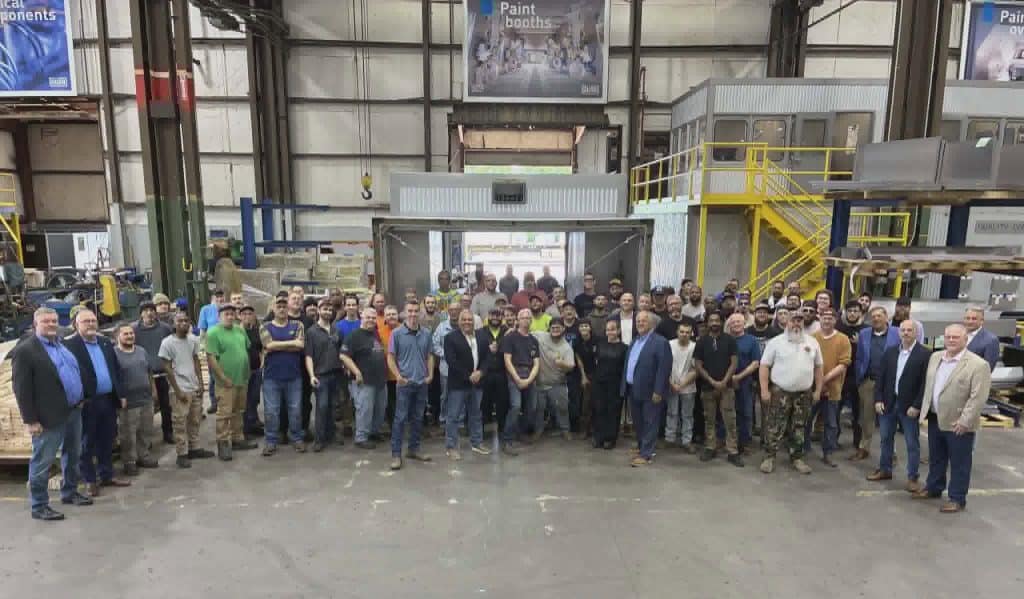
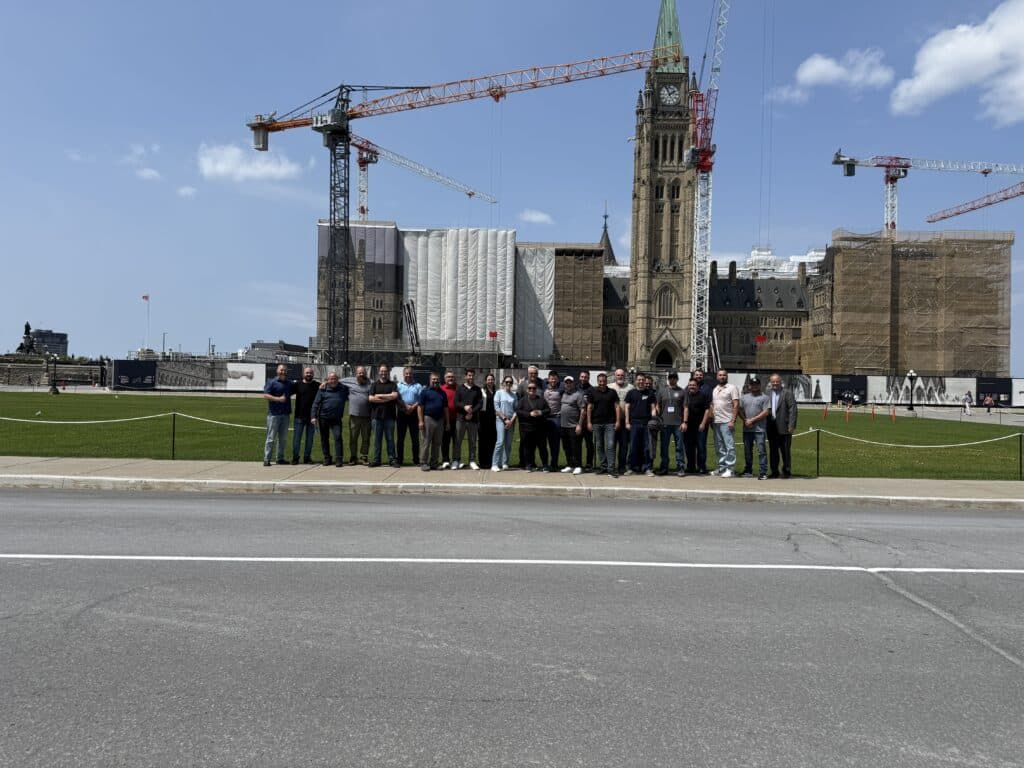
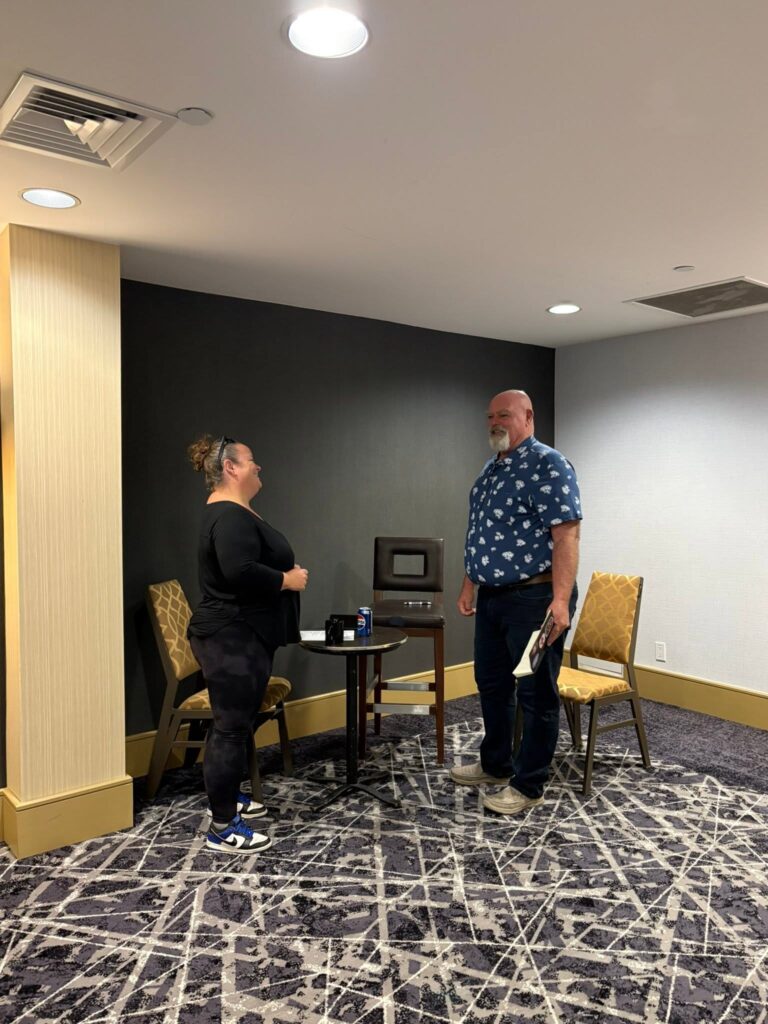
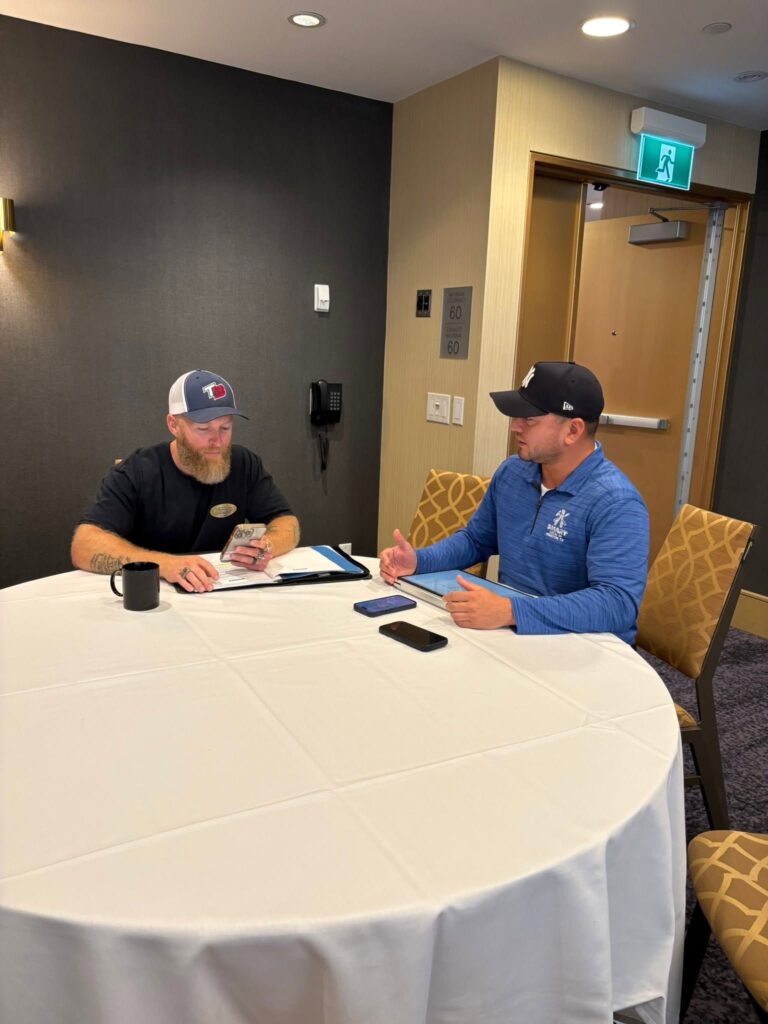
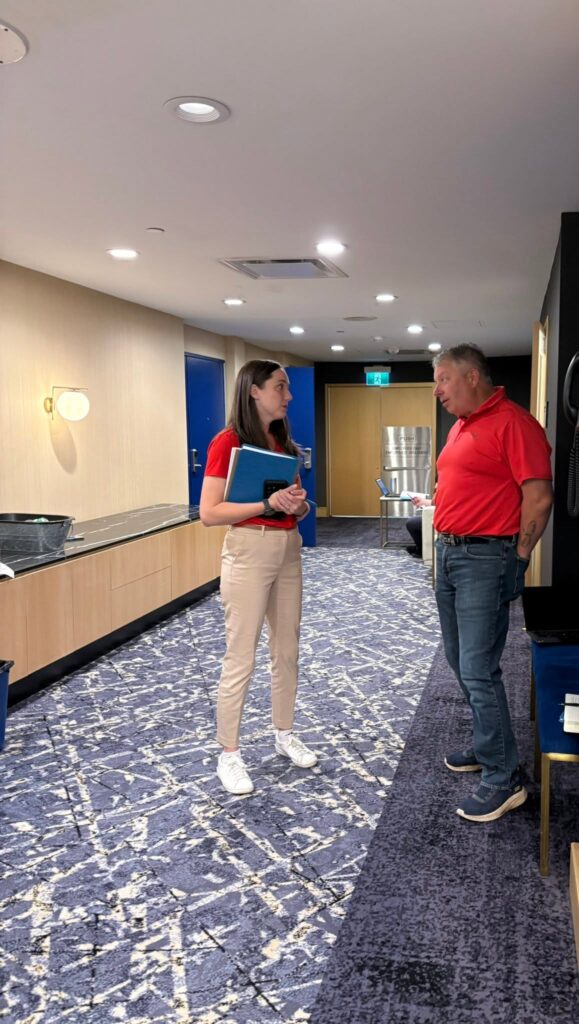
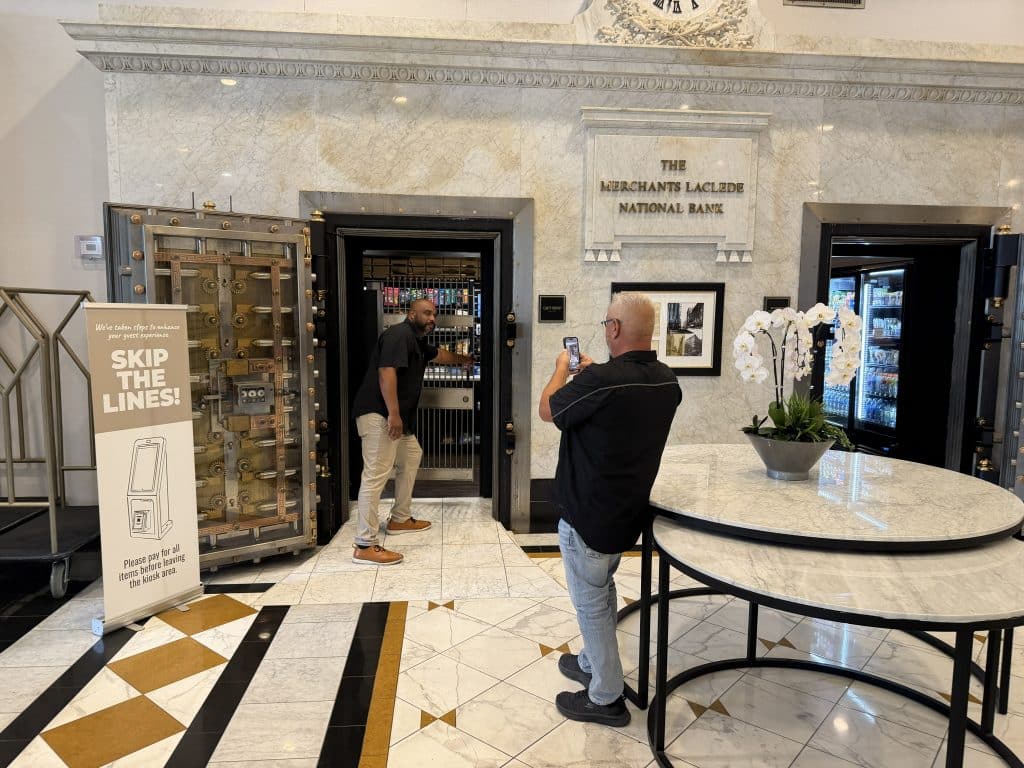
From June 2-4, 2026, SMART General President Michael Coleman and Assistants to the General President Tom Wiant, Darrell Roberts and Lance Deyette — along with Chief International Rep. Dave Bernett, retired Director of Business and Management Relations Tom Fischbach, current Director Josh Garner and International Representative Tim Miller — visited Local 292 in Southeast Michigan.
The group was welcomed by Business Manager Paul Gualdoni and Business Agent Antonio Silvestri for a three-day tour of Local 292’s contractors and offices. During the visit, contractors provided presentations highlighting their work in custom automotive paint finishing systems and discussed the challenges they face from nonunion competitors and increasing foreign competition.
Each contractor showcased their manufacturing facilities, research and development operations, and the advanced technology utilized in their production processes. SMART leaders witnessed firsthand the craftsmanship, innovation and expertise that set Local 292 contractors apart within the industry.
Local 292 is unique among many locals: Its signatory contractors specialize in the design, fabrication, installation and maintenance of custom automotive paint finishing systems. As a result, Local 292 members possess a highly specialized skill set, with extensive expertise in welding, rigging, fabrication and safety practices, both in the shop and in the field.
One notable stop on the tour was Kais-AIR, one of Local 292’s newer contractors. Kais-AIR has quickly gained momentum and market share in the rapidly growing data center sector. The company is now receiving significant orders for critical data center components in Michigan and across the country, with fabrication work being performed by Local 292 members.
“The visit provided International leadership with valuable insight into the specialized work performed by Local 292 contractors and members, highlighting the local’s continued growth, innovation and commitment to excellence in both the automotive and emerging data center markets,” said Gualdoni.
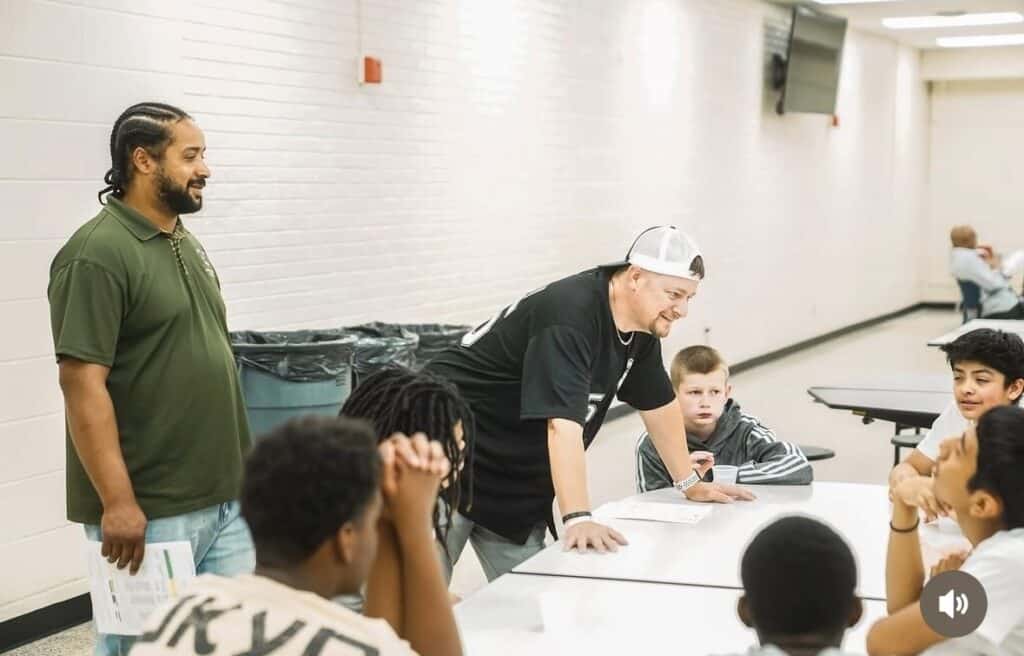
Local 20 (Indianapolis) Instructor Cam Williams brings the mentorship and leadership of the training center to his work with Boys II Men, a local organization that aims to help middle school boys grow into the best version of themselves.
In SMART, the solidarity that defines union membership extends well beyond our fellow brothers and sisters. SMART members pride ourselves on the work we do in our communities, whether it’s food drives, Habitat for Humanity projects or volunteering to mentor youth across North America.
Cam Williams, an instructor at SMART Local 20 in Indianapolis, Indiana, is a prime example, serving as a mentor and board member for a local organization called Boys II Men.
Cam Williams, furthest left, mentors Boys II Men cadets
Founded in 1995 by “four Pike Township teachers who saw a need for middle school boys to have male role models invested in their lives,” Boys II Men “seeks to cultivate the development of adolescent boys in a safe and exciting team environment by promoting civic engagement, personal responsibility, positive relationships, respect for women, and a lifelong appreciation for learning,” according to its website.
What that means in practice? A lot of things, Williams explained. Providing safe spaces for youth transitioning from middle school to high school so they can talk about the challenges in their lives, from school to home and beyond. Helping program participants develop leadership skills, practice public speaking, and be active and attentive listeners. Putting on college visits, outings to baseball and football games, and mission trips to Nicaragua. From personal finance management and tying ties to team-building outings in the area, Boys II Men facilitates a huge range of activities to help young people be the best they can be.
“We seek to give them an opportunity to see the world and expose them to skills and an education that’s more than what’s right in front of them,” Williams explained.
Coming full circle via the sheet metal trade
For Williams, Boys II Men isn’t just a local organization that does good work in the community.
“I’m the only mentor that was originally a student of the program,” he said. “I started the program in the 1999-2000 school year, when I was in 6th grade, and have consistently returned to help whenever I can.”
Even after finishing the program, Williams stayed connected as a “lifetime member.” Boys II men uses a points system: Participants bring personal progress reports to Friday night sessions, read books each month, participate in community service work, help with the fundraising events and more, with each activity assigned a point value. When participants reach the end of 8th grade, the top 10 “cadets” with the most points can become lifetime members: 9th – 12th grade students who continue to get mentorship through the program, but also provide help to the new cadets.
“Once I graduated high school I had to wait until the age of 21 to become a mentor in the program, but that didn’t stop me from showing up to the Friday night sessions and interacting with the cadets and other life timers,” Williams said.
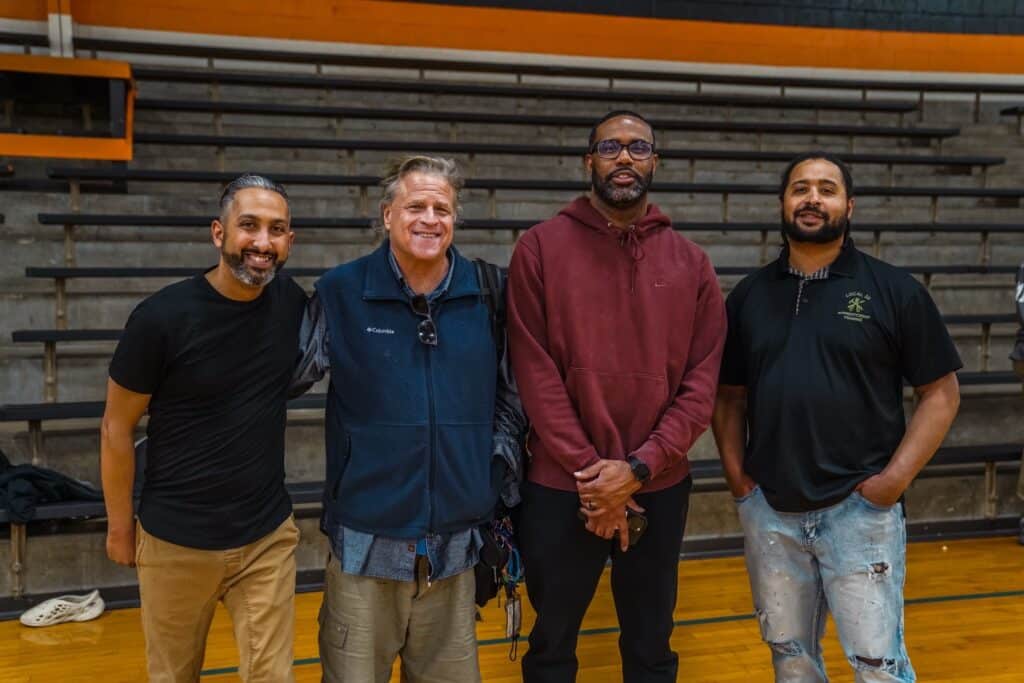
Williams, right, with fellow mentors
Fast forward a couple decades: Williams has enjoyed a successful career in the trade, ranging from working in the field to his relatively new position as an instructor. He credits at least part of that to his formative years with Boys II Men.
“The program has helped me a ton and still is to this day,” he said. “I have realized that Boys II Men helped shape me to be the great Local 20 instructor and mentor that I am today. Those same skills [I learned] apply to my apprentices; they help me to have compassion and patience with everyone. Taking the time to know a person’s situation and trying to understand and help versus judging a book by its cover.”
Building connections, building a future
When Williams joined the sheet metal trade, he didn’t have as much time to spend on Boys II Men. But two years ago, when he became an instructor, he jumped back in — both as a mentor, and then as a member of the board.
Now, he’s aiming to strengthen the connections between Boys II Men and Local 20, helping youth learn more about the sheet metal trade and forging a strong future for both organizations.
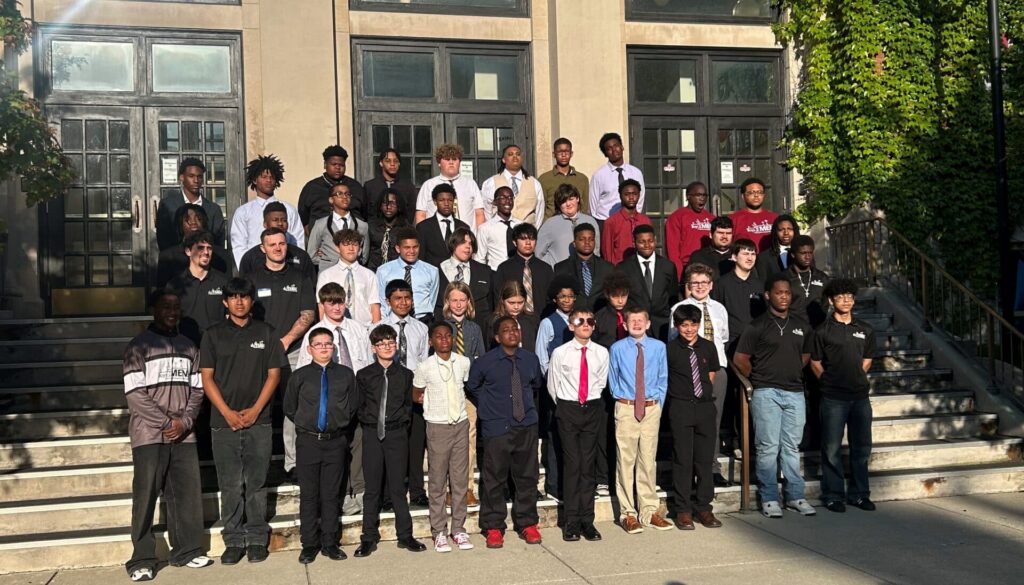
Boys II Men graduates pose for a picture
“I have been trying to connect the program with our local training facility,” Williams said. “I have been approved to start giving tours of the school, holding mockup interviews to teach those skills, and putting together small projects for students to work on and take home — showing the cadets all the equipment we have and what we do with it.”
He considers that relationship a win-win.
“Cadets will know that becoming a sheet metal worker is an option, and that they can make good money with no college debt. The local would benefit from this tremendously; we would not have random applicants but ones that understand what it takes to be successful and what it means to be a good human and to bring that culture with them.”
That isn’t just about building the future of Local 20’s membership and exposing young people to the union sheet metal industry. It’s also about both organizations’ values.
“Boys II Men’s core values are to HELP — Humility, Encouragement, Love and Purpose,” said Williams. “These all align with those of our local and training facility. We preach self-awareness to our brothers and sisters, ask them to demonstrate empathy and have a willingness to listen and learn from those around them.”
A foundation of mentorship
Mentorship is one of the core pillars of our union. Since sheet metal workers first organized back in the 1800s, our union has thrived on a tradition of solidarity and members helping one another, whether teaching in the training center or looking out for one another on the job.
Williams is helping continue that legacy, at the JATC and beyond. It’s another reminder that SMART members practice our union values both on and off the job.
SMART members and union construction workers across Canada have their sights set on a bright future: Thanks to partnership with the federal government, huge investments are being made in Canadian infrastructure and the building trades. From nuclear energy to ongoing work on hospitals, data centers and beyond, enormous workforce demands are coming down the pipe.
That’s why it’s more important than ever for SMART local unions to continue growing their signatory contractor base, providing more work opportunities for members in every province. And that’s why the Education Department held its Top-Down Organizing class the week of July 20-24, 2026, in Ottawa, Ontario — the first class that SMART has held in Canada. (The department plans to return again in October and twice annually moving forward.)
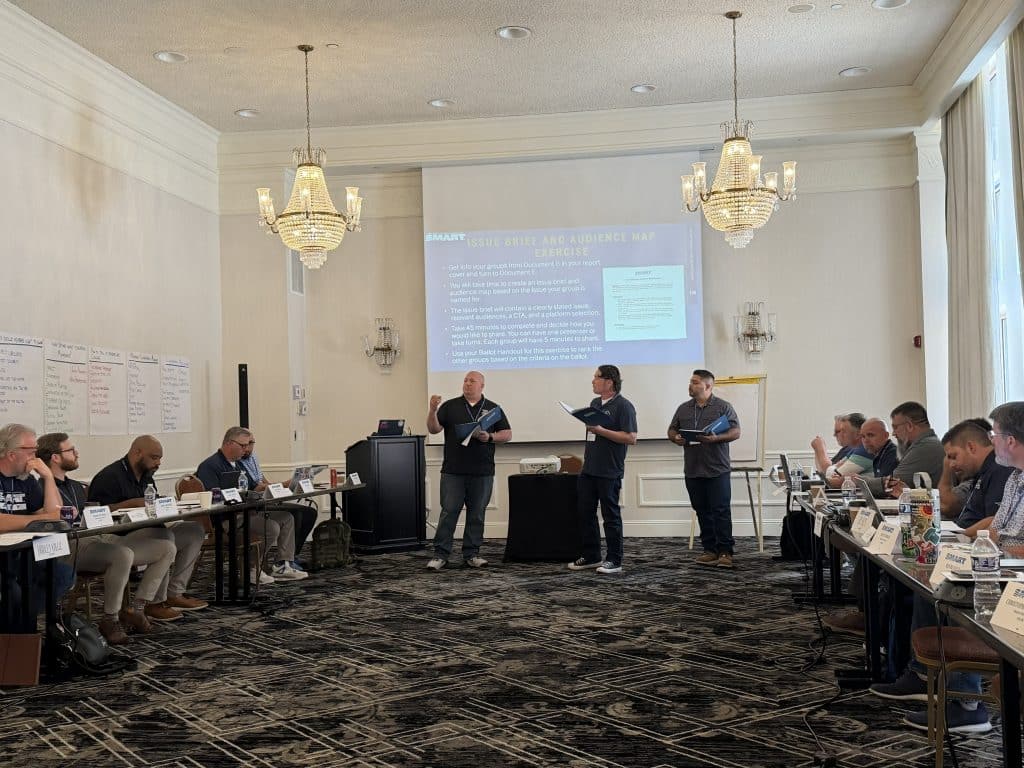
The July class focused on the “top-down” organizing strategy — where the local union approaches a contractor directly — with a specific focus on developing organizing campaigns targeting non-union contractors. The main focus of the class was on how to understand the needs of non-union contractors and how to communicate with them to translate our principles into information they find valuable.
“Participants roleplayed interactions with the gatekeeper, delivered a custom-built elevator pitch, first meetings, and subsequent meetings with the contractors,” said SMART International Instructor Richard Mangelsdorf. “There was an emphasis on making sure you are always asking for the next meeting and getting it on the books before finishing the current one.”
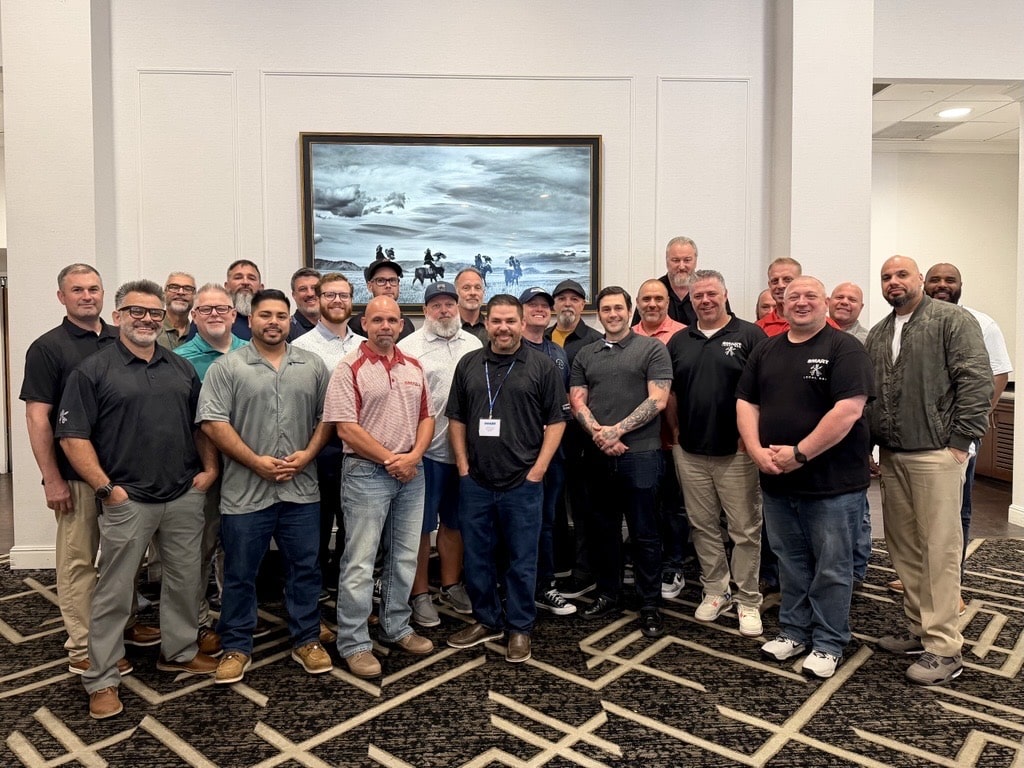
There were around 20 exercises throughout the week, many of them involving peer evaluations/ranking and group evaluations/rankings. After mock exercises, participants debriefed with critical feedback to their peers, and class participants voted to determine the class winners. “Local 9,” consisting of Brent James (Local 47), Constance Pagnello (Local 269) and Michael Beaudoin (Local 285), came in third place; “Local 4,” consisting of Jimmy Jones (Local 30), Donald Phillipo and Jake Jordan (Local 276) came in second place; “Local 2,” consisting of Shannon Kilgar (Local 30), Tim Last and David Harrison (Local 537) came in first place. The overall individual winner was Tim Last.
“We hope participants took away valuable skills for approaching contractors using the top-down strategy, and that they all enjoyed the class,” said Mangelsdorf. “We look forward to returning to Canada in the fall!”
FOR IMMEDIATE RELEASE: The members of SMART Railroad, Mechanical and Engineering Department (SMART-MD) Local 434 employed by Alstom on the Los Angeles Metrolink have overwhelmingly voted to ratify a new collective bargaining agreement. The new four-year contract delivers a total of 22% in general wage increases, $5,000 total in lump sum bonuses and substantial improvements to the members’ health and welfare benefits and monthly contributions.
“This ratification is a testament to what can be achieved when members stand together with a united voice,” saidSMARTGeneral Committee 2 Directing General Chairman John McCloskey. “From the very beginning, our members made it clear that they expected an agreement that recognized their skills, dedication, and the critical role they play in serving the riding public. Because they remained engaged and united throughout negotiations, we were able to secure an agreement they could overwhelmingly support.”
“Every contract is ultimately won by the strength and solidarity of the membership,” saidSMART International Representative Robert Shanahan, Jr. “Our members stayed engaged, informed, remained united, and demonstrated that when workers stand together, they have tremendous power at the bargaining table. This agreement belongs to every member who supported one another throughout this process.”
This agreement would also not have been possible without the support of SMART Local 105.
“A strike with Alstom appeared imminent, but when we reached out to Local 105’s Business Manager Al Hernandez, he and Local 105’s Political Director Fernando Ochoa immediately went into action. Their outreach and solidarity sent a clear message that an injury to one is an injury to all. Alstom got the message, and together, we got a historic agreement,” said SMART Railroad, Mechanical and Engineering Director Peter Kennedy. “We are incredibly grateful for Local 105’s support in this contract campaign. This victory belongs not only to the bargaining unit, but to officers and members of Local 105 who stood with us.”
SMART International leadership emphasized that the ratification represents more than a successful contract — it reinforces the importance of solidarity in advancing the interests of railroad workers.
“Local 434 members at Alstom are essential to public transportation in Los Angeles, and they made it clear during negotiations that they needed a contract that recognized their work. Most importantly, they stood together and spoke with one voice to ensure their demands were heard,” said SMART General President Michael Coleman. “This agreement demonstrates that unity works. We are proud of our members, proud of our local leadership, and excited to continue building on this momentum.”
The newly ratified contract runs through June 30, 2029.
One of the biggest barriers unions face is misinformation: misconceptions about labor unions, often promoted by anti-union organizations, that cause workers to question the power of membership and collective strength. In Idaho, two SMART Local 55 staffers demonstrated the importance of communication in spreading the truth about the union difference.
At Southwark Metal Manufacturing’s Idaho operation, a recent new employee orientation became a strong example of what consistent union communication can accomplish. Carlos Arroyo and Chris Howell, who work for SMART Local 55, spoke with new hires about the value of union membership and, with support from workers who helped carry those conversations, signed up 20 of the 22 workers entering the facility.
Southwark Metal Manufacturing’s Idaho Division, located in Caldwell, Idaho, produces sheet metal products and services wholesale distributors across Idaho, Montana, Nevada, Oregon, Utah, Washington and Wyoming. Organizing members in a production shop can be difficult, and doing so in a “right-to-work” state — where local unions are weakened by having to represent workers who don’t sign up to pay dues — makes the challenge even greater.
That made the results of the orientation especially meaningful.
Rather than leading with a scripted pitch, Carlos and Chris began by asking workers what they had heard about unions. From there, they focused the conversation on real workplace experience, and they relied on the credibility of workers who helped explain what the union means on the shop floor.
They explained that union strength comes from participation. When more workers join and take ownership of their union, their collective voice becomes louder in negotiations and stronger on the shop floor. That message connected union membership directly to the issues workers care about every day.
The conversation also covered concrete benefits, including vacation, Union Plus programs and holiday pay. At this shop, workers receive 10 paid holidays.
Carlos and Chris were careful not to overdo the message. Instead, they kept the discussion focused, practical and tied to real results. They talked about workplace conditions the union had helped improve, including times when painting fumes became a problem or when blistering heat made the floor harder to work on. In those situations, the union helped push for solutions such as moving fans onto the floor and addressing conditions workers were facing directly.
Local 55 Regional Manager Kolby Hanson recognized this effort, noting that organizing production workers is especially difficult in a right-to-work environment. He credited Carlos with developing strong communication skills with production workers over the past couple of years and added that Chris is now building those same skills alongside him.
Their success at Southwark is more than a one-day achievement. It reflects the importance of steady communication, clear explanations of union value and trusted conversations with workers. By meeting new hires where they are, answering questions honestly and working alongside worker leaders who can speak from direct experience, Carlos and Chris helped demonstrate what strong internal organizing looks like.
Congratulations to Carlos and Chris on this important achievement and on helping to strengthen Local 55 at Southwark!
SMART sheet metal workers are no strangers to change. Over the years, the sheet metal industry has transformed drastically — what was once a trade of snips and hammers now features computer-aided drafting, sophisticated 3-D mapping, artificial intelligence and much more.
The same goes for the ways that SMART members interact with each other and the world, with social media and digital communication largely taking the place of the media channels that existed for most of our union’s history. For that reason, SMART local officers gathered in St. Louis, Missouri, from June 23-26, to build the skills and strategies needed to engage current and future members — from the jobsite, to the union hall, to social media.
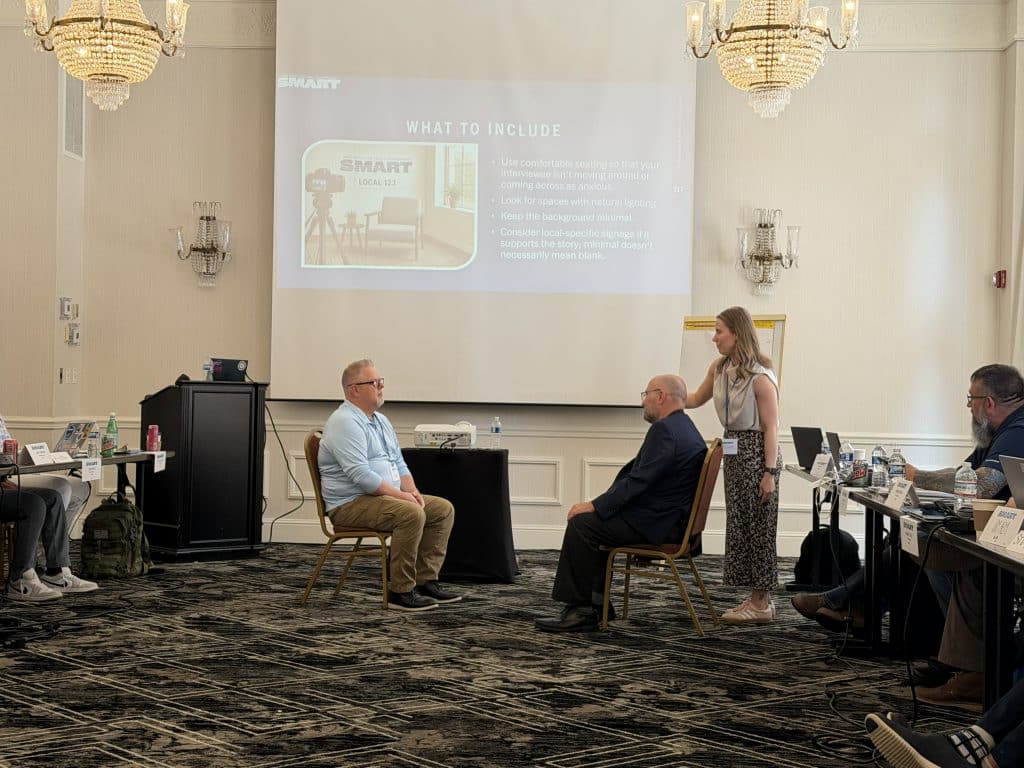
The class, titled Communication Strategies for Membership Engagement & Retention, was a collaboration between the SMART Education and Communications Departments. Course material covered a variety of topics: creating effective talking points, taking photos and videos using your phone, graphic design 101, how to measure engagement in digital communications and much more.
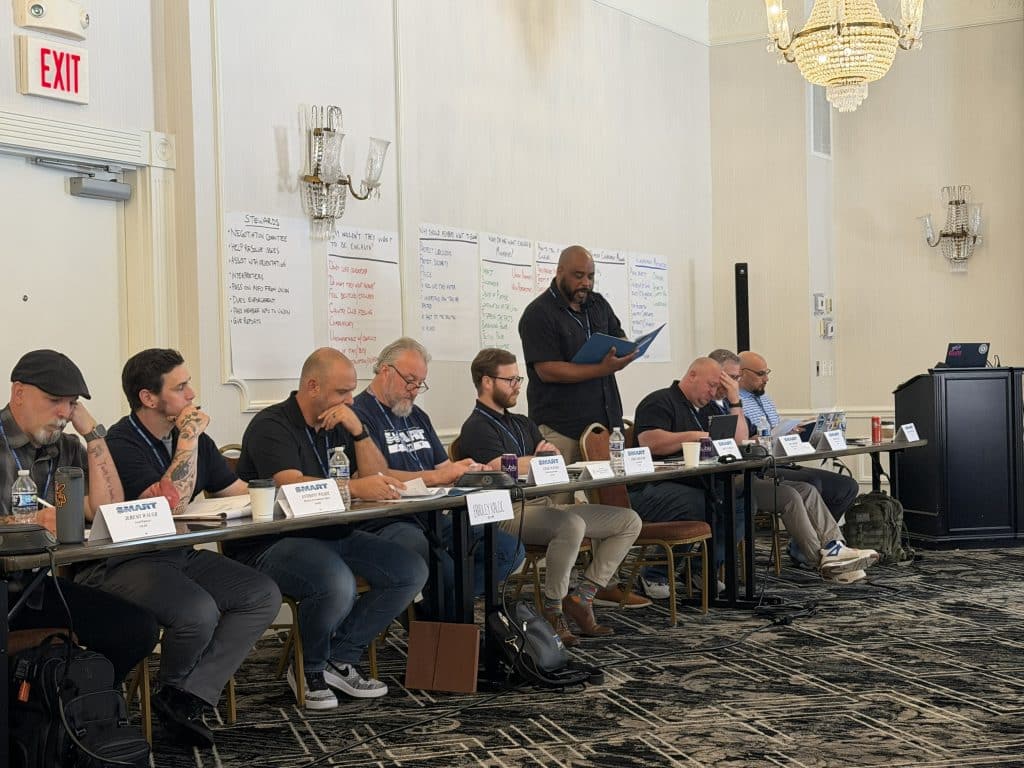
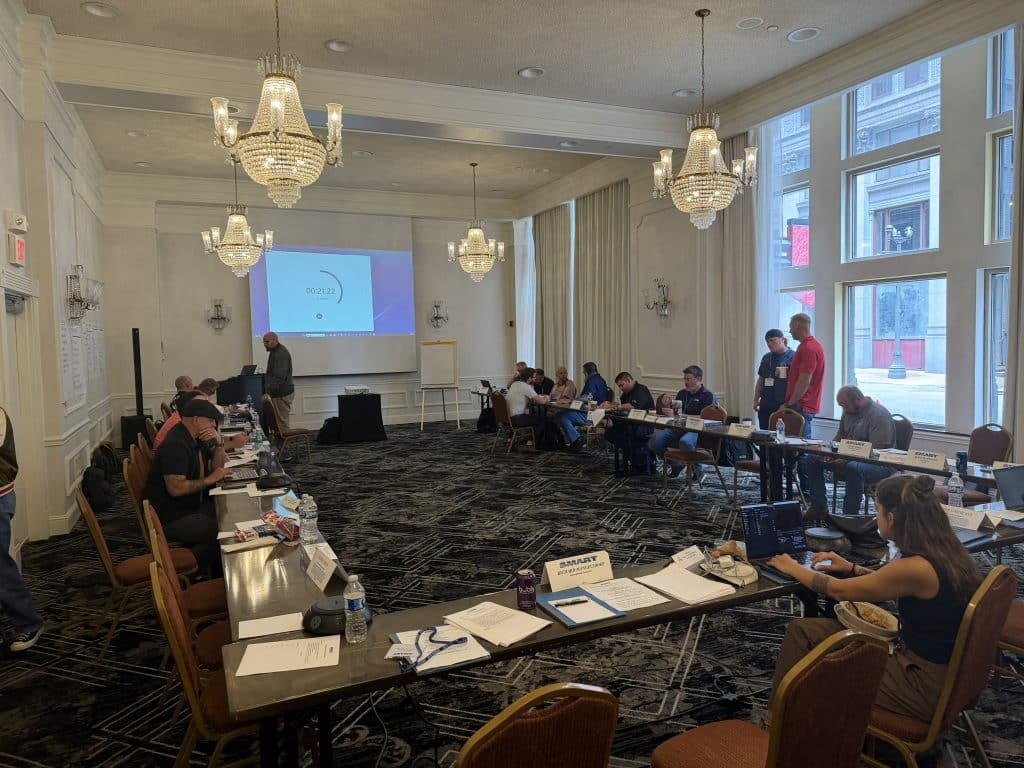
Local officers and staff learned hands-on tips and tricks from Education and Communications Department instructors about everything from creating effective social media videos to distilling complex topics into simple messages. Then, each day, they broke into groups tasked with putting those lessons into practice: filming and editing videos, creating draft social media flyers and strategizing on the most effective ways to reach target audiences.
“There are countless tools and platforms that people use, every day, to interact with each other, to share their passions, to engage with the world around them,” said SMART Director of Communications Paul Pimentel. “By helping local union officers equip themselves to engage with those tools and platforms, we can make sure we’re meeting members where they are and helping them get involved in their union.”
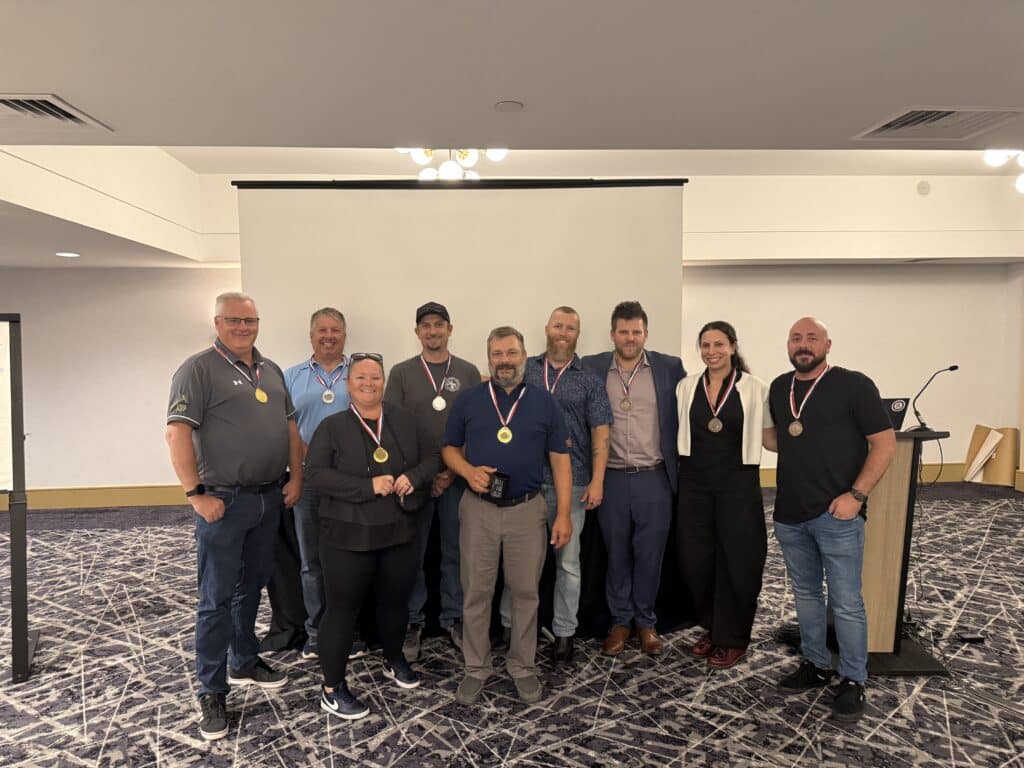
Groups were evaluated by their peers throughout the week, with points awarded for each exercise. Group 1 was awarded by fellow classmates as the top group in the class, with Jeremy Snyder (Local 36), Sam Hem (Local 66) and Jeremy Waugh (Local 110) — with an honorable mention for Stu Wilson of Local 18 — earning the highest score.
The work didn’t end with the conclusion of the class: Attendees went back to their home locals with a two-week communications plan, detailing concrete steps to implement their new communications skills and strategies.
“We design these classes so that local officers can go back to their unions, take what they’ve been practicing throughout the week, and start working to benefit their local union and their members,” said SMART International Instructor Andre Mayes. “We’re already seeing some of our attendees create new, engaging content on their local platforms, and we hope to see more as we work to engage members across North America.”
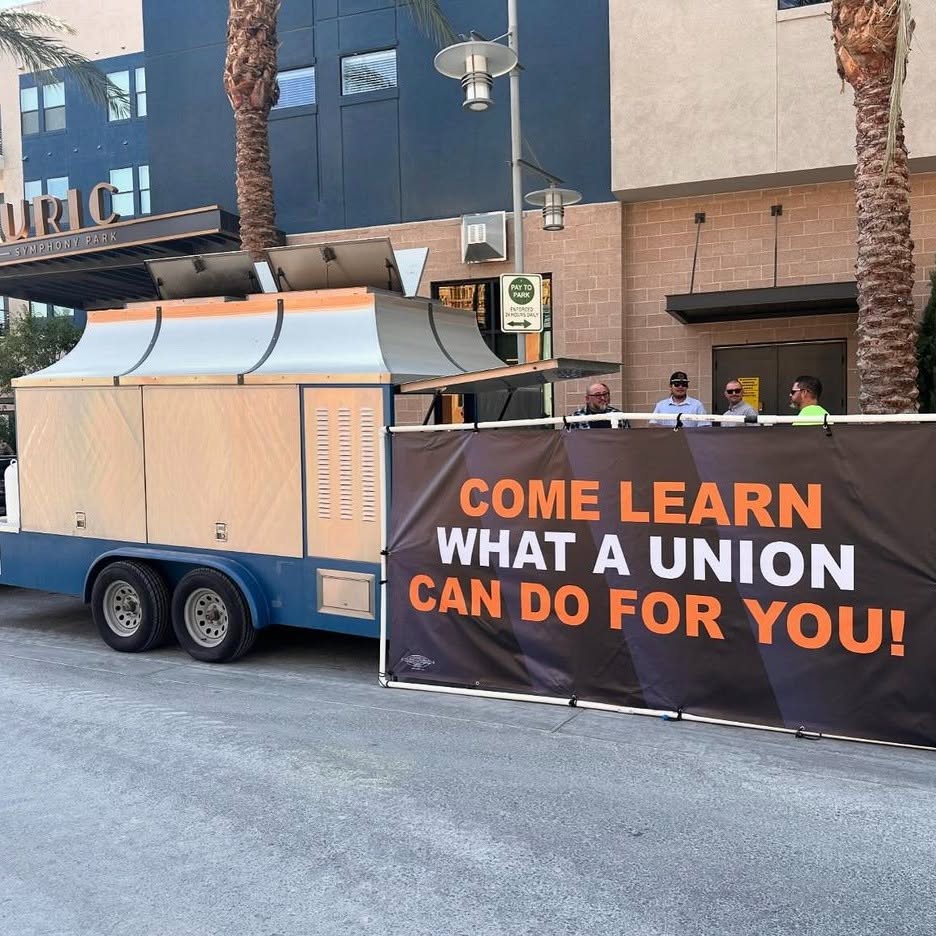
Throughout the state of Nevada, SMART Local 88 (Las Vegas) is organizing to grow its membership, strengthen union contractors and create more opportunities for members. That organizing has paid off, with the local recruiting sheet metal workers from nonunion competitors to meet ongoing workforce demands in Northern Nevada’s Reno area, home of SMART Local 26.
When SMART local unions work to bring new members into the unionized sheet metal trade, it isn’t just about growing the strength of our union. It’s about making life better for those workers and their families — and it helps current members by growing the strength of unionized contractors.
Local 88, under Business Manager Geremiah Robnett’s leadership, has demonstrated that union difference clearly. In the last two months, the local’s Organizing Department of Alfonso Lopez and Robert Diaz has signed up 15 new journeypersons from larger nonunion contractors in the region. These are foremen and workers that the local has known for years, maintaining constant contact through jobsite visits and referrals.
These newly organized Local 88 members are increasing their incomes in the range of $8-12 per hour solely on base hourly wages, with another $30 an hour in benefits that include Health & Welfare for their entire families, plus Tri-State and International pension plans.
Organizing new members to take on work in the Reno area — specifically from contractors who drive down wages in Southern Nevada — benefits the workforce for the entire state. It also helps level the playing field between union contractors and the bad-faith employers who consistently drive down area pay and working standards.
For many years, the mainstream narrative around entering the United States job market has been straightforward: Go to college, get a degree and join the white collar workforce.
Today, as demand for skilled workers continues to grow, that narrative is changing: More and more tradespeople are needed to build the infrastructure, data centers and public facilities that Americans rely on.
In Wheeling, West Virginia, SMART Local 33 and the Heavy Metal Summer Experience (HMSE) are taking advantage, not just telling but showing young people in the area what it’s like to earn a great living while working in the sheet metal trade.
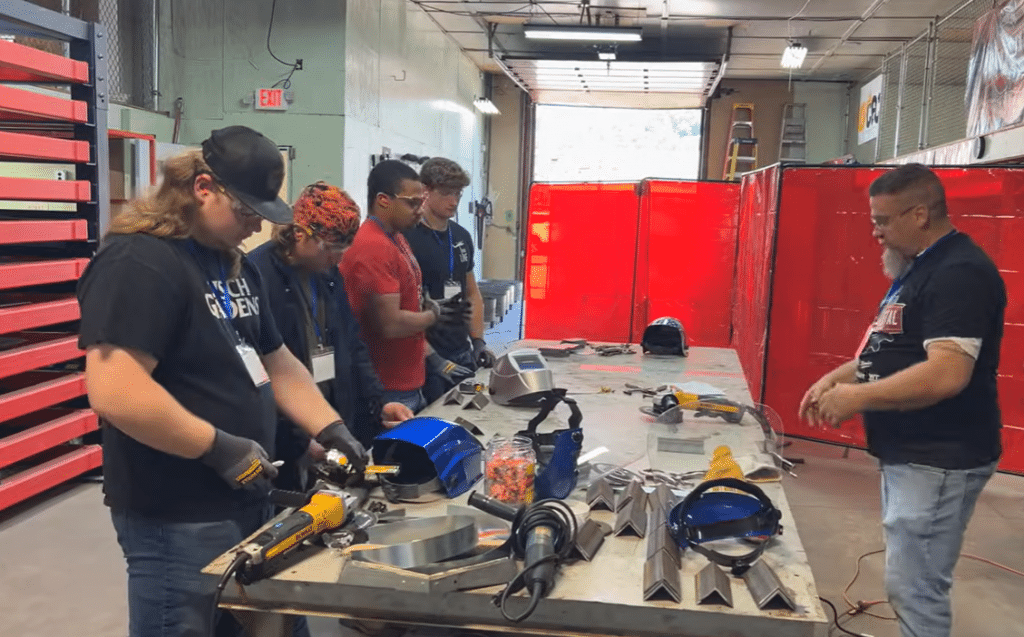
The experience paid off at Wheeling’s 2026 HMSE camp, which brought students to Local 33 to try their hand at a variety of sheet metal work. Out of 19 participants, nine are now working as apprentices for Local 33 contractors, and three more are on the list of apprentices to start soon.
Heavy Metal Summer (HMSE), cofounded by former SMACNA President Angie Simon, provides an opportunity for young people across the U.S. and Canada to get hands-on experience with the trades: HMSE students work with skilled craftspeople at shops, jobsites and local union training centers, discovering for themselves whether they may want to pursue a future in the union.
“Heavy Metal Summer [Experience] is a program meant to bring in kids age 15 to 19 to teach them a little bit about the sheet metal trade and what we do, get them a little hands-on projects, help them get a better understanding [and] see if this is something they want to pursue,” said Local 33 Partnership Development Representative Steve Hancock.
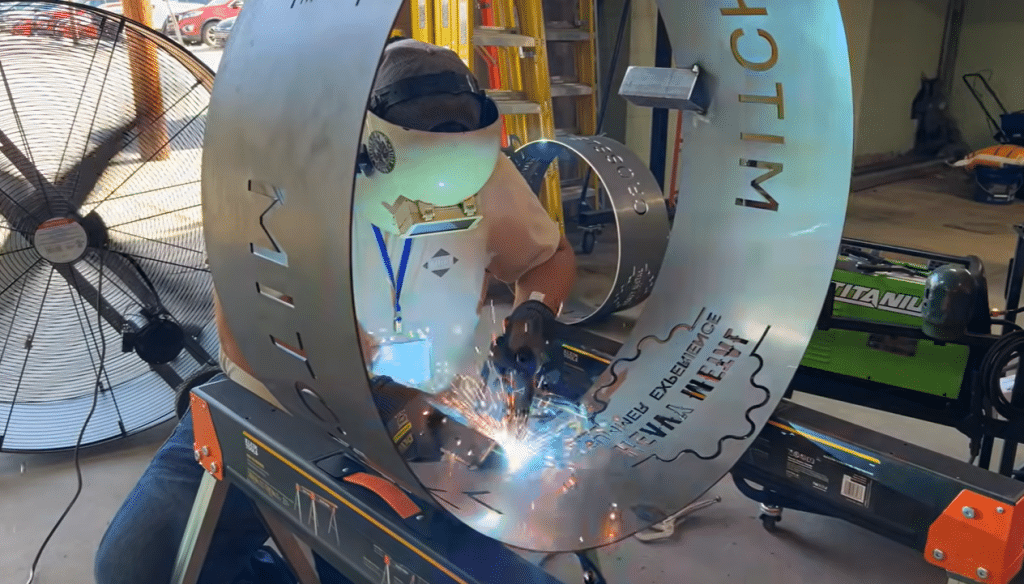
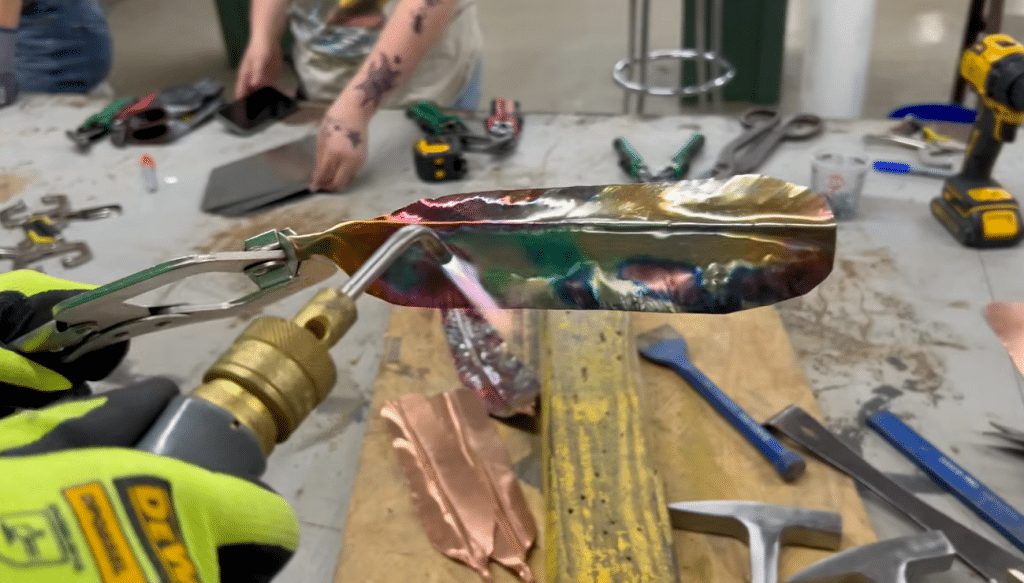
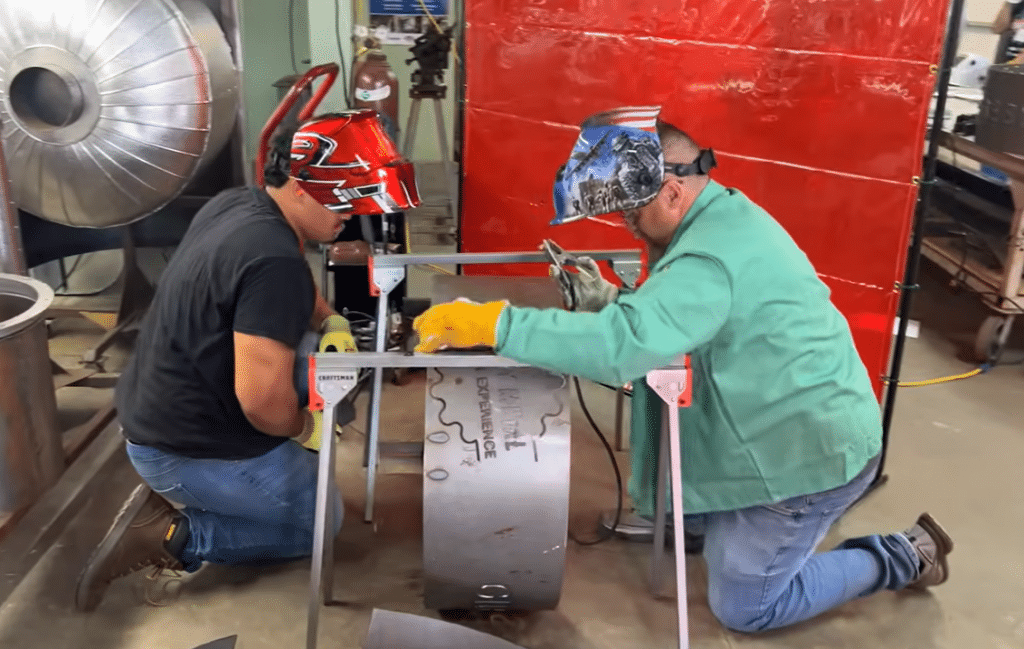
In Wheeling, that meant exploring just a preview of all that the sheet metal trade has to offer. Students learned welding by making a fire ring out of eight-inch black iron; formed, cut and put all the extrusions on an architectural metal panel; formed, cut and put together an architectural metal star; and worked with softer metal to make a copper feather from scratch.
“I made [the] fire pit, or fire ring, the other day, so I thought that was pretty cool,” said 2026 HMSE student Landon. “I was pretty proud of myself.”
Welding, fabricating, forming, cutting, hammering — the Wheeling HMSE students got to do some of it all, plus hear about the many, many more options that exist in the sheet metal trade. From detailing to architectural sheet metal work, the unionized sheet metal industry has a lot to offer. And for many members, it all starts in the earn-while-you-learn apprenticeship program.
“Programs like Heavy Metal Summer [Experience] are extremely important because it gives the younger generation a vision into what it’s actually like to be in an apprenticeship program … before they actually even potentially graduate high school or decide a career path,” said Josh Jablonski, Local 33 partnership development representative.
In 2026, 19 Wheeling HMSE students experienced that vision — and at least 12 decided that they liked what they saw.
“A lot of kids are pushed from high school straight to college … so the trades are often the best-kept secret in towns, especially like this one here,” concluded Scott Mazzulli, Local 33 Wheeling business representative. “Heavy Metal Summer helps put us on the map.”
A lot has changed in the many decades since sheet metal workers first organized in 1888. Back then, tin knockers were known for their snips and hammers; today, technological advancements like AutoCAD and artificial intelligence have not just shaped the way we work, but the world in which we live.
However, one thing has not changed: the pride that comes with being a skilled tradesperson. Being able to drive past a building and say, “I built that.”
That precise feeling is what Local 24 (central Ohio) member Roger Hoover drew upon when he titled his 2026 book, I Built That! And So Can You. Now available for purchase via Braughler Books, the 128-page book was called a “must read for students” by the Urbana Daily Citizen.
Working in the industry as an apprentice, draftsman, foreman, estimator, field supervisor, project manager and instructor — Hoover’s book has plenty of insights for both current members and future sheet metal workers. It includes stories from throughout Hoover’s career, which spans from the years predating the Occupational Safety and Health Administration (OSHA) to the high-tech data centers that thousands of SMART sheet metal workers are helping build today. He has witnessed many innovations throughout his years in the trade — and he played a key role in more than a few.
Hoover has also played a part in helping our union and our industry expand. Starting in the 1990s, he partnered with SMACNA to deliver leadership classes across the United States and Canada, and he authored the Basic Sheet Metal Estimating Manual through the same partnership.
Today, with the publication of I Built That! And So Can You, he aims to keep spreading the gospel about working in the sheet metal industry, particularly to young people who may otherwise think the only road to job security is a college degree.
In this episode, Roger speaks with Talking SMART about his career, some of his most memorable stories, what inspired him to write the book and more.
Talking SMART brings listeners the voice, stories and power of SMART union members across North America. Members are invited to send feedback and questions to info@smart-union.org.
The percentage of work that union sheet metal workers and contractors perform in a given region is called “market share.” When a local union’s market share is high, that means members have more work opportunities. When a local’s market share is threatened, members could face the possibility of reduced jobs.
That’s why SMART locals organize constantly to maintain and grow their market share. A recent example from Nevada demonstrates the impact.
A threat to Local 26 members
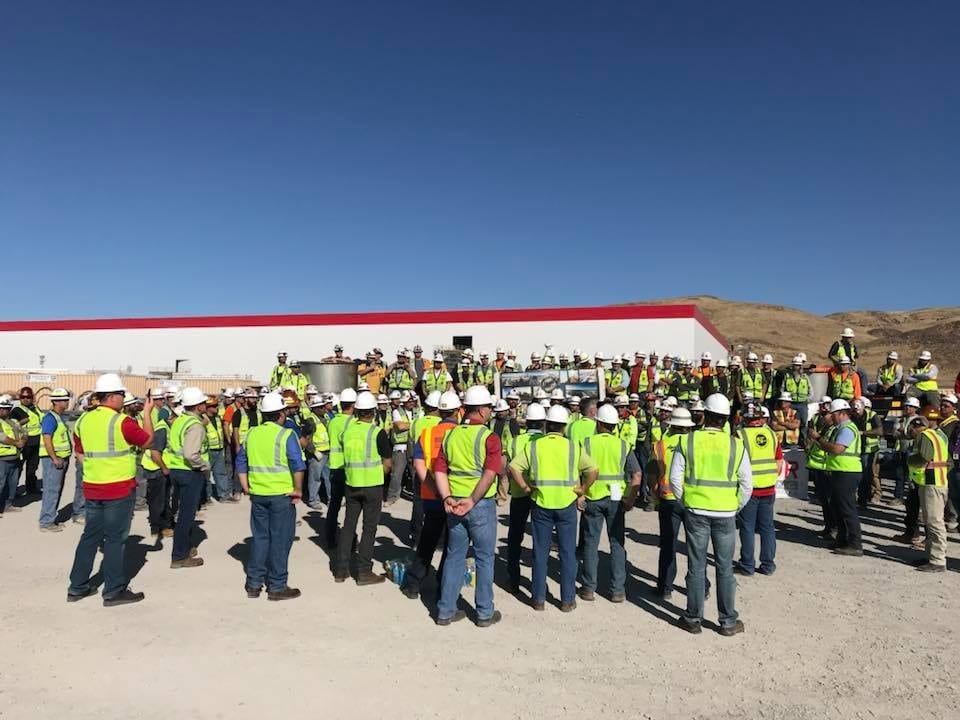
Since construction began at Tesla Gigafactory 1 in Reno in 2014, SMART Local 26 union contractors have successfully performed almost all mechanical sheet metal work on the project. The scale of the facility required workforce support from SMART members across the country, with sheet metal workers traveling from nearly every region to assist Local 26 in meeting the workforce demands of one of the largest industrial projects in the United States.
Members at the Gigafactory in 2017
Toward the end of 2025, rumors began circulating that Tesla had started self-performing a significant portion of the sheet metal work outside of the main Gigafactory building. Initially, Local 26 was unable to verify the reports until a former Tesla employee visited the union hall seeking employment opportunities.
During discussions with the worker, organizers learned that Tesla was performing large-scale ductwork installations using more than 60 workers from across the country — workers who were not SMART members. The worker also identified the project location and explained that Tesla was staffing the operation through a temporary labor provider, Superior Skilled Trades (SST), based out of Florida.
Further investigation revealed that SST was recruiting heavily from Southern states and other regions with lower wage rates, making Tesla’s compensation package highly attractive to workers willing to travel. SST’s focus was on providing labor quantity rather than skilled sheet metal experience, resulting in many workers possessing only limited sheet metal backgrounds.
Tesla’s use of out-of-state workers posed a clear danger to SMART members, taking away work opportunities in the region. Recognizing this threat, Local 26’s Organizing Department quickly mobilized.
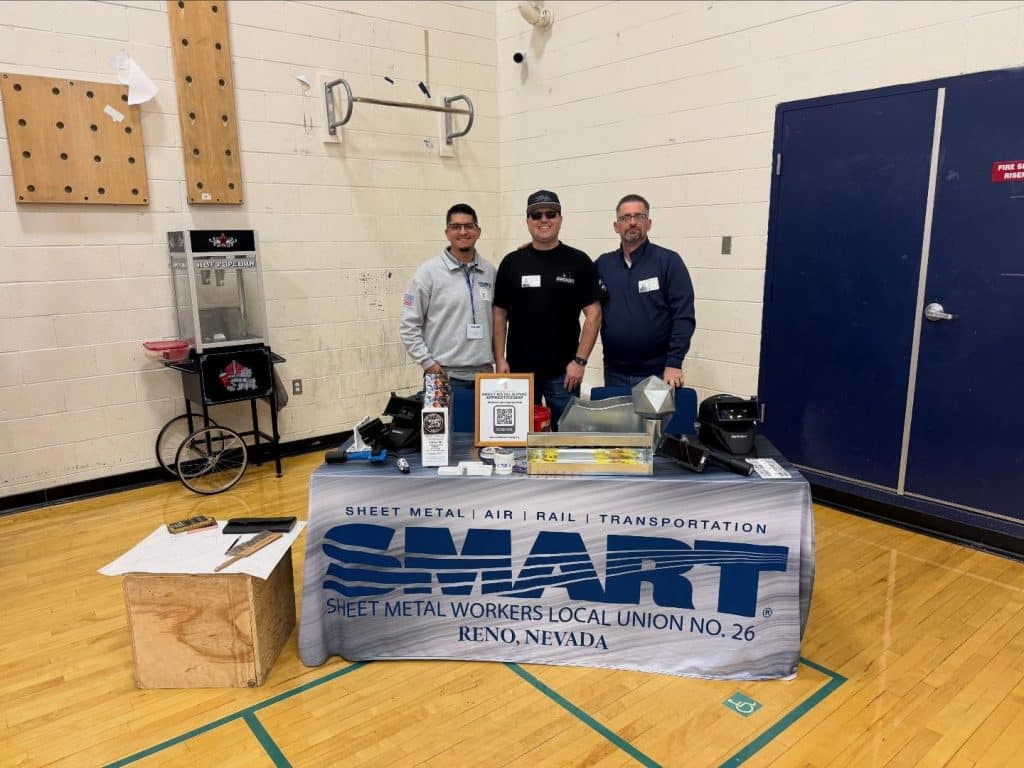
From left to right: Organizer Cesar Carrillo, newly elected Business Manager Sean O’Keefe and newly elected Business Representative Shane Henderson
An opportunity to build union strength
Organizers began building relationships with workers on the project and developed an extensive list of potential members from the Tesla workforce. Through consistent jobsite visits, conversations and follow-up efforts, organizers identified qualified workers who could strengthen the local union while also reducing Tesla’s ability to self-perform work.
Over the following months, Local 26 successfully recruited more than 30 workers from the project, including 18 journeypersons, 7 forepersons and 5 apprentices.
The successful recruitment of these workers was an immediate help to Local 26, which was facing a period of unprecedented workforce demand. The additional workers helped the local satisfy workforce requests while simultaneously creating opportunities for union contractors to reclaim portions of the work that Tesla had originally planned to self-perform.
As of the end of the second quarter of 2026, Tesla continues to self-perform some sheet metal work; however, the scale of those operations has been significantly reduced compared to the previous year. Through aggressive organizing and workforce recruitment, Local 26’s Organizing Department successfully mitigated a major threat to members’ work opportunities while strengthening the local’s membership for future growth.
What began as a challenge to members’ market share ultimately became one of the local’s most successful recruitment efforts in recent years. Great work, Local 26!